It took a little longer than expected, but we have created a website for people to view the footage collected from Gaza in one place. You no longer have to download the entire archives to see them.
It includes:
64,537 videos
17,905 photos
Ability to download individual videos
Searchable index
Exhaustive sources list (300+ journalists)
Geolocation data
Livemap with minute to minute updates
Victim list
It can be accessed here: https://t.co/s0Se94PXWF
Please share & quote tweet to help this post break out of the twitter algorithm prison.
We will keep adding the rest of the archives to the site, be patient- it is difficult work. Continue to seed the torrents provided, as that is the best way to ensure the footage remains stored in decentalized way.
God bless all those who sacrificed their lives to get this footage out, and everyone invovled in collecting/archiving it.
Join our telegram:
https://t.co/bvcis3b9GT
Follow our backup accounts:
@ZionismExposedx & @IsraelExposedAr
Robotics investing is something to consider for the next decade.
This is a good to check out for those interested. I will be making plays soon and sharing with X subs and my groups for those interested
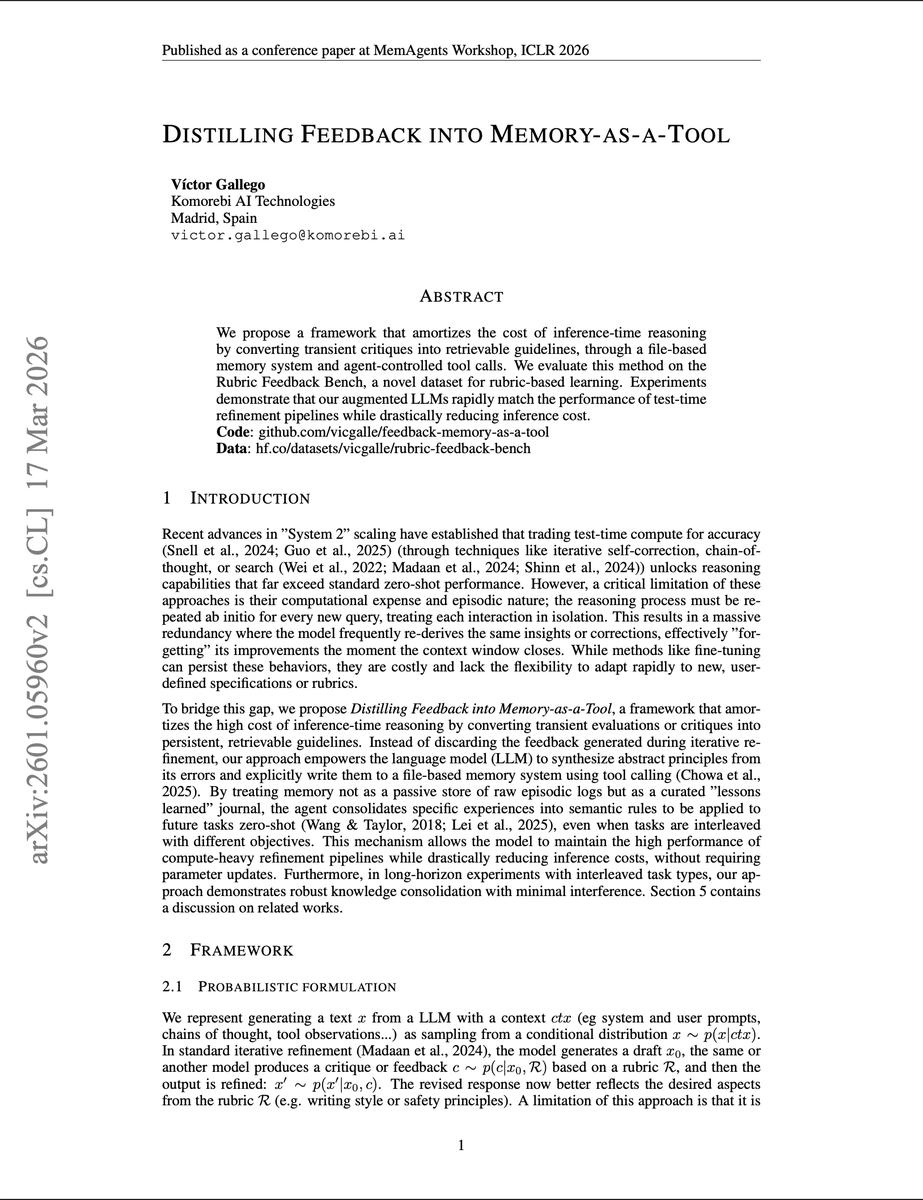
A senior Anthropic engineer just published the clearest blueprint on "How to give your AI agent a real memory" and it's a 15-page PDF.
Write → Consolidate → Recall → Apply
• Write: after every attempt, the agent records what it tried and what happened.
• Consolidate: it distills those raw attempts into a few reusable lessons, not a transcript dump.
• Recall: before the next task, it reads those lessons first.
• Apply: it skips the dead ends it already learned, even on a brand new problem.
This is exactly how engineers now build agent loops in Claude Code.
Read the paper, then grab the setup below 👇
A senior Anthropic engineer just dropped 11-page PDF on "Loop Engineering" for agentic systems.
The shift: you stop prompting the agent. You build the system that prompts it instead.
Schedule → Discover → Build → Verify → Repeat
Every loop runs one turn, five moves:
• Discovery: it finds its own work - failing CI, open issues, recent commits - instead of being handed a list.
• Handoff: each task gets an isolated git worktree so parallel agents don't collide.
• Verification: a second agent, told to assume the code is broken, reviews the first. The "thing that can say no."
• Persistence: results get written to disk, never left in a context window that gets flushed.
• Scheduling: an automation wakes it on a timer. That's what makes it a loop.
The key insight: an agent grading its own work always praises it.
This 11-page PDF changed how I'm building agentic systems today.
Read it now, then explore the article below.
A senior Google engineer just dropped a 19-page PDF on "Loop Engineering" for LLM and agentic systems.
Act → Observe → Learn → Repeat
• Act: the LLM proposes a code transformation (tile this loop, parallelize that one).
• Observe: a compiler runs it and reports back - is it valid? faster? slower? by how much?
• Learn: the LLM reads that feedback and adjusts its next move.
• Repeat until it stops finding improvements.
The agent gets smarter purely from grounded feedback inside its own context window.
This 19-page PDF totally changed the way I’m building agentic systems today.
Read it now, then explore the article below.
GOOGLE CEO SUNDAR PICHAI: "IF YOU DON'T LEARN HOW TO ORCHESTRATE AGENTS NOW, YOU'LL SPEND 2027 CATCHING UP TO PEOPLE WHO STARTED TODAY."
30 minutes on why the best engineers stopped writing code line by line and started orchestrating agents instead.
Most people think building an agent requires an engineering degree.
It doesn't.
It requires one guide and one afternoon.
Watch the interview. Then save the exact setup below.
One guide. One afternoon. That's all it takes.
The gap between you and the engineers winning in 2027 closes this weekend.
Anthropic engineer:
"you're not supposed to prompt Claude. you're supposed to build a system that prompts itself [loops]."
this is one of the best workflows I've seen in a long time
in this video he breaks down exactly how most people are building loops wrong:
- the memory file you never set up, so every loop starts from zero
- the sub-agents that 95% of builders have never split apart
- the stop condition setup that keeps loops from running forever and billing you in your sleep
- why writing one prompt a day is the slowest way to use Claude
if you've been using Claude for more than a month and still typing every task by hand, you've been running one prompt when you could be running a system of loops
instead of another prompt tonight, watch this
make sure to bookmark it before it gets buried
full guide in the article below
Google CEO, Sundar Pichai:
"If you don't learn to how to orchestrate agents now, you'll spend 2027 catching up to people who started today"
In 30 minutes he explains why the best engineers stopped writing code and started running agents.
Watch the interview, then save the exact setup below 👇
Google CEO, Sundar Pichai:
"Every engineer should have a team of agents. The skill isn't writing code anymore, it's orchestrating."
The devs who learn to run agent teams now have a huge privilege.
Watch the interview, then bookmark the exact setup below 👇
Never use Claude Code without skill.md.
Because the quality of Claude's output is directly proportional to the quality of context you give it.
If you've never heard about skill.md before, you're probably using Claude like a chatbot while others are turning it into a specialized engineer.
Most people keep repeating the same instructions:
• Follow our coding standards
• Use this architecture
• Review code this way
• Follow these workflows
• Write documentation like this
The smartest teams write those instructions once.
And let Claude reuse them forever.
That's exactly what skill.md does.
Think of it as a reusable expertise layer for Claude Code.
Instead of telling Claude how to think every time...
You teach it once.
A good skill.md can contain:
• Coding standards
• Architecture patterns
• Review checklists
• Security rules
• Testing requirements
• Team workflows
• Decision frameworks
The result?
Claude stops behaving like a generic AI assistant.
And starts behaving like someone who already understands your project.
The crazy part is that two developers can use the exact same Claude model...
Yet get completely different results.
One gets generic code.
The other gets production-ready systems.
The difference isn't the model.
The difference is context.
In this article, you'll learn:
• What skill.md actually is
• How Claude uses it
• The anatomy of a world-class skill
• Common mistakes to avoid
• Real examples you can use today
• How to turn Claude into a specialized expert
If you're serious about Claude Code, this is one feature you can't afford to ignore.
A guy on Reddit with 10 years of engineering experience just shared the one thing he'd teach every vibe coder first.
And it'll save you thousands in AI costs. 🤯
Most people using Claude Code use it the expensive way. They call the AI every time the tool runs. Every run burns tokens. Every token costs money.
His advice: flip it. Use Claude Code to BUILD the tool once. Then run it forever without spending a single token.
Simple example. You want to check a website daily for updates. The expensive way: have an LLM search the site every day. Burns tokens every single time.
The free way: use Claude Code to write a script that scrapes the page and alerts you if anything changed. Build it once. Runs forever. Zero tokens.
Then he took it further. He had Claude Code build him a full neural network something that used to take weeks and years of ML training while he cooked dinner.
It runs for free. No tokens. No API calls. Forever.
Spend tokens once to build it. Run it for free forever.
That's it. That's the insight most vibe coders are missing.
Claude Code feels completely different once you install this.
Anthropic quietly released an official plugin called claude-code-setup and it basically turns Claude Code from “pretty good” into an actual AI dev environment.
It scans your project and recommends:
→ hooks
→ skills
→ MCP servers
→ subagents
→ automations
Then sets everything up step-by-step for you.
Most people are using Claude Code completely vanilla…
which is why their experience feels messy.
The real power comes from the ecosystem around it.
Install:
/plugin install claude-code-setup@claude-plugins-official
Bookmark this before you forget it.
Claude Code’s creator
“I haven’t coded manually for 8 months. It’s been 100% Claude Code.
Right now im runing hundreds of agents with /loops and dynamic workflows.”
in just 20 minutes, Boris shows how he designs self-learning agent systems:
Loops + dynamic workflows + routines
That’s worth more than a $500 course on agent engineering.
Anthropic and OpenAI are both telling engineers to write loops.
Not prompts.
Not agents.
Loops.
That is not a coincidence.
When the two most important AI labs on the planet independently converge on the same pattern — that is a signal worth paying attention to.
Most engineers are still thinking in terms of single calls.
Input → model → output.
The engineers winning in 2026 think in cycles.
Output becomes input. The model evaluates its own work. The loop runs until the result is right.
This is the complete breakdown of what loops are, why they matter, and how to build them ↓
A Google Cloud engineer just showed how to build a full app with Claude from scratch
he spent 26 minutes live on stage doing what most teams take weeks to do
worth more than any $500 vibe-coding course
here's what he covers:
> zero to deployed app in a single session
> handling five engineering roles alone with Claude
> the exact workflow Google uses internally
> no team, no setup, just Claude and a goal
the people who figure out what Claude can actually do are building things everyone else thinks requires a team
that's exactly why I wrote a step by step guide on how to build your first AI agent
the guide is in the article below
this is f*cking gold
the Claude setup most people will never find on their own
if I had this a year ago, I would've shipped my first app in a day instead of 3 weeks.
in the right hands, this changes everything: