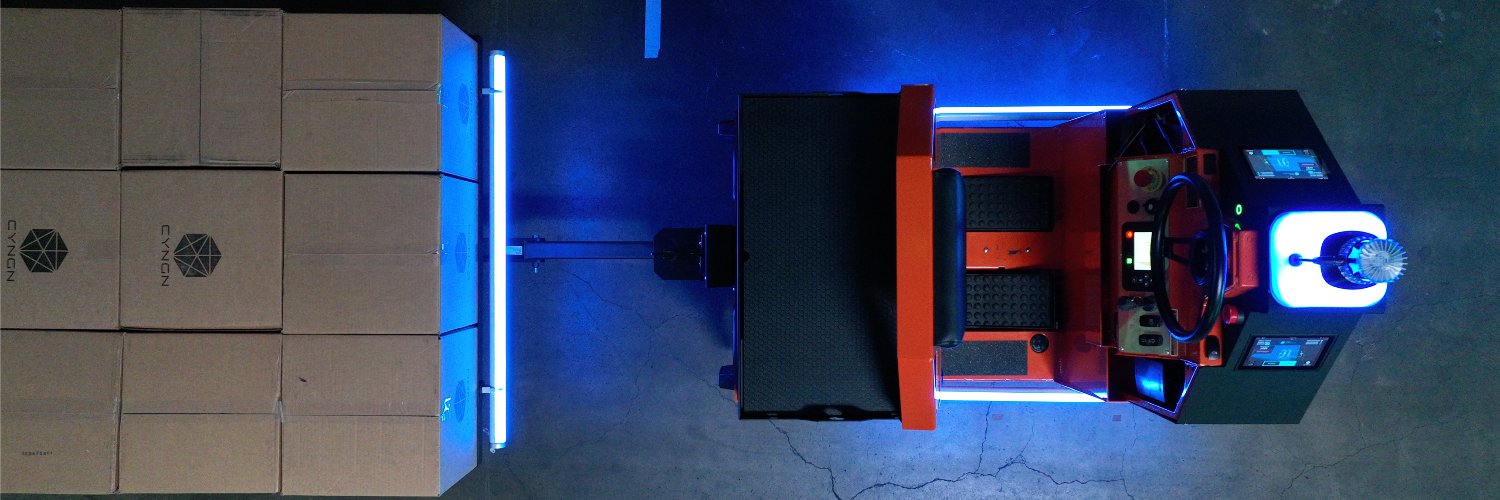
When our autonomous vehicle orders triple in a year, it signals a major industry shift. We're transforming how manufacturing and logistics operate with DriveMod technology.
Here's what we accomplished in 2025: https://t.co/OvxPTQu4uT $CYN #AutonomousVehicles #IndustrialAutomation
The interesting takeaway isn’t that humanoids aren’t ready.
It’s that industrial #automation doesn’t need one #robot to do everything.
Purpose-built autonomous systems can solve real industrial problems today, while humanoids continue developing toward more general-purpose work.
That's why AMRs have gained so much traction in manufacturing.
Moving materials from A to B doesn't require a robot that looks like a person. It requires one that's reliable, predictable, and built for that specific job.
Your warehouse might have a spaghetti map problem.
If your facility looks like this, with forklifts crisscrossing, looping, and backtracking all day, you probably do.
Those tangled paths aren’t just messy. They mean unnecessary forklift miles, wasted labor hours, more high-risk crossings, and extra wear and tear.
Amazon has deployed more than a million robots.
The more interesting question is why.
Amazon’s own planning documents make the rationale pretty clear: as order volume grows, the operation needs more capacity, but hiring at the same pace isn’t always realistic.
Amazon has deployed more than a million robots.
The more interesting question is why.
Amazon’s own planning documents make the rationale pretty clear: as order volume grows, the operation needs more capacity, but hiring at the same pace isn’t always realistic.
Your warehouse might have a spaghetti map problem.
If your facility looks like this, with forklifts crisscrossing, looping, and backtracking all day, you probably do.
Those tangled paths aren’t just messy. They mean unnecessary forklift miles, wasted labor hours, more high-risk crossings, and extra wear and tear.
Safety isn't a limit on autonomy — it's what makes it a win for every facility, driving fewer accidents and more productivity.
We build that safety in from the start, so workplaces run smarter and stay protected. 👇
That's why AMRs have gained so much traction in manufacturing.
Moving materials from A to B doesn't require a robot that looks like a person. It requires one that's reliable, predictable, and built for that specific job.
Everyone keeps asking what shape a robot should be.
The better question is: What job does it need to do?
We're spending too much time talking about form instead of function. The robot should fit the task, not the other way around.
The humanoid progress is impressive. But factory automation isn’t a 100-meter dash.
AMRs are already proving their value in real facilities, moving materials safely and reliably through complex environments.
The bigger question isn’t what a robot can do in a competition.
It’s what it can do every day on the factory floor.
https://t.co/4nqOxhHxHF
The humanoid progress is impressive. But factory automation isn’t a 100-meter dash.
AMRs are already proving their value in real facilities, moving materials safely and reliably through complex environments.
The bigger question isn’t what a robot can do in a competition.
It’s what it can do every day on the factory floor.
https://t.co/4nqOxhHxHF
The DriveMod Tugger navigates without wires, tape or magnets, so there's no dedicated navigation infrastructure to install across the facility.
For enterprise manufacturers, that's worth considering.
Because when you're evaluating automation across multiple facilities, the deployment requirements matter just as much as what the automation can do.
How much does your facility have to change to accommodate automation?
It's an important question when you're looking at brownfield deployment.
Existing aisles, traffic patterns, forklifts, pedestrians and material flows all have to be considered. Add fixed infrastructure to the mix, and deployment can become even more involved.
This is one of the benefits of automation we don’t talk about enough.
Take the repetitive work off experienced workers’ plates, and give them more time to pass on the knowledge that can’t be found in a manual.
A plant manager recently told me that his best mechanic is retiring in six months after 28 years on that floor.
When he walks out, so does everything he knows that's never been written down.
https://t.co/XGL9A8sXs7
More manufacturers are turning to automation to improve efficiency, increase consistency, and stay competitive.
The fact that adoption is broadening across industries shows how quickly automation is becoming part of the manufacturing conversation.
A plant manager recently told me that his best mechanic is retiring in six months after 28 years on that floor.
When he walks out, so does everything he knows that's never been written down.
https://t.co/XGL9A8sXs7
I liked an analogy Cognex’s CEO used recently.
Every operations team has an “open folder” of automation ideas. Projects that got put aside because the technology wasn’t ready, the economics didn’t work, or implementation looked like too much of a headache.
But some of those projects may look very different today.