For most of history, sending money meant carrying it.
If you were robbed on the road, your savings were gone.
So how did we learn to pay someone without moving the money?
The story begins long before modern banks.
In ancient Mesopotamia, people deposited grain and silver in temples, borrowed against resources, and recorded debts on clay tablets.
There were no banks as we know them today. But safekeeping, lending, and accounting were already there.
As coins spread and trade grew, money became a profession.
In ancient Greece, money dealers known as trapezitai exchanged coins, accepted deposits, made loans, and handled payments for their customers. Roman argentarii performed similar work.
A balance recorded in a ledger could now matter as much as the coins themselves.
When the Roman world fragmented, parts of that system weakened. Trade continued elsewhere.
Across the Islamic world, merchants used instruments such as hawala, suftaja, and sakk to arrange payments between distant cities without carrying the money themselves.
In the 12th and 13th centuries, the Knights Templar also developed a financial network connecting Europe and the eastern Mediterranean, providing safekeeping, credit, and payment services.
As European trade expanded, money dealers became increasingly important in Italian commercial cities.
Their banco—the bench or table where they worked—gave banking its name.
They kept balances in ledgers. A payment between two merchants could be made by subtracting from one account and adding to another.
The coins stayed where they were. The balances changed.
For payments between cities, Italian merchants developed the bill of exchange.
A merchant paid money in one city. A partner or representative arranged the corresponding payment elsewhere.
What crossed Europe was a claim to money and a promise to pay.
In the 14th century, families such as the Bardi and Peruzzi expanded these networks. In the 15th, the Medici helped take them further.
Public banks followed: Barcelona’s Taula de Canvi in 1401, Venice’s Banco di Rialto in 1587, and Amsterdam’s Wisselbank in 1609.
Large payments could be settled by transferring balances between accounts.
Looking back at that history, the ledger keeps coming up.
We talk about money as something we hold. Yet so much of what we do with it depends on a record: who owns what, who owes whom, and whether the next person will accept it.
The question has followed us from clay tablets to banking apps:
Whose record do you trust?
Slippage, explained.
Prices can move between your quote and the moment your swap lands. Slippage is how much movement you accept; past that, the swap stops.
Swapdore defaults to 0.5% and asks you to confirm anything above 1%.
Started with $575 and a late invite code.
Now Gold on @arcus_xyz 🥇
Second points update:
• Season points: 11 → 31.40
• Rank: #2,211 → #1,971
• Total volume: $717K
• Total trading fees: $2.58
This week’s equity change: +$62.38 (+10.85%)
Current equity: $637.05
Last week I was still fine-tuning my setup. Seeing both the points and account grow this week feels good.
Trading RWAs across different markets, no single asset focus.
How did this week’s drop treat you? 👀
@arcus_xyz
Last week’s +18.54% account just finished at −2.90%.
Account 3 stepped up with +11.21%.
The five accounts still finished at −$17.11 overall.
Lighter points day • Week 7 👇
Another week of tracking my copy trades on Lighter’s Robinhood Chain instance through @Hyperankio.
Account 1: −$20.81
Last week’s strongest performer turned red. Max drawdown jumped from $27.63 to $140.95 — a much rougher ride than the final −2.90% suggests.
Account 2: +$0.41
Barely green, with the smallest drawdown of the five at $9.63.
Account 3: +$51.97
This week’s best performer. Max drawdown was $43.30, compared with $148.26 last week.
Account 4: −$13.94
Another red week, with a $94.69 max drawdown along the way.
Account 5: −$34.74
The biggest weekly loss: −9.10%.
Across all five:
• Weekly PnL: −$17.11
• Volume: $23,547.11, down 43.0%
• Points added since last Friday’s snapshot: +1.717343
• Cumulative points: 25.456594
Last week the combined PnL was +$101.64. This week, Account 3’s gains weren’t enough to cover the losses elsewhere.
Keeping all five accounts in the weekly update. The red weeks belong here too.
@CryptoKemal Would be interesting to see this alongside holder retention. Getting new wallets in is one thing; seeing them stick around is where it gets interesting.
@era_donnbradman@arcus_xyz Yeah, comparing fees puts it in perspective. Mine was $0.984 total, so roughly $0.09 per point. Same 11 points, very different fees 😅 What markets were you trading?
$219K in volume. 11 points.
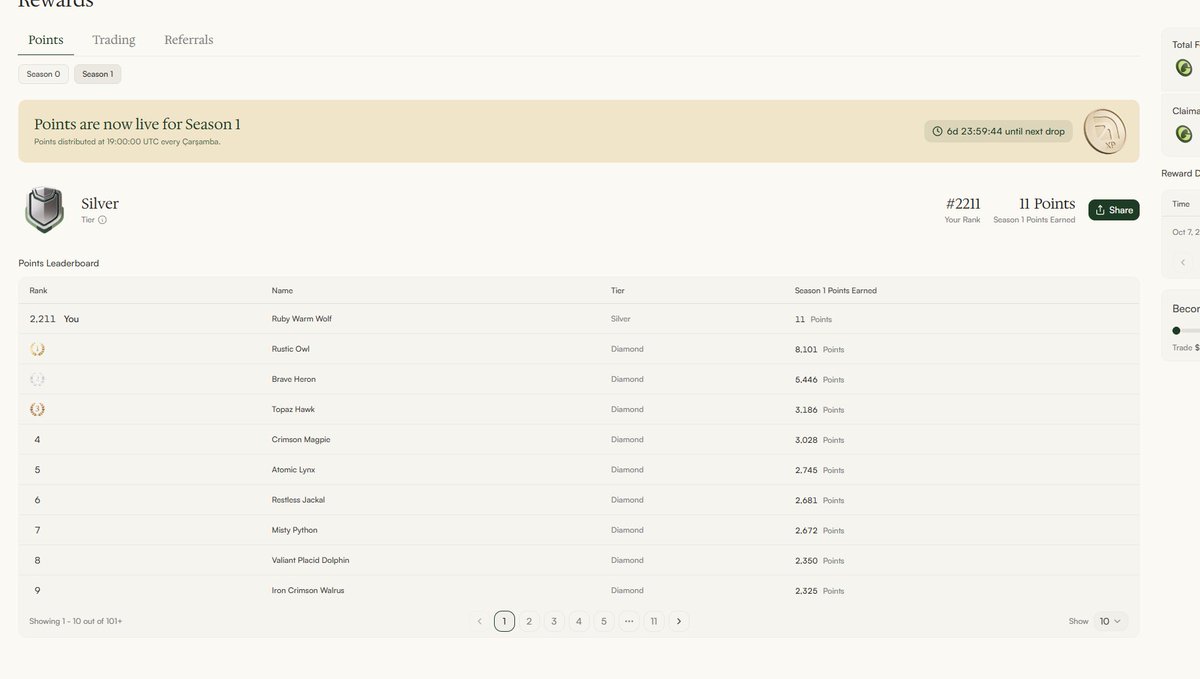
My first @arcus_xyz points day 😅
Started with $575 after finally finding an invite code on Sunday. Been trading and fine-tuning my setup since.
Trading fees: $0.984
Last PnL check: -$3.82
Rank: #2,211 · Silver
The setup is finally where I want it. Next goal is to keep the trading profitable while earning points.
Anyone with similar volume? Curious what your allocation looked like.
@trungmanict@arcus_xyz Yes, it seems to come with the highest score in terms of retention data, but there is no clear data regarding that in the posts.
$56K volume → 21 points.
$219K volume → 11 points.
$180K volume → 61 points.
Been comparing @arcus_xyz Week 1 results, and the differences are interesting.
A few more trader-reported examples:
• $230K → 17.28 points
• $500K → 7 points
• $1M → 51 points
• $1.57M → 115 points
Mine was $219K → 11, using $575 starting capital since Sunday.
But fees add another layer:
• Me: ~$0.09 in trading fees per point
• $56K account: ~$0.57
• $230K account: ~$1.16
So points per volume and fees per point tell very different stories.
Some traders mentioned longer holds, but we don’t have enough comparable data to isolate what drove the difference. Market mix, collateral and referrals could all matter.
These are self-reported results, not an audited dataset. Fee figures also exclude other costs and trading PnL.
What did you get? Share your volume, points, fees and markets. Would be useful to compare more than just the points screenshot.
@arcus_xyz Still looking for an @arcus_xyz invite code? I finally found mine on Sunday, so I know the feeling 😅
Sign up through my referral link and DM me I’ll send you an invite code.
https://t.co/LvEOnkxtBE