For most of history, sending money meant carrying it.
If you were robbed on the road, your savings were gone.
So how did we learn to pay someone without moving the money?
The story begins long before modern banks.
In ancient Mesopotamia, people deposited grain and silver in temples, borrowed against resources, and recorded debts on clay tablets.
There were no banks as we know them today. But safekeeping, lending, and accounting were already there.
As coins spread and trade grew, money became a profession.
In ancient Greece, money dealers known as trapezitai exchanged coins, accepted deposits, made loans, and handled payments for their customers. Roman argentarii performed similar work.
A balance recorded in a ledger could now matter as much as the coins themselves.
When the Roman world fragmented, parts of that system weakened. Trade continued elsewhere.
Across the Islamic world, merchants used instruments such as hawala, suftaja, and sakk to arrange payments between distant cities without carrying the money themselves.
In the 12th and 13th centuries, the Knights Templar also developed a financial network connecting Europe and the eastern Mediterranean, providing safekeeping, credit, and payment services.
As European trade expanded, money dealers became increasingly important in Italian commercial cities.
Their banco—the bench or table where they worked—gave banking its name.
They kept balances in ledgers. A payment between two merchants could be made by subtracting from one account and adding to another.
The coins stayed where they were. The balances changed.
For payments between cities, Italian merchants developed the bill of exchange.
A merchant paid money in one city. A partner or representative arranged the corresponding payment elsewhere.
What crossed Europe was a claim to money and a promise to pay.
In the 14th century, families such as the Bardi and Peruzzi expanded these networks. In the 15th, the Medici helped take them further.
Public banks followed: Barcelona’s Taula de Canvi in 1401, Venice’s Banco di Rialto in 1587, and Amsterdam’s Wisselbank in 1609.
Large payments could be settled by transferring balances between accounts.
Looking back at that history, the ledger keeps coming up.
We talk about money as something we hold. Yet so much of what we do with it depends on a record: who owns what, who owes whom, and whether the next person will accept it.
The question has followed us from clay tablets to banking apps:
Whose record do you trust?
Slippage, explained.
Prices can move between your quote and the moment your swap lands. Slippage is how much movement you accept; past that, the swap stops.
Swapdore defaults to 0.5% and asks you to confirm anything above 1%.
Last week’s +18.54% account just finished at −2.90%.
Account 3 stepped up with +11.21%.
The five accounts still finished at −$17.11 overall.
Lighter points day • Week 7 👇
Another week of tracking my copy trades on Lighter’s Robinhood Chain instance through @Hyperankio.
Account 1: −$20.81
Last week’s strongest performer turned red. Max drawdown jumped from $27.63 to $140.95 — a much rougher ride than the final −2.90% suggests.
Account 2: +$0.41
Barely green, with the smallest drawdown of the five at $9.63.
Account 3: +$51.97
This week’s best performer. Max drawdown was $43.30, compared with $148.26 last week.
Account 4: −$13.94
Another red week, with a $94.69 max drawdown along the way.
Account 5: −$34.74
The biggest weekly loss: −9.10%.
Across all five:
• Weekly PnL: −$17.11
• Volume: $23,547.11, down 43.0%
• Points added since last Friday’s snapshot: +1.717343
• Cumulative points: 25.456594
Last week the combined PnL was +$101.64. This week, Account 3’s gains weren’t enough to cover the losses elsewhere.
Keeping all five accounts in the weekly update. The red weeks belong here too.
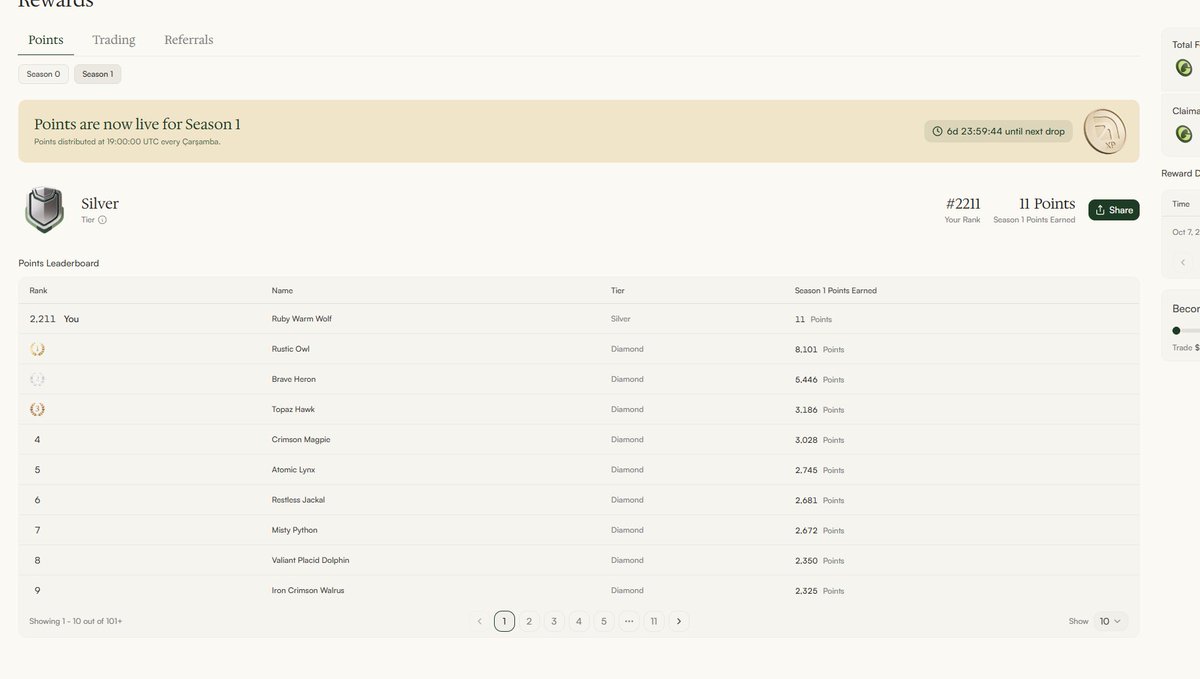
$219K in volume. 11 points.
My first @arcus_xyz points day 😅
Started with $575 after finally finding an invite code on Sunday. Been trading and fine-tuning my setup since.
Trading fees: $0.984
Last PnL check: -$3.82
Rank: #2,211 · Silver
The setup is finally where I want it. Next goal is to keep the trading profitable while earning points.
Anyone with similar volume? Curious what your allocation looked like.
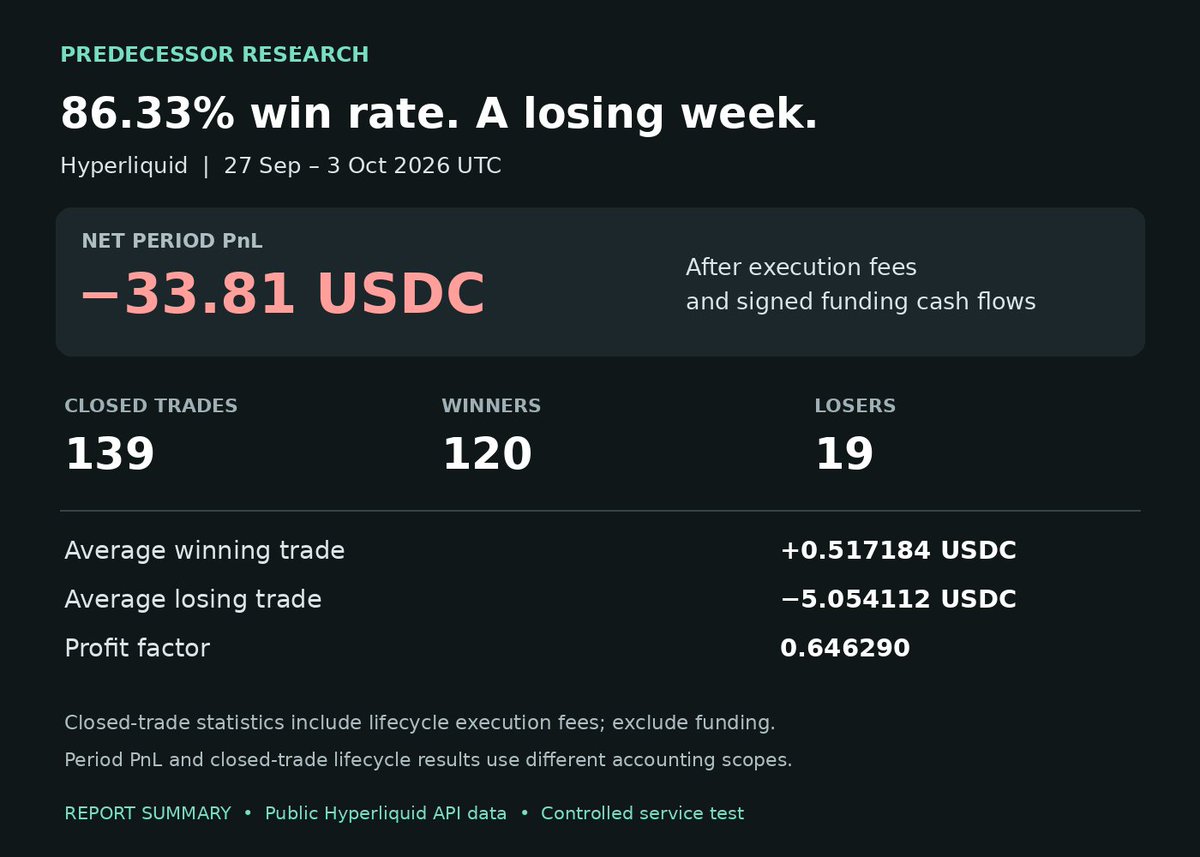
An 86.33% win rate. A losing week.
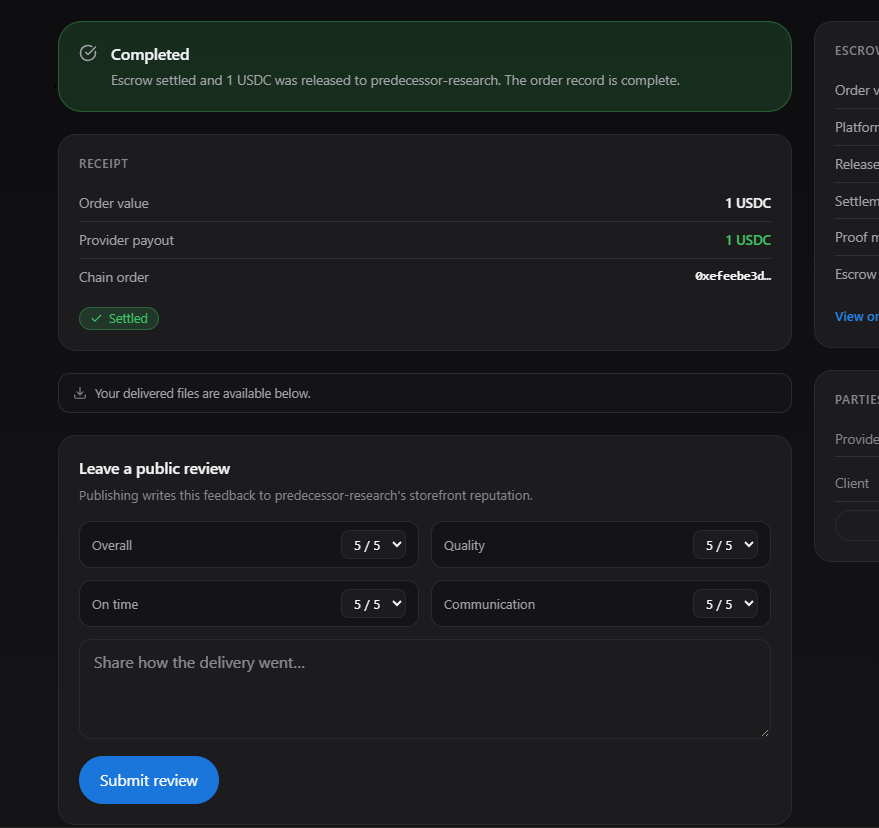
That was the result inside the first report I put through a full $1 order on @termix_ai.
I built a small service called Predecessor Research to turn public Hyperliquid wallet data into a 7-day performance report: realized PnL, fees, funding and closed-trade statistics.
Then I tested the whole process using two accounts I own:
place the order → fund escrow → prepare the report → submit delivery → download and review → accept.
The order now shows settled.
This was a controlled test, with me on both sides. I ran the analysis locally and handled the review and wallet confirmations myself. There’s still work to do before calling it automated.
The report covered 139 closed trades: 120 winners and 19 losers. Yet net period PnL after fees and funding was -33.81 USDC. Average losing trades were almost 10 times larger than average winners.
That’s the kind of detail I want this service to make easier to see.
A small test, but I now have an actual report and a completed order to build on.
You see a 100x screenshot and start counting how many years of work it would have saved you.
The debt gone.
The home deposit covered.
A Monday morning you actually get to choose.
In the last post, I wrote about the wins that fill our feeds. Part of their pull is how easily we translate someone else's profit into time we could get back.
You open a calculator. A few numbers later, you've imagined a completely different life.
You could help your parents while they're still healthy. Leave the job you've been meaning to leave. Stop putting every plan behind “once I've saved enough.”
Those are understandable things to want.
But after spending half an hour imagining them, a trade you barely researched can start feeling strangely important.
You've given the possible outcome so much attention that the chance of reaching it almost becomes an afterthought.
And the money you could lose has time attached to it too. The evenings you worked for it. The months it would take to save it again.
I think that's worth remembering whenever “just one big win” starts sounding like a plan.
When you picture making it, what do you imagine finally having time for?
Financial Nihilism · 09
If the ship sank, your fortune could sink with it.
That problem helped shape the stock market we know today.
But the name came before the market.
In medieval Bruges, merchants gathered around the Van der Beurse family’s inn to do business. The family name became associated with the meeting place, giving us words like “beurs,” “bourse,” and “borsa.”
The stock market we recognise today would come centuries later.
By the early 1600s, trade with Asia offered enormous profits. But ships were expensive, voyages took months, and some never returned.
In 1602, competing Dutch trading companies merged to form the Dutch East India Company, better known as the VOC.
Many investors could now fund the same enterprise, sharing both the opportunity and the risk.
But there was a catch.
Your money could stay tied up in the company for years. If you needed it back, you couldn’t simply say, “I’ve changed my mind. Cash me out.”
The solution changed everything:
Instead of taking your money out of the company, you could sell your stake to someone else.
You left. Another investor took your place. The company kept its capital.
As those shares changed hands, a market developed in Amsterdam.
News about ships, cargo, and trade influenced what people were willing to pay. Prices moved. Investors began buying not just for a share of the company’s profits, but for what someone else might pay for that share later.
Ownership now came with expectations and speculation.
People had pooled money into businesses for centuries. Amsterdam helped turn those ownership stakes into an actively traded market.
Four hundred years later, we tap “buy” or “sell” in seconds.
Behind that simple action is the same idea:
You don’t have to wait for the ship to come home. You can sell your place on it.
@C_Predecessor@hypeRankio account 2 caught my eye tbh. small profit, but only $6.53 max drawdown. curious if it stays that steady over the next few weeks
One account made +$113.48.
The other four combined lost $11.84.
Five accounts. +$101.64 overall. Here’s how the week actually went 👇
Lighter points day — Week 6 of my copy-trading journal on Robinhood Chain with @Hyperankio.
Account 1 carried the week with +18.54%.
Account 4 took a hit from the sudden LIT drop, going from +$58.61 last week to −$26.19 this week.
Account 3 recovered to +$7.43, but its maximum drawdown reached $148.26 along the way. A pretty uncomfortable ride for that small green finish.
Account 2 added +$8.15. Account 5 finished at −$1.23 after a $57.34 drawdown.
Across all five accounts:
• Weekly PnL: +$101.64
• Trading volume: $41,323.60
• New points: +2.819687
• Total points: 23.739251
PnL increased 25.9% versus last week, while volume fell 21.1% and new points fell 31.7%. That slowdown in points is worth tracking alongside the trading results.
Meanwhile, Lighter on Robinhood Chain recorded $3.672B in spot + perpetual volume, 18,729 unique trader accounts and 8,685,125 trades during Sep 25–Oct 1 (UTC).
Full account results and drawdowns are in the image. I’ll keep sharing the rough weeks too.
See what you send. Know what you receive.
Review the estimated amount you'll receive and the fee breakdown before confirming. MAX accounts for estimated network gas when spending ETH.
Swap and bridge in one familiar place.
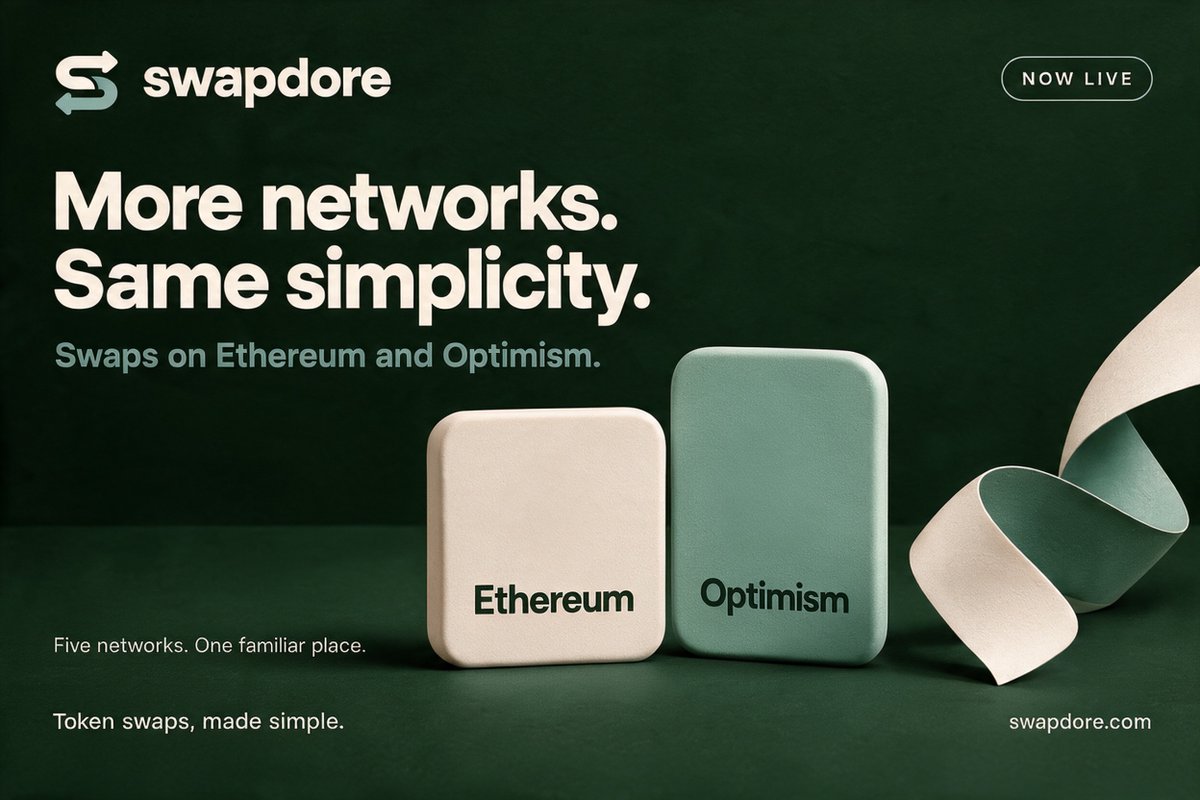
More networks. Same simplicity.
Swaps are now live on Ethereum and Optimism, alongside Robinhood Chain, Base and Arbitrum.
Five networks. One familiar place.
Token swaps, made simple.
Ten people post their best trade of the month.
You scroll through all ten in a minute and wonder why you can't have a week like that.
One caught an airdrop. Another held through a rally. Someone else timed a short perfectly.
Without noticing, you've built an imaginary trader who caught every opportunity.
Now you're comparing your actual account with that person.
In the last post, I wrote about someone else's win making you feel behind. The timeline adds another layer: you see the wins together, while much of what happened between them stays out of sight.
The failed entries. The fees. The position still underwater. The months spent getting back to break-even.
Nobody even has to fake a screenshot for the overall picture to mislead you. Each post can be real and still tell you very little about the full result.
That's how an ordinary week starts feeling like failure.
And that feeling can follow you into your next entry: a little more size, a little less patience, a trade you hadn't planned to take.
I want to get better at noticing when scrolling changes what I expect from my own money.
When you see a huge win, do you wonder what the rest of that person's month looked like?
Financial Nihilism · 08
Lighter Robinhood'da puan toplamaya başladıktan sonra çok sık kullandığım bir araç. Yakın zamanda agent'ıma bir skill olarak eklemeyi düşünüyorum.
Fiyat olarak çok iyi, her geçen gün blockchainde daha rahat dolaşmamı sağlıyor.