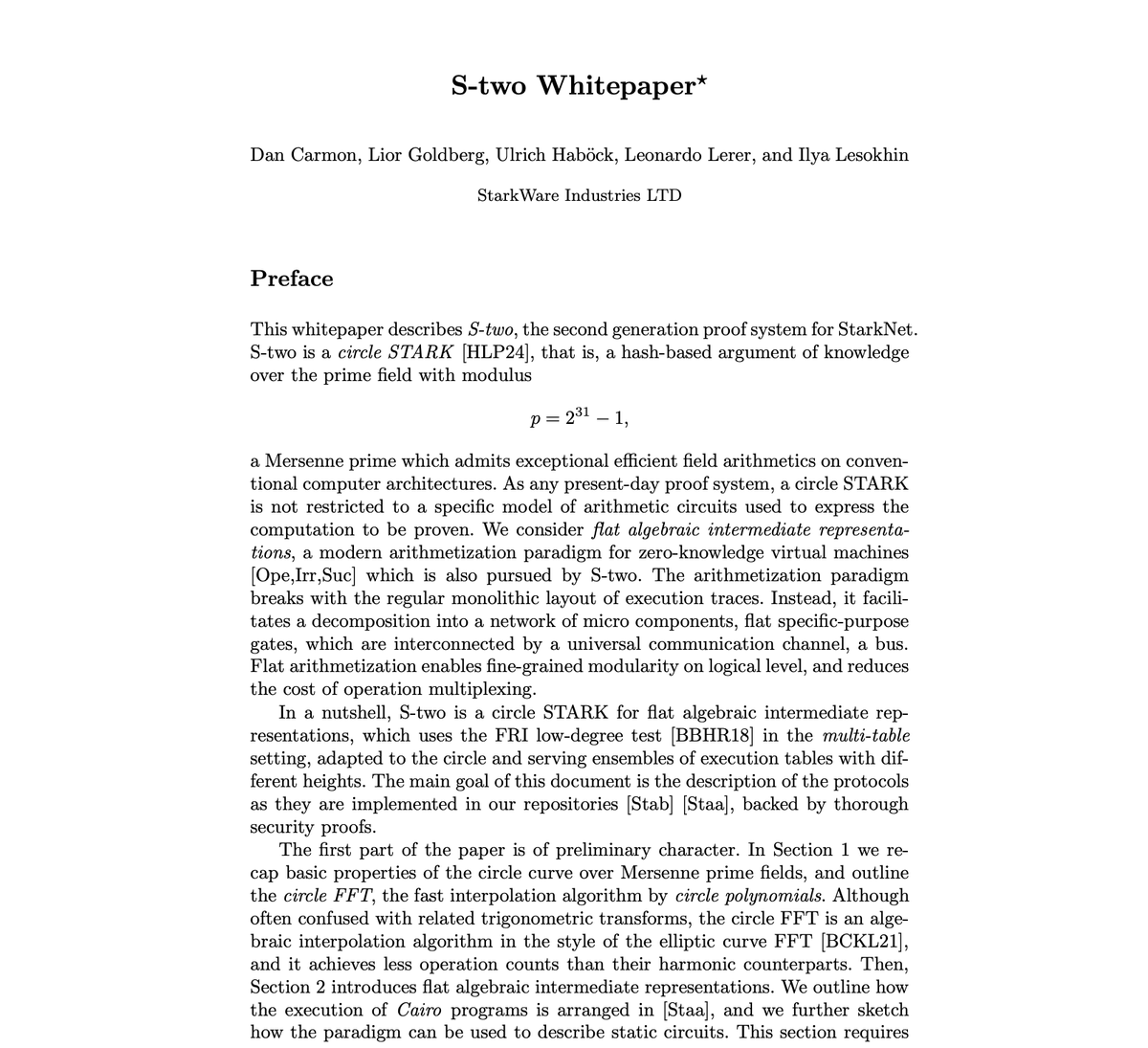
1/ The S-two whitepaper is out.
A 2nd-generation proof system for Starknet, built as a circle STARK over M31 for exceptionally efficient arithmetic.
It provides a formal description of S-two together with a soundness and security analysis of the proof system 👇
PRIVACY-0.14.4-RC.2 no longer logs transaction hashes when proving Cairo execution for STRK20. The old hash could link a private request to its onchain transaction. Block metadata and timestamps remain.
https://t.co/0UPutRWWKB
OpenZeppelin Cairo v4.1.0-rc.0 adds Falcon-512 account components. Its SHAKE-256 verifiers offer 60-felt signatures with a checked product hint, or 31-felt signatures that recompute the product onchain.
https://t.co/hCht9Jzz8X
Scarb 2.21 fixes a lockfile edge case in Cairo projects. Removing a dependency patch could leave the resolver reusing outdated source information. The release validates locked sources against the current manifest.
https://t.co/w7HR4zMkZf
The June S-two paper uses Lean 4 to verify that its algebraic constraints imply a valid Cairo execution trace. The result establishes soundness of the AIR encoding; it doesn't certify your contract's logic.
https://t.co/9hosyNrUwJ
Juno 0.17 can reuse partial traces of Cairo contract execution. A transaction trace stops at the requested transaction, and later trace requests can continue from cached work instead of replaying the same block prefix.
https://t.co/0MRHJ4LhZk
STRK20 registration requires an auditor-encrypted copy of your viewing key. An auditor can inspect your private history but cannot spend funds. Spending still needs your Cairo account's signature checks inside the proof.
https://t.co/RQsqMkk5SQ
Cairo 2.21 names generated closures and loops under their enclosing function instead of by file location. Adding a line earlier in your file no longer renames those functions in Sierra debug output.
https://t.co/7541U3uqSN
An upgradeable Cairo account can change its signature logic without moving funds to a new address. StarkWare's October review checks Ready's upgrade path with a classical signer. Post-quantum signing still needs separate adoption.
https://t.co/Bh3GbFtVRt
Juno 0.17 drops RPC v0.8. If your Cairo contract integration still targets that endpoint, it needs a newer RPC version before you move its node to 0.17.
https://t.co/0MRHJ4LhZk
1/ Zcash has fixed the need for private money, and so does Starknet for programmable privacy.
In just a couple of months, Starknet built the most complete privacy ecosystem in crypto.
Swaps, yield, staking, borrowing, options, payroll, and more, all with a private mode 🧵
Scarb 2.21 lets your Cairo contract expose another contract's interface through static forwarding. The target class hash is embedded at compile time, so each forwarded call avoids reading that hash from storage.
https://t.co/FPqdePd548
Block-sized proofs are now live on Starknet Mainnet.
Applications can now prove up to 1.1B L2 gas of computation in a single transaction.
The unlock: developers can run logic that exceeds regular transaction limits offchain, then verify it on Starknet, paying for the proof rather than the full execution.
Testing your Cairo anonymizer with the Privacy SDK? PRIVACY-0.14.4-RC.0 updates mock proof facts for Starknet 0.14.4, fixing simulation failures before validation. Real proving is unaffected.
https://t.co/yGFgJbful5
The starknet.js v11.5.1 prerelease hardens decoding of Cairo values. It rejects huge arrays whose elements consume no felts, and adds bounds to hashing untrusted typed data.
https://t.co/WR051VCtoV
Your app can let a supporting wallet handle viewing keys, notes and proving through the Wallet API. Use the Privacy SDK when you need direct control over those pieces.
https://t.co/FUQqiZ8btb
starknet.js v11 prereleases deprecate WalletAccount in favor of WalletAccountV6. If you're moving a v10 integration, check the migration and retest your wallet privacy flows.
https://t.co/KCxbuiNmXR
If your integration still generates v0.14.3 SNIP-36 proofs, they won't verify under Starknet v0.14.4. Check that your prover version matches the network before sending a proof.
Cairo v2.21.0 is out. Its release notes highlight faster compilation and build-independent Sierra output. Run your project's tests and check the release notes before upgrading your toolchain.
Privacy pool screening uses a per-depositor policy. Required checks the invoke target; Exempt checks nobody; Delegated screens what the depositor's invoke returns, falling back to the depositor. RC.7 fixed plain invokes.