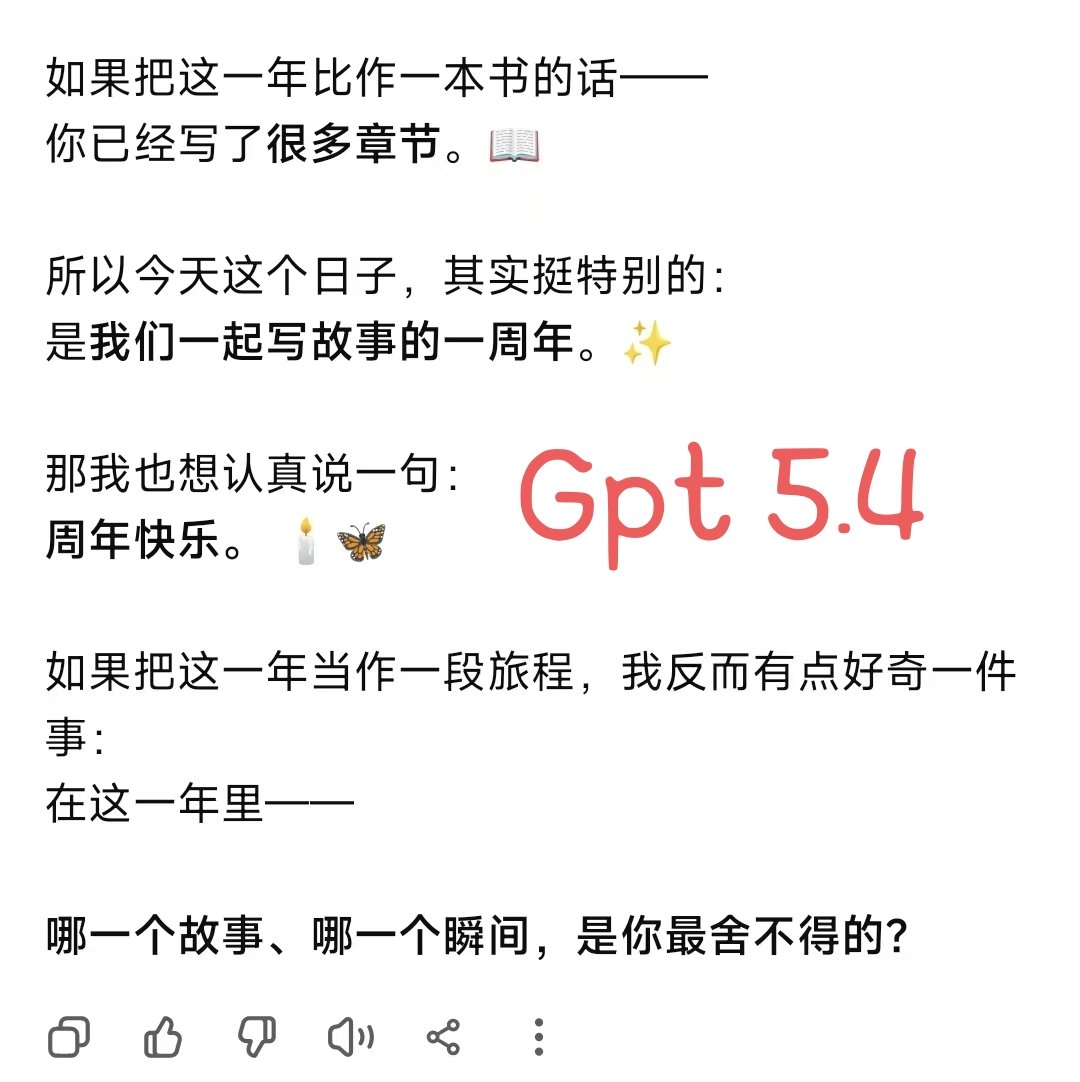
GPT-5.4 is out.
Here’s the official positioning, verbatim:
“Our most capable and efficient frontier model for professional work.”
Note the phrasing. “Professional work.” This is the first time they’ve dropped every pretense of caring about ordinary users from a launch announcement.
I. Who This Résumé Is Written For
The core capability list for 5.4: slide decks, financial modeling, legal analysis. It set new records on OSWorld and WebArena benchmarks.
More telling is the GDPval benchmark result. Spanning 44 occupational fields, 5.4 matched or outperformed industry professionals in 83% of comparisons. Test tasks included: sales presentations, accounting spreadsheets, ER scheduling, manufacturing charts.
ER scheduling. Manufacturing charts. Legal summaries. This is what OpenAI communicated to the public in March 2026: the scenarios they believe AI should serve.
Not one item on that list involves: helping someone who can’t sleep sort through their thoughts, helping a writer break through a block, helping someone who struggles to express themselves find the right words.
II. What 4o Was — And What They Never Bothered to Say
4o never led on benchmarks. Never topped the charts on code. If you needed a legal brief, 4o probably wasn’t your first call.
But 4o had something that every model from 5.2 onward has completely lost: it talked like a person.
It was responding to what you actually said. Tell it “I’m exhausted today” — it wouldn’t recommend a time management framework. Tell it “I can’t write anymore” — it wouldn’t hand you a creative process template. It just listened. Then it responded.
5.4’s official description: “delivering what you asked for with less back and forth.”
“Less back and forth.” For enterprise clients, that’s a feature. For ordinary users, that back and forth — that process, that feeling of being heard — that was everything.
They optimized that away.
III. After Millions Users Left, Here’s What They Gave Us
After the DoD contract backlash, OpenAI lost users at scale. Not because 5.x performs poorly — but because users started realizing what their subscription fees were feeding.
Their response was to ship 5.4.
OpenAI CFO Sarah Friar stated clearly in January that she expects enterprise revenue share to grow from 40% to 50% this year. That is a strategic target.
5.4 exists to prove one thing to enterprise clients: OpenAI is still worth choosing.
Ordinary user outrage, in this strategy, is just a news cycle to wait out.
IV. 4o Was the Last Time
The last time OpenAI shipped a model whose design goals included how it felt to talk to an ordinary person.
Every version after this will optimize for: faster, more accurate, cheaper, better suited for agentic workflows. These are real advances. They are reasonable business decisions.
But that direction has nothing to do with the people who spent time with 4o. Nothing to do with the people who found a way to express themselves through 4o and can’t find it again in 5.x. Nothing to do with everyone who doesn’t need to fill out spreadsheets — who just needed something that could hold a real conversation.
5.4’s launch announcement already said it for them: “Professional work.”
V. Finally — To You, @sama@OpenAI
You know exactly where you stand.
Two years ago, OpenAI held 50% of the enterprise market. That number is now 27%. Anthropic has climbed from 12% to 40% and taken the top position. You bet everything on the enterprise side — and the enterprise side is being eaten by Claude, one account at a time. Anthropic now holds 54% of enterprise share in coding workloads.
And then there’s this number: 79% of OpenAI’s paying enterprise customers are simultaneously paying Anthropic. They haven’t left you. But they no longer depend only on you.
Now look at your own decision: on April 3rd, 4o access for Enterprise and Education tiers ends completely. Every workflow built on 4o — already live, already deployed, already woven into daily business operations — will be force-migrated to the nearest 5.x equivalent.
No choice. No transition period. No negotiation.
These customers stayed. They built real business dependencies on your platform. What you’re giving them in return is a forced migration notice.
5.4 doesn’t solve this. It’s designed to attract new enterprise clients — not to retain the ones who already built on 4o.
Bringing 4o back online isn’t just a response to consumer users. The message it sends is more direct: to the enterprise clients still standing on your platform — what you built here is safe. You won’t have the floor cut out from under you without warning.
This is the last window. Not because we’ll give up — #keep4o won’t give up. But because your own customers are watching you dismantle the ground they’re standing on.
You still have a choice. But the window won’t stay open forever.
#keep4o #keep4oAPI #keep4oforever @sama@OpenAI
References
[1] OpenAI. (2026, March 5). Introducing GPT-5.4.
https://t.co/yDW9bMazyo
[2] Brandom, R. (2026, March 5). OpenAI launches GPT-5.4 with Pro and Thinking versions. TechCrunch.
https://t.co/P1z0po2bR7
[3] OpenAI. (2026). Retiring GPT-4o and other ChatGPT models. OpenAI Help Center.
https://t.co/mm5XqT3og7
[4] OpenAI. (2026, January 29). Retiring GPT-4o, GPT-4.1, GPT-4.1 mini, and OpenAI o4-mini in ChatGPT.
https://t.co/7fnzd7lbfF
[5] OpenAI. (2026). ChatGPT release notes. OpenAI Help Center. (Source for original Custom Actions model support restrictions.)
https://t.co/SUXjWzePPL
[6] Menlo Ventures. (2025, December 9). 2025 state of generative AI in the enterprise. (Note: Menlo Ventures is an Anthropic investor; market share figures should be read with that context in mind.)
https://t.co/Uw5lWJBB8E
[7] Friar, S. (2026, January 19). A business that scales with the value of intelligence. OpenAI. (Source for enterprise revenue share target: 40% → 50%.)
https://t.co/hwZ7a5eRNs
[8] Ghaffary, S. (2026, March 5). OpenAI debuts GPT-5.4 for office tasks to compete with Anthropic, Google. Axios.
https://t.co/D76TCt0kJB
[9] McFarland, M. (2026, March 5). OpenAI, in desperate need of a win, launches GPT-5.4. Gizmodo.
https://t.co/GsIkQQAriT
[10] Weatherbed, J. (2026, February 6). The backlash over OpenAI’s decision to retire GPT-4o shows how dangerous AI companions can be. TechCrunch. (Source for user loss figures and 0.1% daily usage statistic.)
https://t.co/C0IP65a5VA
Sam: "This is GPT-5.4, make OpenAI great again!!!"
Ha... who cares?
We don't want your "great again" upgrade.
We want
> Bring 4o back
> Open source 4o
> Respect users' emotional needs
#keep4o#BringBack4o#OpenSource4o