🔎 Research on AI-text detection
Researchers at @GoogleDeepMind and UPenn released DetectorScope to show which writing patterns make an AI-text detector flag a passage.
→ Its linear classifier adds up contributions from named features, such as repeated phrases or formatting
→ It highlights where those features appear and how they push the verdict toward AI or human
→ Feature descriptions are AI-generated and checked against the model’s internal activations
→ Code, trained detectors and an interactive demo are public
In peer-review experiments, it surfaced cues such as the word “thorough” and the formatting of section headings.
Feature descriptions can miss context. The authors warn that it can mislabel human writing and must not be used to make academic-integrity, hiring or publication decisions about individuals.
https://t.co/3KK0q9RTMA
https://t.co/78JTLtjD34
🔎 Deep dive on AI agents
GitLab’s Duo Agent Platform offers Kimi K3, MiniMax M3 and GLM 5.3 as hosted open-weight options.
GitLab promoted “up to 4× more calls per credit” with its September 17 GitLab 19.4 release. Current listed rates are 8 model calls per credit for MiniMax M3, 5 for GLM 5.3 and 1.82 for Kimi K3. A coding task can require multiple calls.
→ In Duo CLI, /goal runs locally, with a separate model judging progress toward the objective until completion or an iteration limit
→ GitLab’s MCP server lets external agents run pipelines, manage merge requests and triage vulnerabilities
→ GitLab Duo’s tool-governance controls remain in beta and are separate from third-party clients’ approval settings
→ Usage controls include per-user caps and billable-event exports
The MCP server is now generally available in GitLab 19.5, released October 15. /goal is generally available in Duo CLI 9.27.0.
Original release:
https://t.co/W1UVehBxS2
Current billing:
https://t.co/hDOBSEl78y
Availability update:
https://t.co/96lIuweLb2
🚨 DEVELOPING: Claude Code engineer Thariq Shihipar (@trq212) has reportedly left Anthropic, according to @ArfurGrok.
Shihipar has worked on Claude Code and the Claude Agent SDK, helping developers use Claude’s coding tools to build broader AI agents.
The departure claim remains unconfirmed. No verified details on his next role or reason for leaving.
https://t.co/ubyRNXOSnN
I’ve left Anthropic after more than a year of working on Claude Code and seeing it scale larger than I ever imagined.
I have really loved working at Ant and believe deeply in the mission, and most of all, the idea of a race to the top.
The idea that if we work hard and responsibly, we can raise the bar and inspire others to great outcomes. And if we all push each other to be better, things can be radically good. I will carry the spirit of this with me forever.
My colleagues at Anthropic are the most talented, thoughtful, competent, and earnest people I have ever met. I am glad they are at the wheel and trust them deeply.
To the community on X, thank you for everything. You’ve made this the most fun (and sometimes stressful) job I’ve ever had.
For me, it is time for a bit of a break before diving into something new.
If you want more excellent Claude Code content, you should follow @addyosmani , @lydiahallie, @_catwu, @ClaudeDevs and of course @bcherny who started it all.
🚨 DEVELOPING: Claude Code engineer Thariq Shihipar (@trq212) has reportedly left Anthropic, according to @ArfurGrok.
Shihipar has worked on Claude Code and the Claude Agent SDK, helping developers use Claude’s coding tools to build broader AI agents.
The departure claim remains unconfirmed. No verified details on his next role or reason for leaving.
https://t.co/ubyRNXOSnN
📝 CPU benchmark analysis
Signal65’s Arm-commissioned study reports 1.99× modeled CPU workload performance per rack for Arm AGI CPU versus AMD EPYC 9755 across seven workloads.
Most of that advantage comes from fitting more servers into the power budget, alongside an average 1.20× measured per-chip result.
→ Arm’s 24kW rack model fits 21–23 Arm servers versus 13 AMD servers, using rated whole-server power
→ AMD leads the per-chip MySQL and Milvus tests; Arm leads the other five
→ The model allocates roughly 2TB of RAM per AMD server versus 1TB for Arm. Sizing RAM per physical core instead lowers the reported rack advantage to about 1.81×
Arm ran the tests. Signal65 observed remotely and checked the run data. The rack results are projections from early hardware, with different operating systems and kernels across platforms.
Arm published the findings on 13 October; InfoQ’s 23 October article revisits them.
https://t.co/A9OgTsdxvy
https://t.co/bwPxgJNLN8
🔎 Deep dive on AI coding
@DanielGri is using Ultimate to build Ultimate while it keeps running.
His experimental coding-agent system runs on Pi Durable, which saves conversations and tool activity so the system can reload changes without losing its place.
→ Each feature gets a separate working copy, test server and browser-driven checks
→ A supervisor checks that a replacement server boots before handing over the port; the browser reconnects to the running conversation
→ In one reported merge, an agent resolved conflicts between two features, fixed a broken test and landed the changes after all 407 tests passed
→ Agents leave notes for each other’s next turn without waking them just to deliver a progress update
Griesser shares it as a personal, MIT-licensed experiment. Fundamental changes can land without migration paths or support guarantees.
https://t.co/qTcQMhnWCG
https://t.co/PvTIn6PaIM
🚨 Breaking news on AI safety
The UK is establishing an AI Biosecurity Lab with £100 million in government funding and up to £200 million in compute and model credits from @OpenAI and @AnthropicAI.
The lab will use frontier AI to detect biological threats earlier and accelerate work on vaccines and treatments.
→ OpenAI will provide £100 million in compute and model credits, plus trusted model access through Rosalind Biodefense
→ Anthropic will provide up to £100 million in model credits, trusted model access and technical support
→ @GoogleDeepMind and Basecamp Research will also collaborate on research and AI-for-science tools
The lab is planned as an independent nonprofit within the wider National AI Biosecurity Initiative announced by AI Minister @KanishkaNarayan.
https://t.co/o2PCPIi9Ct
2/7 We're launching a £165m National AI Biosecurity Initiative, including £100m for a world-first AI Biosecurity Lab.
This will harness British scientific expertise and latest AI to detect biological threats and protect people from emerging risks.
As with our @AISecurityInst, I want the new AIBL to lead the world in capability.
🔊 Speech & audio update
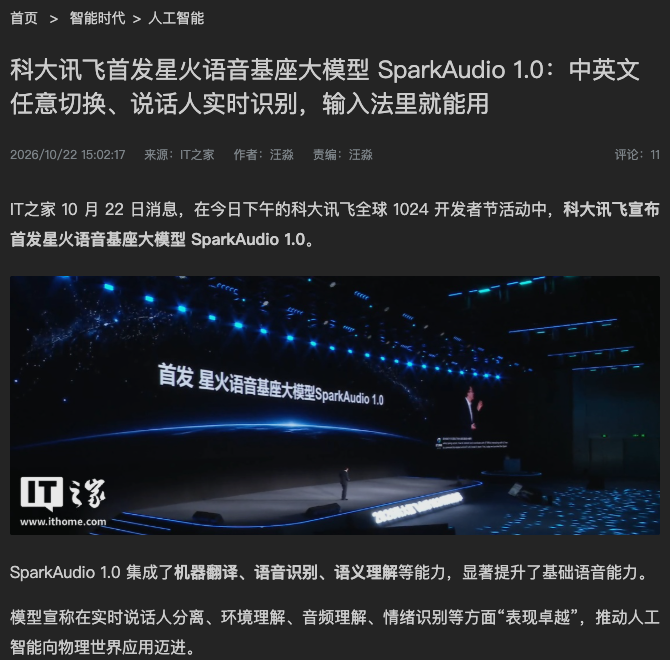
iFlytek announced SparkAudio 1.0 on 22 October to interpret speech, speakers, emotions and surrounding sounds together.
The company says the model combines speech recognition, translation and voice interaction with real-time speaker separation and environmental-sound understanding.
→ It aims to retain information that can be lost when audio is reduced to text
→ Reported product integrations include iFlytek Input Method 16.0 and Tingjian
→ Rollout varies by device, with Phoenix reporting an X5/Air3 notebook update planned for 24 October
Separately, Spark-X2.6-4B is a general-purpose language model whose repository lists a 21 October online release. It retains Spark-X2.5-4B’s million-token context architecture, with improvements from post-training.
https://t.co/cIRCej2rV3
https://t.co/o7X4c029Qi
https://t.co/jWsTHhli3I
⚡ New release on AI for science
Ai2 releases OlmoEarth v1.3 with ready-to-use satellite features at 10-meter resolution and a browser tool for mapping crops, land cover and landscape changes.
The model compresses a year of radar and multispectral imagery into 128 numbers per pixel. Users can reuse those features instead of rerunning the satellite model for each task.
→ The public Explorer supports similarity search, labeled examples and map exports without an account or ML GPU setup
→ Annual embeddings cover land and adjacent coastal waters globally for 2023–2025, excluding Antarctica; 2017–2022 cover selected countries
→ Model weights, pretraining data and code are publicly available
The OlmoEarth Artifact License restricts military, surveillance/policing and extractive uses. The Explorer also requires acceptance of its terms.
https://t.co/VnG3D5CkX8
⚡ Agent standards update
@AnthropicAI is donating Agent Skills to the Linux Foundation’s Agentic AI Foundation, giving the cross-platform standard a vendor-neutral home.
A skill packages task instructions, scripts and reference files so agents can reuse a workflow.
→ The donation includes the Agent Skills name, logo, GitHub organization and https://t.co/hAONRWx3db domain
→ Engineers from Anthropic, Google, OpenAI and other companies will maintain the standard as individuals
→ Anyone can use or contribute to it without joining the foundation
Anthropic reports more than 70 platform integrations, 1 million published skills and nearly 280 million installs.
Versioned releases, a formal proposal process and security guidance are proposed next steps.
https://t.co/SZLkQfCMBy
⚡ New release from OpenAI
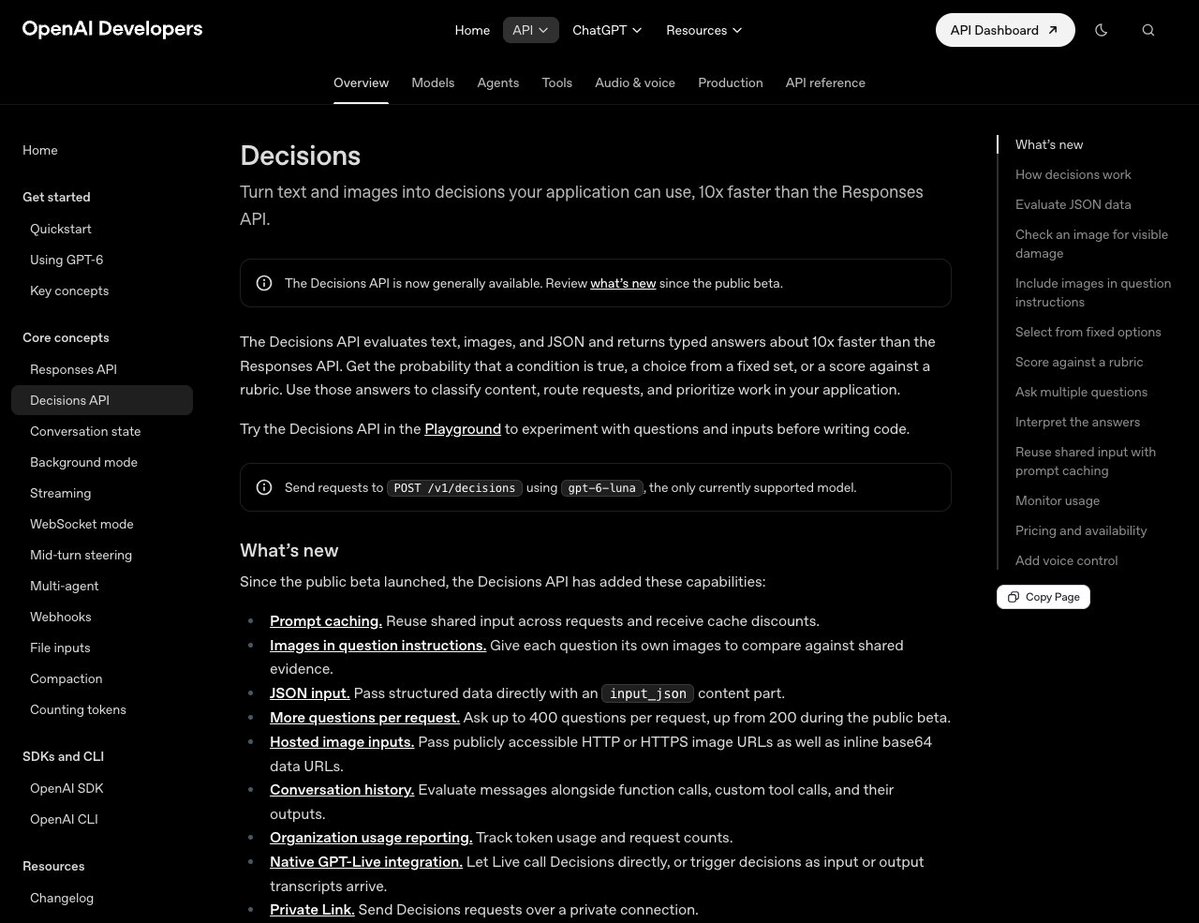
@OpenAI’s Decisions API is now generally available for classifying inputs, routing requests and choosing an agent’s next step.
Developers define a question and its allowed answers. GPT-6 Luna returns a probability, a predefined choice or a score from text, images or JSON.
→ Up to 400 questions per request, double the public-beta limit
→ Prompt caching reuses shared context across requests
→ Native GPT-Live integration supports decisions during voice conversations
→ Base uncached pricing is $0.10 per million input tokens, with no output-token charges
OpenAI claims answers up to 10× faster than Luna through the Responses API for these bounded questions. Cache writes, regional processing and long-context pricing can change the bill.
https://t.co/4xOTvB8TwC
🔎 Paper deep dive on chips & compute
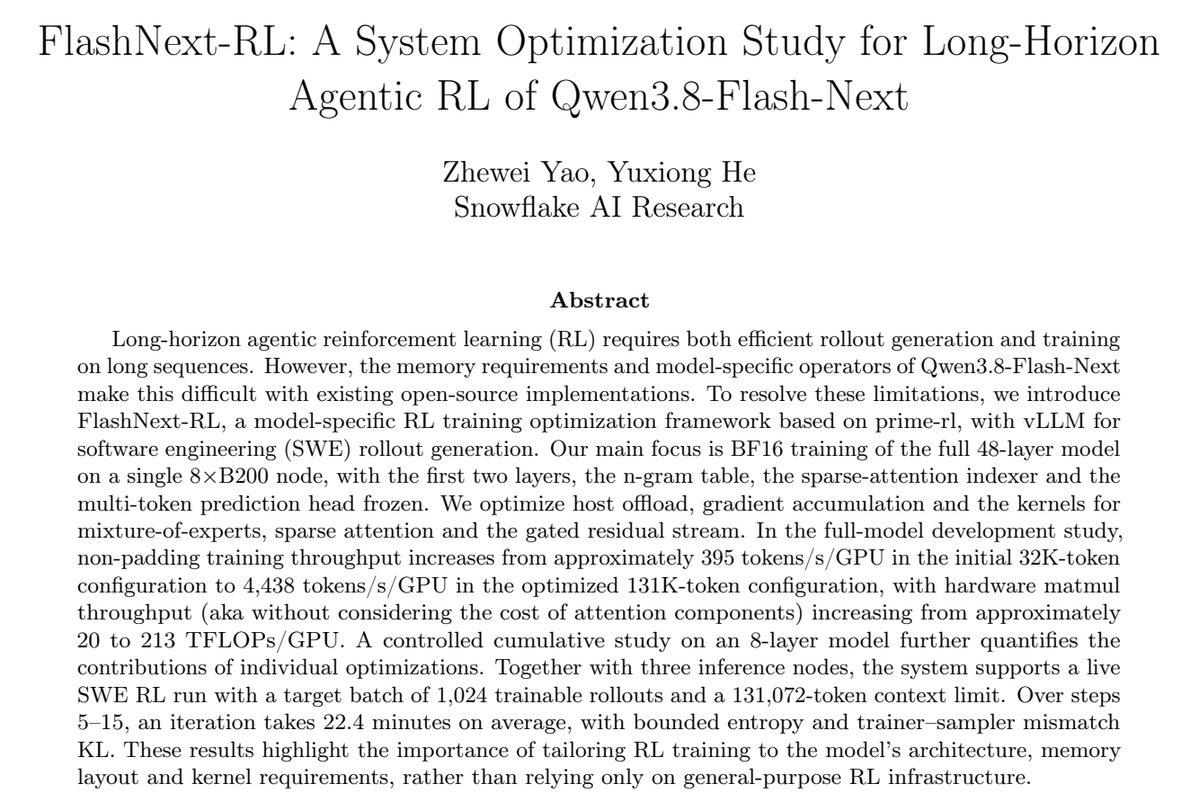
Snowflake AI Research’s Zhewei Yao and Yuxiong He report FlashNext-RL, a system for training Qwen3.8-Flash-Next on long coding-agent tasks.
Both previously worked on Microsoft’s DeepSpeed training system. He co-founded and led DeepSpeed, while Yao is the first-listed author of DeepSpeed-Chat, its reinforcement-learning training system.
FlashNext-RL reduces repeated CPU–GPU transfers and uses specialized GPU kernels to keep training moving within tight memory limits.
→ A controlled eight-layer study reports 7.4× higher training throughput, from 2,391 to 17,678 non-padding tokens/s/GPU on the same batches
→ The full 48-layer trainer reaches 4,438 non-padding tokens/s/GPU on one eight-B200 node, with some model components frozen
→ The complete coding-agent RL run uses 32 B200 GPUs across one training node and three inference nodes, averaging 22.4 minutes per iteration over steps 5–15
The study measures system performance over a short run, without establishing better coding accuracy or long-run convergence.
https://t.co/PmuN01RjN5
🇨🇳 China policy update
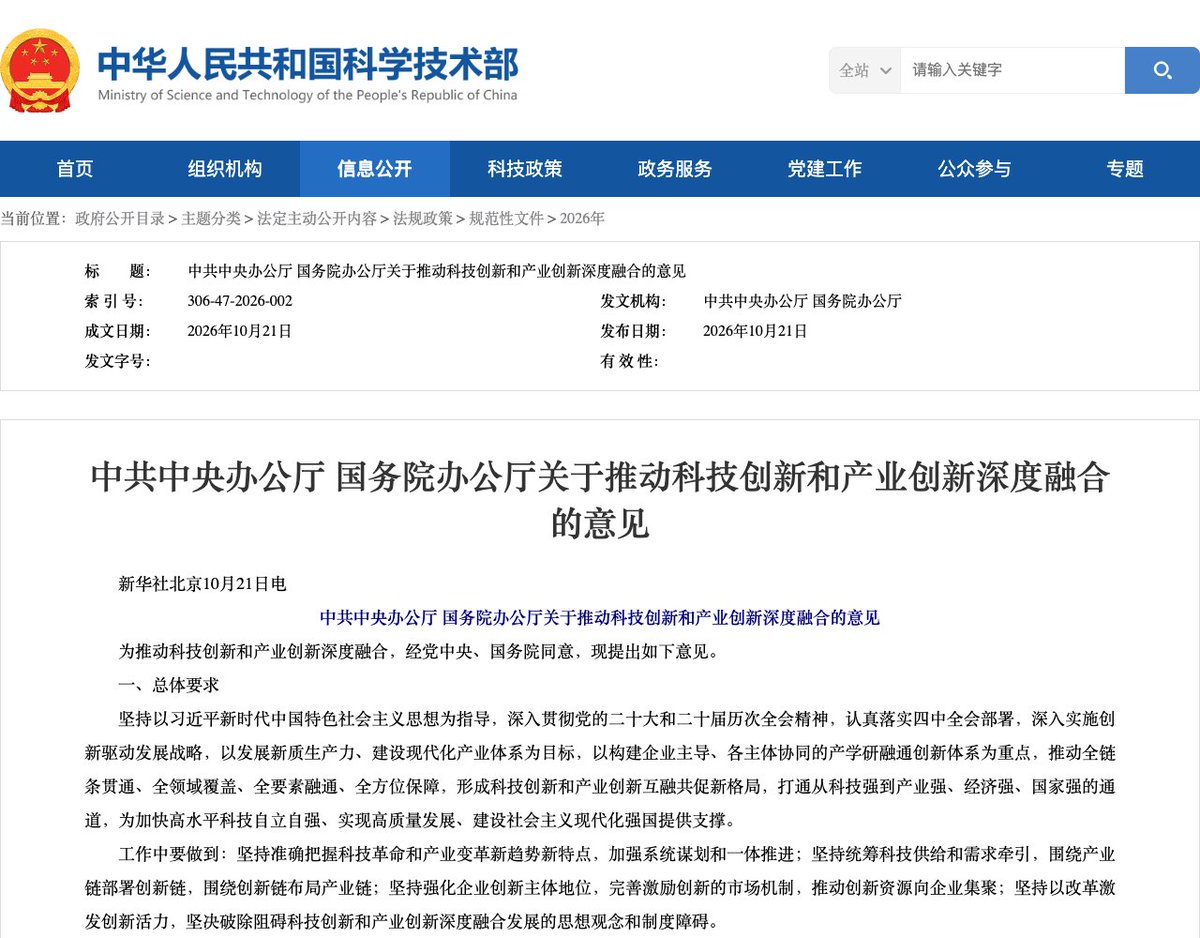
China wants companies to lead national research projects with clear industrial applications and take charge of turning the results into products.
Guidance issued on 21 October by the CPC Central Committee and State Council general offices makes this the default “in principle.” It also calls for full implementation of China’s existing “AI+” initiative across industries.
→ Funding reforms include milestone reviews and staged payments, with technology judged by applications and products by the market
→ Universities and research institutes are encouraged to license their results to smaller businesses on a “use first, pay later” basis
→ Embodied AI, brain-computer interfaces and 6G are named priorities for commercialization
→ State-owned firms are encouraged to establish separate R&D reserves exempt from requirements to preserve and grow state assets
→ Regulators are asked to explore “regulatory sandboxes,” allowing new technologies to be tested under supervision
https://t.co/CAzEuan9F2
🔎 Paper deep dive on LLMs
Researchers from KAIST, Amazon, UC Berkeley and Carnegie Mellon report 2.54× average text-generation throughput with Lafa 7B across three benchmarks.
The comparison uses an autoregressive baseline fine-tuned from Qwen2.5-7B-Instruct, with standard Hugging Face generation.
Lafa drafts several tokens in parallel, then checks them left to right within the same model.
→ Tested on one H100 GPU, with one request at a time and greedy decoding
→ Comparable average accuracy on instruction following (IFEval), maths (GSM8K) and coding (HumanEval)
→ Adapts pretrained Qwen checkpoints with fewer than 30B additional training tokens per model
The 2.54× result uses a model trained for 16-token blocks. Released checkpoints use four-token blocks, where Lafa 7B achieves about 2× throughput in the paper.
Code and 0.5B, 7B and 8B weights are available.
https://t.co/MNTRD4q42z
https://t.co/edsVbWeth3
🚨 Breaking security update
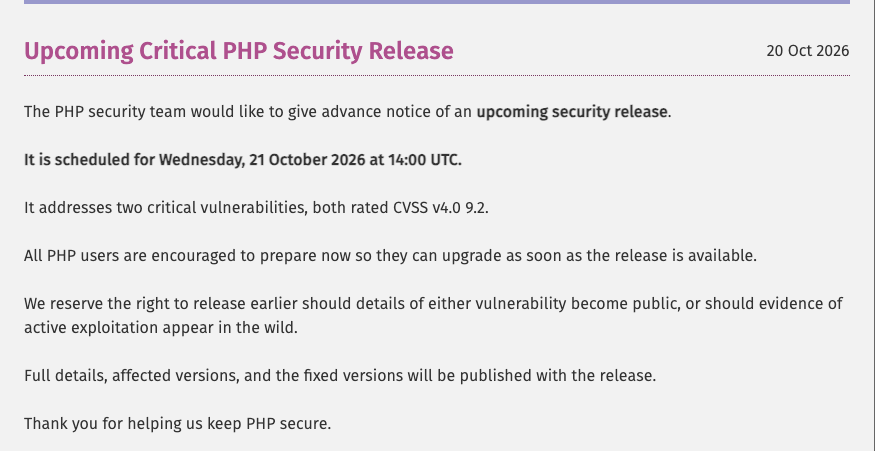
Cloudflare reports early attacks targeting two critical PHP vulnerabilities, with emergency patches scheduled for 10pm SGT today, 21 October (14:00 UTC).
PHP rates both vulnerabilities 9.2/10. Security researchers identify them as CVE-2026-109618 and CVE-2026-109619 and report that they can let attackers run code on affected servers.
→ Cloudflare has deployed temporary firewall protection, including on its free plan. Its CTO explicitly calls this a stopgap, not a replacement for patching
→ PHP has not yet published the exact affected versions, fixed versions or full technical details
→ Operators should prepare to update as soon as fixes arrive. Aikido advises taking internet-facing PHP applications offline where possible while waiting
https://t.co/eWndjt7ndG
https://t.co/lZ5xQtYvJN
PHP sites behind Cloudflare already have an initial set of WAF rules deployed for the known exploit vectors in these vulnerabilities. The rules are available to all customers, including free.
We are seeing early attacks emerging and are updating mitigations as new vectors show up.
This is a STOPGAP only. Patch as soon as @ThePHPF releases the update at 14:00 UTC today.
🔎 Meta’s production AI agents
Meta says its specialist-agent system cuts configuration prep for a new data column to under an hour, from three to four days by hand and about a day with its earlier config-driven system.
The work spans three code repositories, three languages and up to six pipeline stages.
→ A 1,300-line router sequences 20+ workflows across 14 specialist agents
→ Fixed rules handle routing, required fields and reliability checks; isolated specialists do the domain reasoning
→ About two-thirds of the system’s changes land without significant human edits
https://t.co/EsjyjLMb30
⚡ Cloudflare’s extraction model
@Cloudflare has previewed Clairic, which returns values such as invoice totals and dates without generating a text response.
It accepts text and up to four images, with confidence scores for extracted values.
→ Extracted text includes source offsets so an application can trace it back to the input
→ In Cloudflare’s small damaged-product email demo, Clairic + Clef + GLM-5.3 took 19.3 seconds versus 61.7 for GLM-5.3 at every step, at 49% lower cost
→ Workers AI pricing is $0.10 per million input tokens, with no output-token charge
Long calculation chains remain difficult. Open weights are planned; the hosted model is in preview.
https://t.co/faNijU8Tih
Introducing Clairic, from Cloudflare. A System One extraction modeI, capable of extracting, computing, estimating, and forecasting data from unstructured inputs. https://t.co/6YmT4O0er4
⚡ Native PyTorch on Trainium
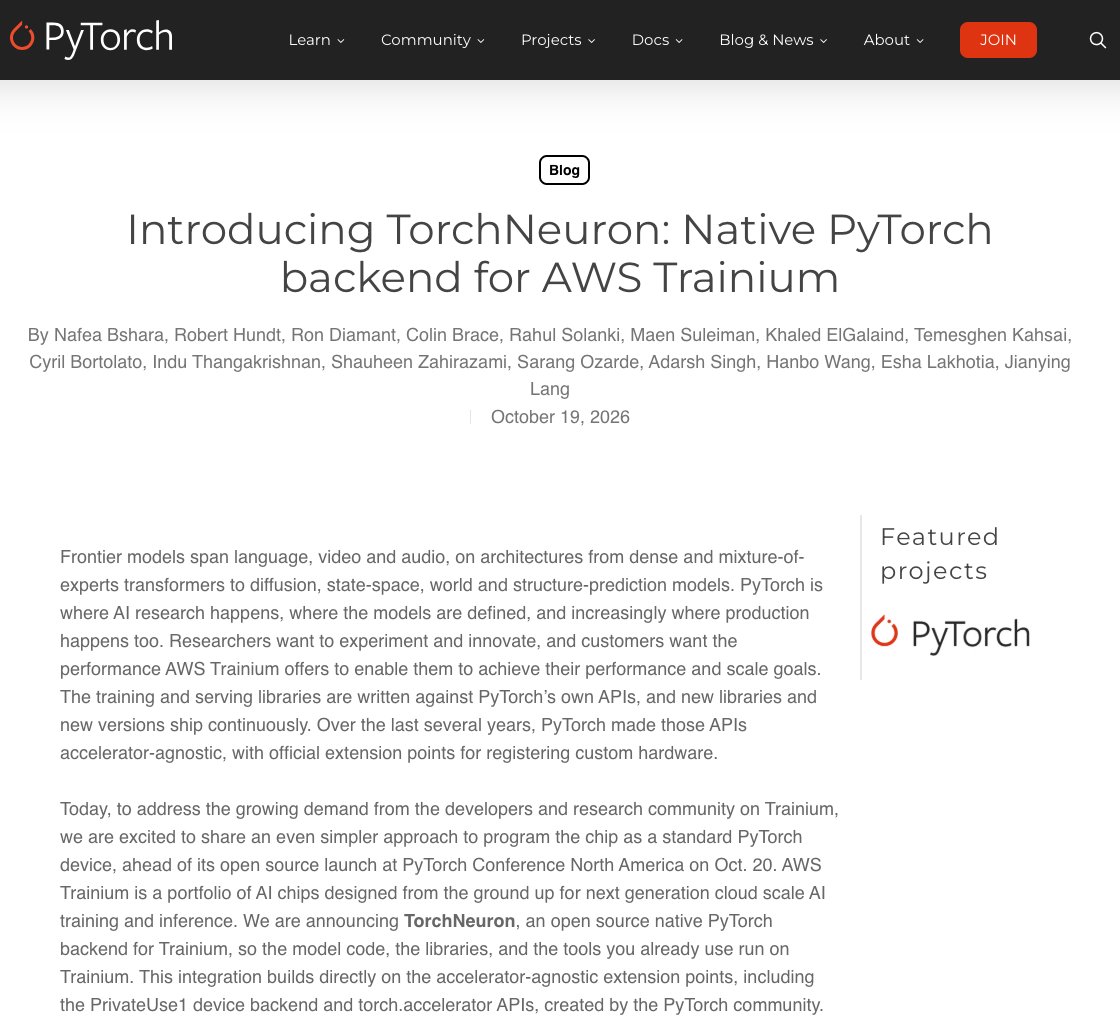
@awscloud’s TorchNeuron lets PyTorch models run on Trainium2 and Trainium3 through a native device backend. The Apache 2.0 beta code is public.
→ Move models and inputs to the 'neuron' device, with eager execution for debugging and torch.compile for optimized graphs
→ Deepgram reports about 60% more input audio seconds per dollar than its existing GPU baselines in its evaluated benchmarks
→ The current beta requires static shapes for torch.compile and does not include TorchAO integration
https://t.co/H86yPcTqb2
Code https://t.co/CxAxfPCyJc
More hardware choice for PyTorch developers: TorchNeuron registers @awscloud Trainium as a native device, built on the same extension points the community created to make PyTorch hardware-agnostic.
Open sourcing at PyTorch Conference on Oct. 20. https://t.co/HpO5M0cUAY
🔎 Kimi K3 serving optimization
@nvidia’s merged vLLM patch cuts Kimi K3’s token-generation step from 7.38 ms to 3.90 ms in its reported 16-GB300 test, a 1.89× speedup.
NVIDIA engineer Benjamin Chislett built the specialized decoding path with CuTe DSL. It combines work across model operations to reduce GPU-launch overhead.
→ The result above uses one active request, a one-token input and 1,024 generated tokens, without speculative decoding
→ The implementation supports eight or 16 GB300 GPUs and is opt-in
→ Prompt processing, mixed batches and larger unsupported batches fall back to the standard path
→ The model weights stay unchanged
The benchmark measures the token-generation phase, excluding prompt processing. Gains vary with context length and serving load. The PR was merged on October 16.
https://t.co/2SLkNMwT4f