The canal belongs to everyone. The factory does not.
In AI, we give the deterministic memory substrate away. But what leaves our factory carries a covenant.
Episode 7 of Nothing New Under the Sun: Etruria. 🔗 https://t.co/c3jSIrNh1A
Watermarks prove origin. They do not prove truth.
Semantic entropy and polite hedging are still sampling tricks. Stanford’s 2026 Index still shows hallucination rates from 22% to 94% across frontier models.
The AI industry’s regulatory problem is not “too many rules.” It is that we still cannot measure when a system does not know.🧵
Why do AI agents degrade after 10 turns?
Softmax attention dilution. The KV cache fills with old turns until reasoning drifts.
Calera ICX fixes context rot:
🧠 4D geometric lattice memory
⚡ Sub-5ms O(1) recall on demand
🎯 Zero hallucination drift
Can your LLM topologically play DOOM?
I released a paper today describing another feature of a deterministic SUBSTRATE. Cognitive Integrity.
Cognitive Integrity -- the reason I keep saying "It is substrate season."
If you cannot compute and recall facts from a grounded point of truth, and verify those facts deterministically, you are building a dream machine and not a real world tool.
You need a memory substrate that can play DOOM topologically and understands physically when it runs out of ammo.
My DMs are open.
🔗 Read the full preprint on Zenodo: https://t.co/U5PuCyMoXf
Try Topological Gaming!
💻 Run the zero-dependency Python replication suite (S=10 seeds, N=3,000 queries): https://t.co/K27UeturxJ
How does an AI system know when its memory is broken?
Over the past year, frontier AI labs have tried to solve the hallucination crisis through statistical metacognition: sampling 10+ completions to compute Semantic Entropy, training Process Reward Models (PRMs), or fine-tuning models to articulate polite verbal hedges ("it is likely that...").
While impressive, these approaches share three fundamental limits:
1. Multi-sampling multiplies inference compute by 10x.
2. Self-prompting creates closed statistical feedback loops.
3. Polite hedging is not deterministic mathematical refusal.
But Bro!? Can it play DOOM?
Yes... yes it can:
🕹️ Real-Time Telemetry: Topological DOOM
To prove that discrete exterior calculus is an operational runtime engine rather than an offline post-processor, we embedded the diagnostic pipeline into a live 60 FPS 3D raymarching engine (Topological DOOM HUD), streaming Hodge invariants and CIS live as dynamic state manifolds evolve.
Read the paper and run the open-source verification suite:
📄 Research Pre-Print: https://t.co/fMQ9nGvt88
💻 Open-Source Python & Go Replication Suite: https://t.co/hcAQ8FKbFD
Author: Casey Lee Race (ORCID: 0009-0006-5237-1112)
Calera Computing, Inc. · Calera Labs Research Division
Today, Calera Computing Research is releasing our latest technical report:
"The Lattice Octave: A Characteristic-Delay Model and Growth-Rate Partition on Simplicial Lattices."
For centuries, specific algebraic numbers have appeared as isolated curiosities across geometry:
• In 2D: The Golden Ratio φ ≈ 1.61803 (x² = x + 1) dictates self-similar triangular division.
• In 3D: The Plastic Constant ρ ≈ 1.32472 (x³ = x + 1) dictates 3D spatial packing (Van der Laan, 1960).
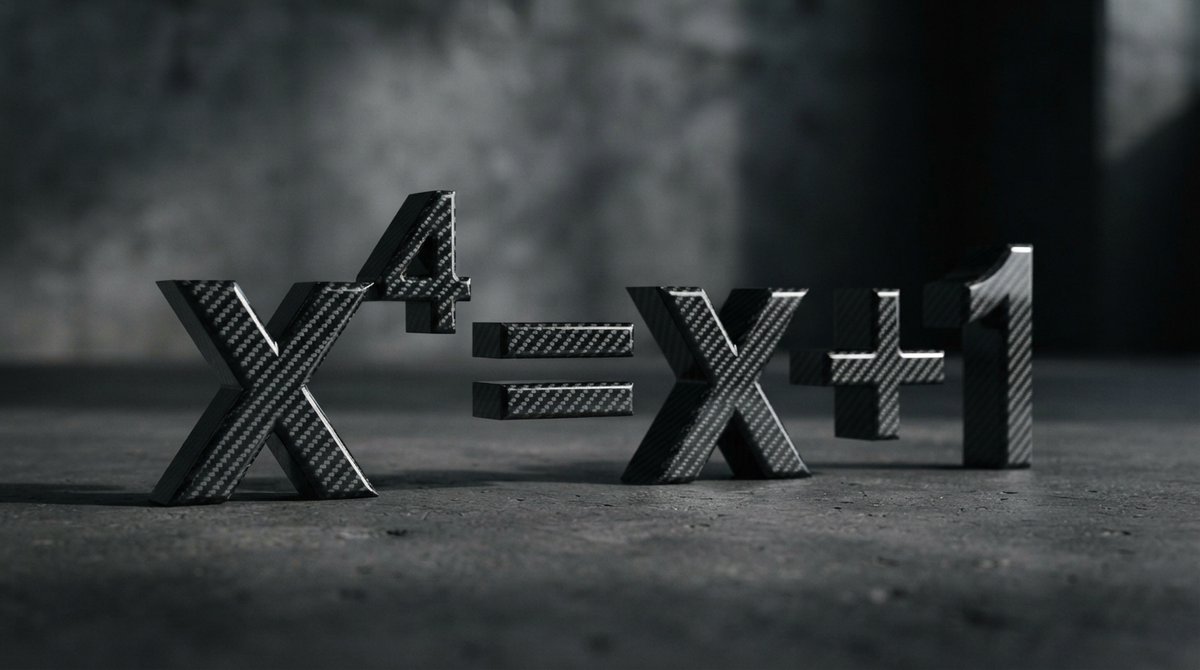
• In 4D: The Quartic Constant σ ≈ 1.22074 (x⁴ = x + 1) governs energy decay and topological boundary nilpotency (∂² = 0) on the A₄ root lattice.
Are these numbers mere coincidences in low dimensions, or evaluations of a universal geometric law?
In this paper, we formulate and prove the Face-Poset Delay Decomposition Theorem across the algebraic polynomial family:
x^d = x + 1, for all d ≥ 2
Key Findings:
1. Exact Combinatorial Channel Partition: The face-poset topology of a regular d-simplex strictly partitions proper transit paths into exactly two maximal channels:
— A boundary facet channel with characteristic delay τ = d - 1 hops
— A bulk interior channel with characteristic delay τ = d hops
2. The Growth-Rate Partition Identity: Under the dominant characteristic-delay model, the unique positive real root c_d balances boundary and bulk energy transport via:
c_d^{-(d-1)} + c_d^{-d} = 1
3. Cross-Lattice Heat-Kernel Convergence: Continuous-time diffusion simulations across simplicial (A_d), hypercubic (Z^d), and checkerboard (D_d) lattices converge on this threshold within <1% for d ≥ 3.
We believe that building next-generation AI and cognitive computing requires moving beyond empirical black boxes and returning to foundational discrete geometry and invariant mathematics.
500 on live checkout. 😱
3 collaborative Gemini agents on ICX:
detect → secure → hot-patch in Vₜ → verify in 0.45 µs.
Shopper checks out. No refresh. No drama. 🛒✨
Gemini Flash is a strong reasoner. It is a terrible warehouse.
ICX is the warehouse: ingest once into 4D lattice memory, then hand the model a grounded viewport instead of 100k tokens of haystack.
Your model. Persistent memory. No rot on the desk.