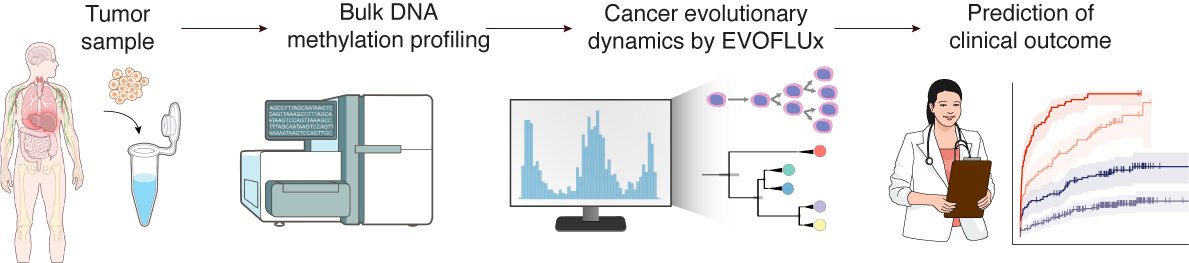
Cancer is an evolutionary disease, but does knowing a cancer’s evolutionary past help predict its future? Out today in @Nature, we learnt the evolution of 2000 lymphoid cancers and found it was highly correlated with clinical outcomes! (1/7, link below)
How do cancers emerge from healthy tissue? In @Nature today: leukaemia evolving in yearly blood samples up to 15 yrs before AML. First driver by age 20; each new driver multiplies growth 2–3×. A remarkably simple set of mathematical rules recapitulate it.
https://t.co/S0GVv97hyE
How long after a mutation does it take for a cell to progress to cancer? In Barrett’s oesophagus, we found that CNAs occurred decades prior to cancer diagnosis, and that their rate is more prognostic than CNA burden alone https://t.co/XJUjlx9Vh5 (1/6)
@woongworks We tend to underestimate the number of non-amplified mutations more than overestimate. So on average, we time CNAs in low purity samples earlier than they really were. In this cohort though, I manually QCd every fit and removed samples where this was a potential problem.
@woongworks CNA detection is pretty sensitive to low purity. The difficulty with samples where purity ≲50% is that it becomes tricky to distinguish non-amlified clonal mutations from neutral subclonal ones. This ends up increasing the error on the CNA timing and therefore rate.
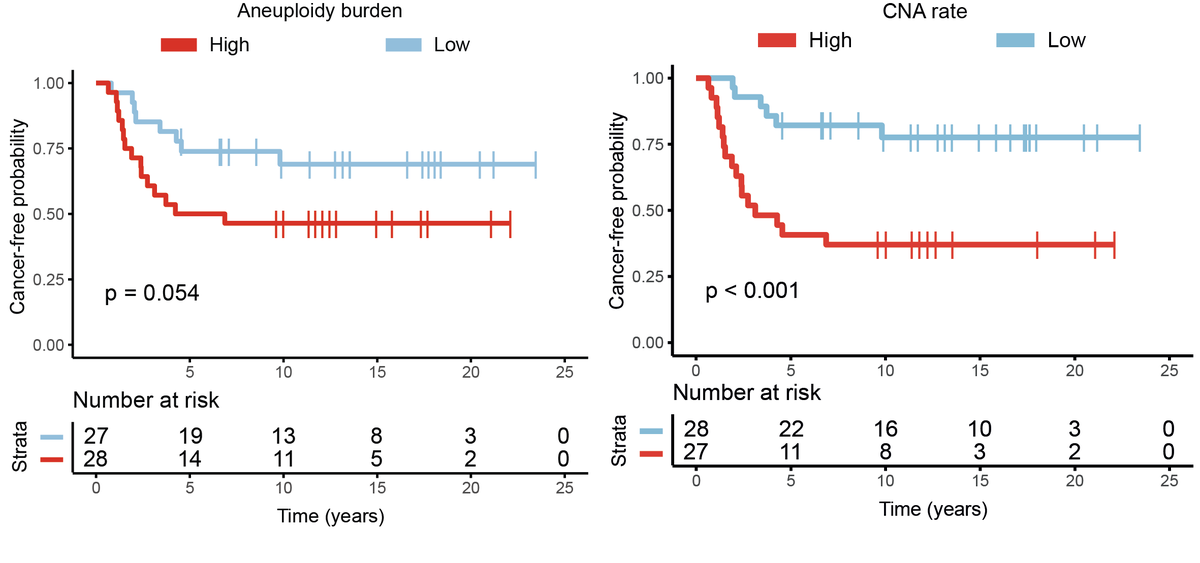
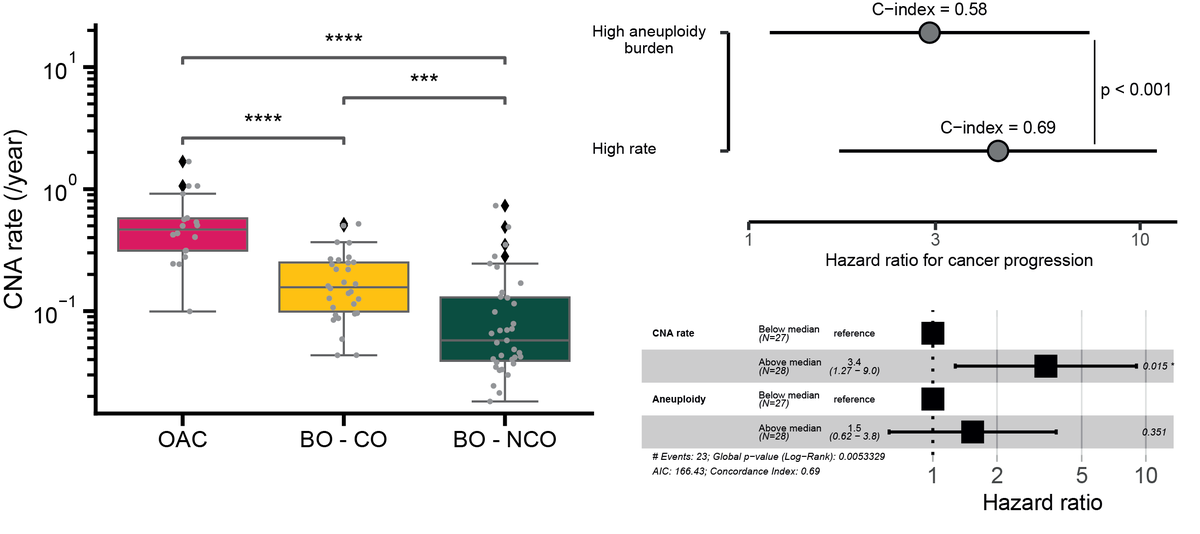
In non-WGD samples, we found that there was a marked increase in CNA rate in both OAC and BO samples who would progress compared to non-progressors. Remarkably, the CNA rate was much better at identifying progressors than CNA burden (5/6)
In non-WGD samples, we found that there was a marked increase in the CNA rate of both OAC and BO samples who would progress compared to non-progressors. Remarkably, the CNA rate was much better at identifying progressors than CNA burden (5/6)
Recently completed your MSc in Bioinformatics? Mathematics postgrad wishing to gain experience of medical research? Looking for a PhD in computational biology? Consider applying for the fully funded position with me at @UniofReading:
https://t.co/P8V9aN8CM8
How do epithelial stem cells in our intestine evolve over our lifetime?
In our new pre-print, @PBousquets and team used fluctuating methylation barcodes to find out!
PHYFUM is therefore a low-cost method to uncover evolution of healthy glandular tissues, and we hope to use the method to develop evolutionary biomarkers of neoplastic progression.