[post] "Network ecology is dead, long live to network ecology!" My comment on the recent provocative article by Carsten Dormann: “The rise, and possible fall, of network ecology”. https://t.co/tbZAKks0In
Diurnal & nocturnal interactions are organized into interconnected modules in the multilayer network. Nocturnal plants were comparatively more important than diurnal plants, due to their role in connecting the 2 temporal layers @CamilaSouzaBot https://t.co/E2xYeFwZjD
Sex-biased parasitism, host mass and mutualistic bat flies: an antagonistic individual-based network of bat-bat fly interactions https://t.co/ngk6AzuYXo @IJPara
*** 🐝finally out 🐝 ***
If you want to find out how #conservation measures and reinforcement of #plants and #pollinators increase flower visitation affecting the #network structure, read our paper here ➡️
https://t.co/BbPXFQiD8u
"Plant‐centred sampling estimates higher beta diversity of interactions than pollinator‐based sampling across habitats". Check it out in @NewPhyt. Congrats to @CamilaSouzaBot for leading this beautiful and important contribution to our field!!
https://t.co/ApUpksSSc1
"Our study is the first to provide a quantitative description of seasonal changes in the metrics of plant-pollinator interaction networks in tropical areas..."
Camila Souza and Pietro Maruyama tell us more about their recent @JEcology paper on the blog.
https://t.co/phO7G7NE6z
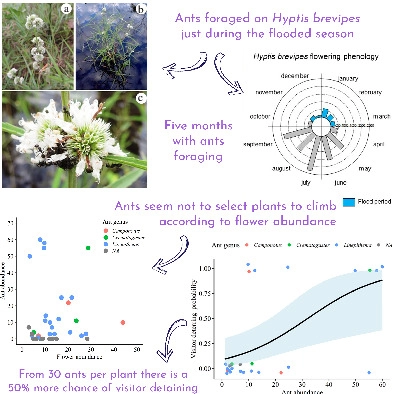
and if the Hymenoptertists were feeling left out @Ecol_Ent caters for them too Ants climb plants because they cannot swim: ant presence on flowers during the flood season reduces the frequency of floral visitors https://t.co/Ad05cxvbnI