Homeowner, Investor, Educator, Believer of market cycles.
Need advice on your home buying process? Feel free to DM me.
Get my free Cdn home buying checklist 👇
Ottawa RE market is seeing very little activity and seeing inventory boom, its only a matter of time until we start seeing real price action...
#ONRE#OttawaRE
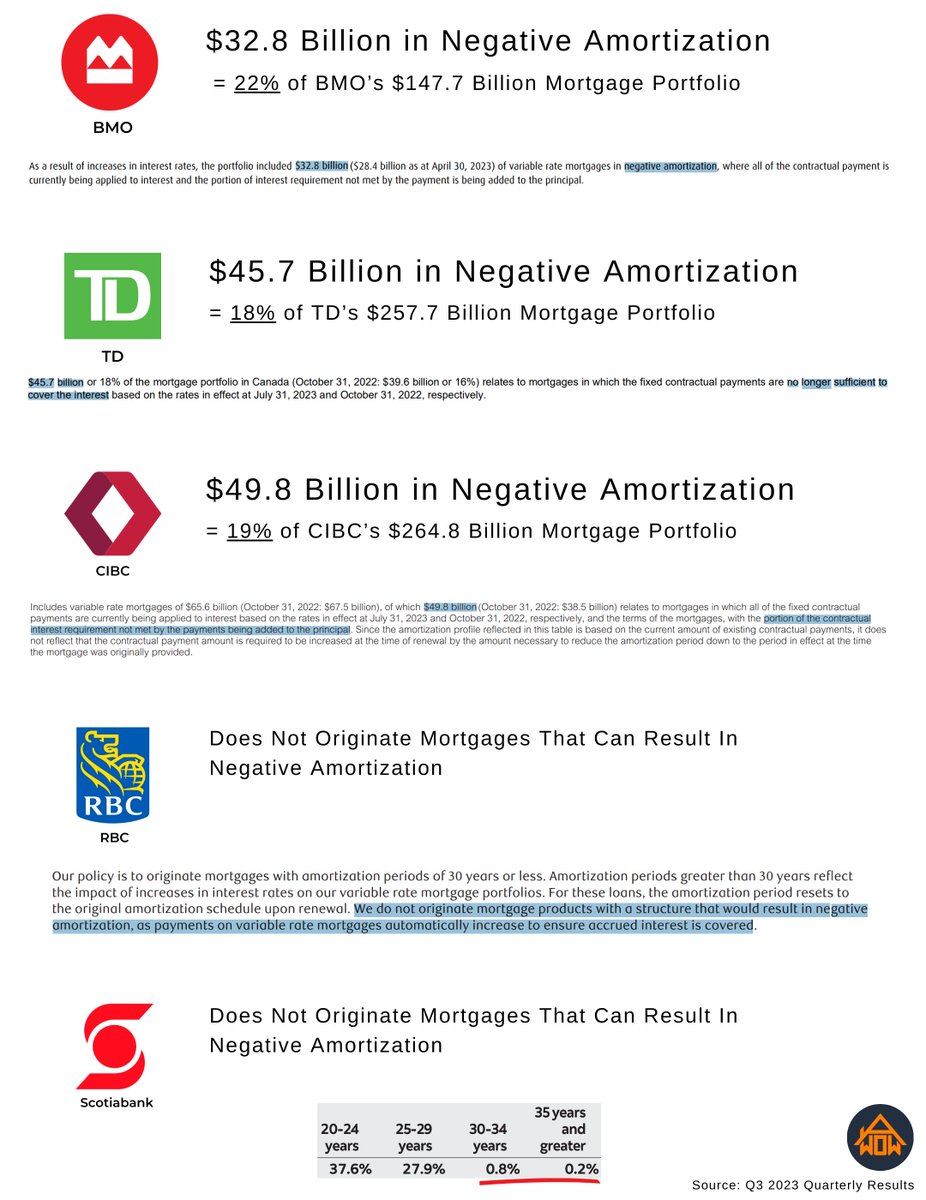
Negative amortization stats from banks' Q3 2023 reports, where mortgage payments < interest:
BMO: $32.2 B; 22% Total Mortgage Portfolio
(up from $28.4 B in Q2 2023)
TD: $45.7 B; 18%
(up from $39.6 B in Q4 2022)
CIBC: $49.8 B; 19%
(up from $44.2 B in Q2 2023)
RBC & Scotia≈0
I second this opinion, a good realtor can prevent you from hitting many mines in your home buying journey but unfortunately they are tough to come by on this sales oriented business...
I personally know realtors who are MASTERS in their field...
They could guide you through foreign ownership tax implications, contract law, municipal bylaws, condo status packages and rules, zoning regs, right-of-way obligations, land surveys..... and all of the other landmines....
all the while being expert negotiators / strategists....
I know other realtors who cant upload a photo properly to MLS.
They charge the same fee.
Caveat emptor.
MORE ADVANCED REAL-ESTATE STUFF:
In theory, real-estate prices should trade in a manner that is 100% correlated to bonds...and be easy to calculate!
The price should be the "discounted value of all future potential rental cashflows"
(yes, this even applies to a principal residence because you are an equity owner who is forfeiting market rent)
Since there is no end to rental payments (cashflows).... we would call this a perpetuity. (like a pension)
Real-estate can be perpetuity because land doesn't depreciate or disappear.
Since rent increases every year, we would then call this a growing perpetuity.
Luckily, the formula for a growing perpetuity is one of the easiest in all of finance!
PV = P / (r - g)
4 numbers, thats!
PV = Present Value
P = cashflow received
r = Discount Rate / 100
g = Payment Growth Rate / 100
The discount rate (the amount of profit you demand to do the deal) in the formula could be the 10 year bond yield + risk premium AFTER COSTS. (this is called the cap rate)
So...lets try it!
Lets assume:
the rental growth rate (g) = 2.5% per year
and, you demand a 4% risk premium vs bonds for the hassle of dealing with tenants.
And lets use a home which CASHFLOWS $12,000 per year after costs, as our example.
(we ignore mortgages because this is a totally separate deal which you MAY have with a bank. Some investors dont have this cost, so its not a REAL expense)
Home price in 2021 with 0.5% 10 year bond yields:
Our demanded return is now 4.5%/yr or we would just buy bonds.... so:
PV = $12,000/yr / (4.5% - 2.5%)
PV = $600,000
Your home is worth 600k!
Home price in 2023 at 4.2% 10 year bond yields:
PV = $12,000/yr / (8.2% - 2.5%)
PV = $210,526.32
YOUR HOME PRICE GOT CHOPPED BY 66%
...when bond rates rose from 0.5% to 4.2% because the asset you own STILL cashflows the SAME AMOUNT as before...
but the market can get what you're cashflowing by putting out 66% LESS money than would have been required in 2021.
In reality, real-estate is more complicated because emotion gets involved.
But in business, its just 4 numbers!
🧂
Once again, decided to compare September GTA detached median prices to the approximate point in time prior to when we saw a sentiment change (BoC rate hike in June). Beginning to see a lot of the bigger markets with double digit declines: Toronto, Richmond Hill, Peel (1/n)
Seeing so many new listings hit the market, its only a matter of time that price reductions start gaining steam...the market has to balance supply with demand as there isn't much demand at current prices...
#ONRE#TORE#OttawaRE