Jessica Zucman-Rossi, Alice Kamphorst, Matthias Heikenwälder, and Fasiha Kanwal will discuss "Molecular Pathogenesis and Risk Factors For HCC" in a plenary at #AACRliver26 (December 6-8; Austin).
https://t.co/mZssGVOzK2
@Zucmanrossi@KamphorstAlice@CancerInflam@KanwalFasiha
It was a plasure and honor to write this review with Suchira Gallage, Olivier Govaere, Quentin Anstee, Gerald Shulman and Frank Tacke. We start to understand more and more about the most prevalent liver disease - still much to be learned-on pathogenesis, prevention and therapy.
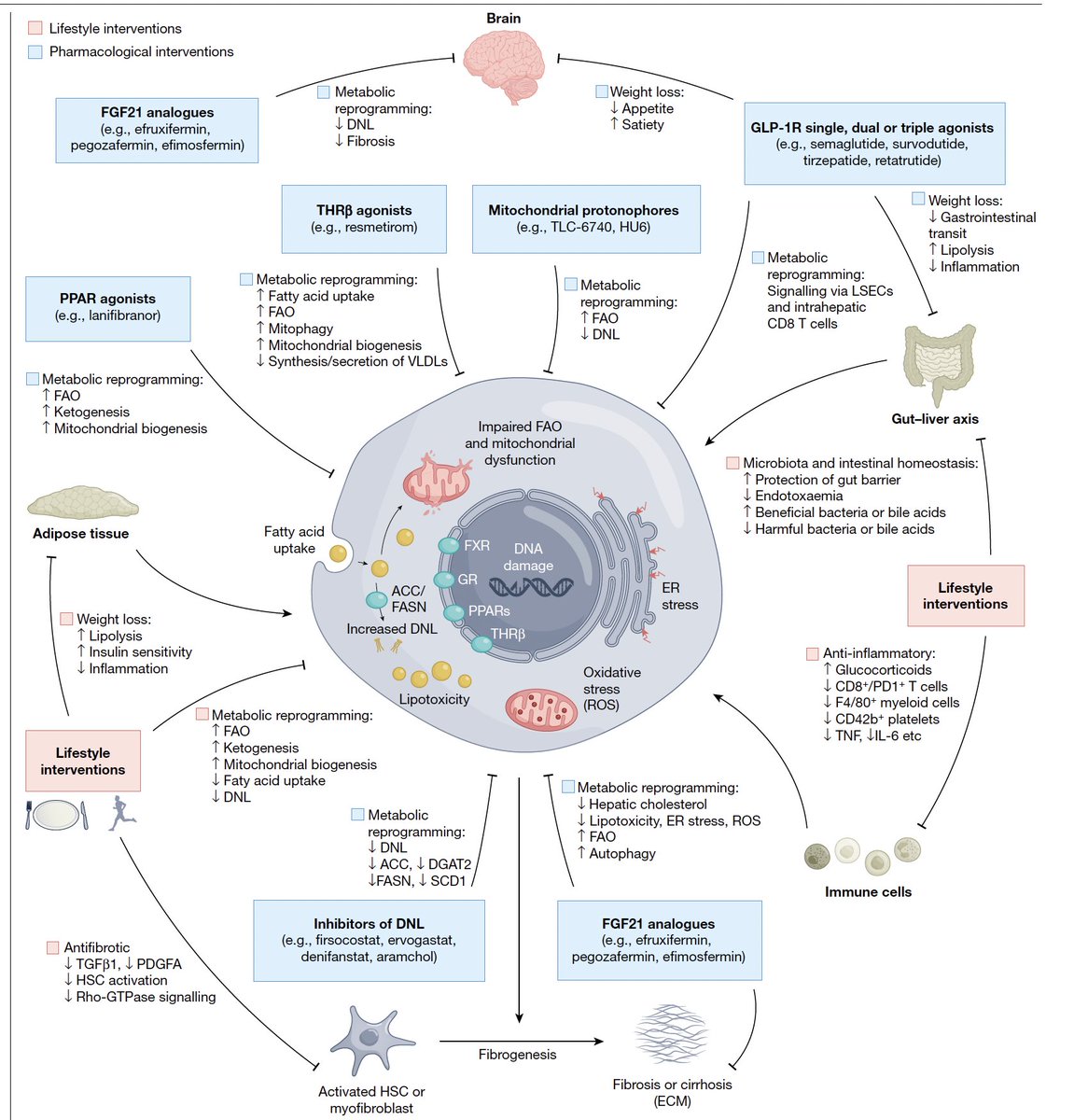
A state-of-the science 5 ★ review of MASH (fatty liver with inflammation, nonalcoholic). Awareness of this important, highly prevalent, often undiagnosed condition has increased in recent years, and now the interventions to go after it have blossomed (Figure)
@Nature@CancerInflam@GallageSuchira
https://t.co/zjECh6YSYJ
Congratulations to Ki Hong Lee & Moritz Jakab for their landmark paper in @NatureComms showing that endothelial cell Wnt-mediated angiocrine signaling in the liver is controlled by hemodynamic forces and not by oxygen gradients. Stunningly beautiful work! https://t.co/CNlxahsFwT
Ready to lead your own research group? 🔬
The science may be familiar but what about managing a team, securing funding, building a research programme and planning a sustainable career?🫣
The next episode of #TalkLiverToMe explores what research independence really looks like.
ℹ️https://t.co/jPQs44bqjB
@C_V_Schneider@CancerInflam@RautouE@Mandorf1@IsraelsenMads@ZanettoAlberto
#LiverX
Very proud to have written this EASL postion paper togehter with so many fantastic people - as well as to have done this #talklivertoME episode with Rui and Suchira - always a pleasure.
New episode of #TalkLivertoMe is now available! 🎙️
🐁Mice, organoids, precision-cut liver slices, human-based systems… which models best reflect human #SLD?
Or maybe the better question is:
Which model is best for the endpoint you’re investigating?🤔
Read the position papar and listen below.
📰https://t.co/HLLKEnbHqN
📺https://t.co/dg5P7jGqr3
🎙️https://t.co/OzcXmlkfaX
🎙️https://t.co/JyviK8IDJR
@JHepatology
#LiverX
🧫 New multisociety consensus on PSVD
🗣️ L. Elkrief | #EASLCongress
🔬 PSVD & NCPF now interchangeable
⚠️ Biopsy mandatory | can be diagnosed WITHOUT portal hypertension
💡 First globally endorsed framework (EASL/AASLD/APASL/ALEH)
🔗 https://t.co/aO1PaWIuN0
This will become extremely useful to the scientific community. What mouse model to use in order to mimic steatotic liver disease (SLD), which in vitro models, what to take care of, what to analyse - we have integrated recommendations and introduced the state of the art models.
Thank you to Suchira Gallage, Rui Castro, Jennifer Estall, Ira Tabas, Quentin Anstee, Dina Tiniakos Gyongyi Szabo, Jun Yu, Chantal Desdouets, Frank Tacke and, Fiona Oakley - it was more than a pleasure to work on this with you - @EASLnews@EASLedu@JHepatology
Early Sat am ☕️ at #EASL2026, but definitely worth waking up for exciting new data and discussions 💡 on “#MASLD-related #HCC: Pathogenesis, Immunology and Treatment” chaired by @CancerInflam and @MarcoSanduzzi
See you there!
@derekamann1@EASLnews
https://t.co/huK8r4GzBN
This will be an excellent scientific session at EASL 2026 congress on HCC in the background of metabolic liver disease. It’s an early morning session on 30th May but is going to be well worth the early morning wake up!
@EASLnews@CancerInflam@Valeriechew29
Diet in liver diseases: What should I tell my patients?
A focused discussion on prevention, treatment and the role of diet–microbiome interactions in liver disease.
Mathias Heikenwälder @CancerInflam & Gabriel Perlemuter
👉 Save your seat for #GMFH2026
https://t.co/ub2svgi8gg
Activated Gene Promotes Liver Cancer but Also Improves Immunotherapy Response
Study suggests that persistently activated ATF6α is a #tumordriver, a potential stratification marker for #immunotherapyresponse, and a therapeutic target for #HCC@CancerInflam
https://t.co/8Qnt2DeK3r
Researchers from DKFZ, University Hospital Tübingen & Sanford Burnham Prebys Medical Discovery Institute discovered that chronic cellular stress promotes liver cancer - but at the same time renders tumors vulnerable to immunotherapy. @Nature@CancerInflam
https://t.co/nSWbnYrw7z
In a state-of-the-art at #LiverCancerSummit 2026 Matthias Heikenwälder @CancerInflam outlined how chronic inflammation, metabolism and immune contexture converge to drive hepatocellular carcinoma, and how this biology can be therapeutically exploited.
▶️MASLD and MetALD are emerging as dominant future causes, adding to tumour heterogeneity
▶️Distinct molecular and immune subclasses of HCC shape prognosis and therapy response
▶️Drug repurposing, such as metformin combined with immunotherapy, shows promise in both experimental and patient data
▶️The future of HCC treatment lies in integrated molecular, pathological and clinical stratification
Liver cancer is caused by chronic inflammation, but it is the specific inflammatory and metabolic context that determines therapy response.