Full-time futures trader since Feb 2020. Self-funded. No prop firms.
Last year I stripped my account down to almost nothing — on purpose. I wanted to rebuild from scratch with one focus: master the mental game, nail my position sizing, and prove I could do it consistently.
14x account growth. 1,300% return.
995 trades. 57.8% win rate. $235K profit.
No secret indicator. No signal service. No guru system.
Just psychology, position sizing, and patience.
Before trading, I spent 20 years as a petroleum engineer. I have a lot to share — especially on the two things nobody wants to talk about: the mental side and how much you risk per trade.
More coming soon. Follow along.
@Tradewrite Yea - but. The only thing that makes this true is position sizing. High win rate = fewer consecutive losses = higher net size. Scale is instrument dependent and psychology is person dependent (so these 2 are not THE reason you are correct).
1/ I WONDERED WHAT HAPPENS IF YOU JUST BUY THE BEST PERFORMING STOCK FROM THE YEAR BEFORE AND DO IT EVERY SINGLE YEAR
SO I BACKTESTED IT GOING BACK 15 YEARS
STARTING WITH $100 IN 2012:
END RESULTS
S&P 500 → $800
LAST YEAR'S WINNER → $176,114
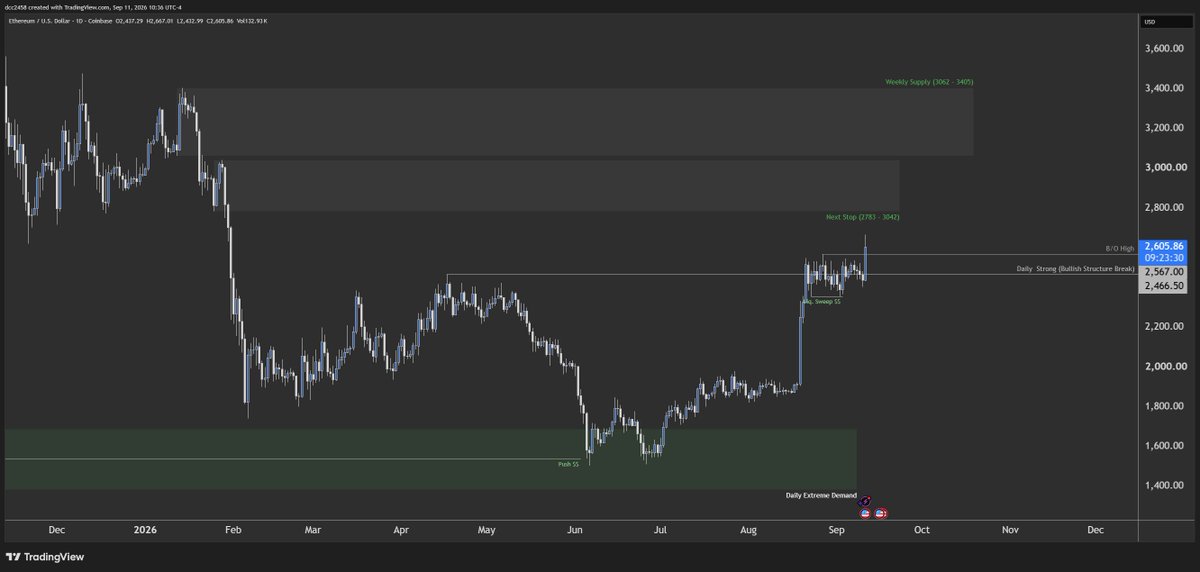
good follow - agree with overall thesis of ethereum:native. I have a target of $12,800 on this move. Normally, you want the opposing liquidity run to happen before the real move, not the other way around....anything can happen. hope he's wrong about this....i'd like to see this trade toward 2900 over next few days (or today). 20 days of incredibly strong price action is actually unusual - when price goes up and sticks - it goes much higher.
I think we will end up taking the resting liquidity on both sides of our $ETH range, but would prefer a scenario in which we take the upside liquidity first.
If that's to happen, ideally we hold our local demand in green.
those are not equal lows...sept 2 swept the aug 23 low. we do not want this move to fail. it's the other way around....we want the lows to sweep first...THEN the move higher. a sweep of the highs and fail at this point would mean we have a lot more retrace. at this point, this should gravitate to 2783 to 3042 area.
Today, we launched the world’s first automated production line for advanced general‑purpose humanoid robots, using robots to mass‑produce robots, autonomously.
This was uncharted territory, and we solved it from scratch. The commissioning of our production line means humanoid robots are now ready to scale up and step into the real world.
What touched my heartstrings most was watching our very first advanced general‑purpose humanoid robot complete assembly and walk off the line on its own. To me, this is not just about a smarter tool or a commodity. I hope it gains true generalization ability to take on dangerous, repetitive, or undesirable tasks, and ultimately make life better. Perhaps one day, robots may become our companions, friends, or part of family.
Grateful to every colleague on this momumental mission. And a warm welcome to IRON!
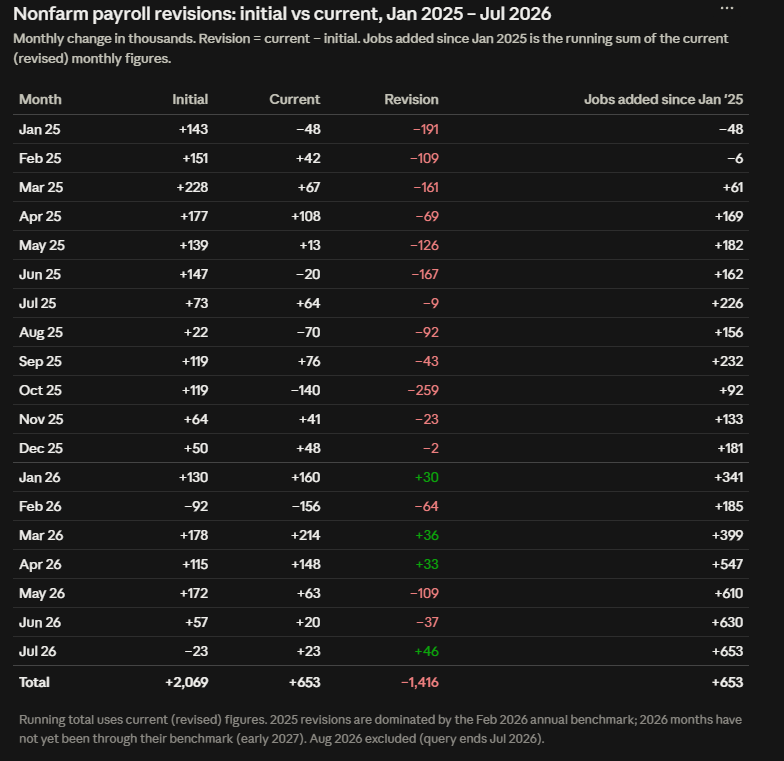
The jobs market was far weaker than anyone was told.
Revised BLS data, Jan 2025–Jul 2026:
The US added just +653K jobs total in 19 months — about 34K/month.
Initial prints claimed +2,069K (~109K/mo). Nearly 70% of reported job growth was revised away.
34K/mo is well below "breakeven" — the ~70–100K/mo needed just to hold unemployment steady.
And it masks two regimes: late 2025 nearly stalled (the running total went backward after October), while H1 2026 recovered to ~75K/mo.
The monthly headline you trade on has overstated hiring by ~3x. The revisions are where the real story lives.
I will bet anybody that the level of 163K jobs in August will be revised lower. Much lower! And we talk at the final revision.
It was a complete and utter BS print. The US is not even close to creating 163K jobs per month. The run-rate into March this year was 16K per month.
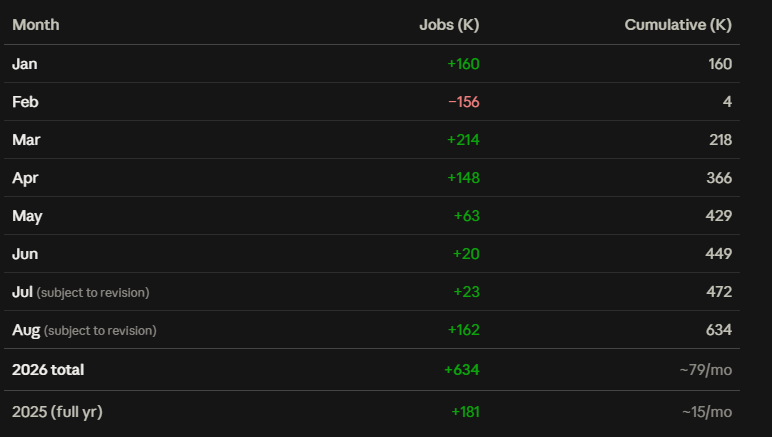
@HenrikZeberg genuine question. what job data is showing declines from 2025 to 2026? Job data is damn difficult. revisions or not...if the NFP data is garbage, then revisions don't mean much and therefore I do not understand why you would argue that revisions are coming...if you believe revision data....then...2026 is trending better than 2025.
@HenrikZeberg genuine question. what job data is showing declines from 2025 to 2026? Job data is damn difficult. revisions or not...if the NFP data is garbage, then revisions don't mean much and therefore I do not understand why you would argue that revisions are coming...if you believe revision data....then...2026 is trending better than 2025.
@HenrikZeberg NFP is probably garbage - but there is nothing in here that suggests we are having a job crisis as 2026 is better than 2025 (by a large margin: average 2026 monthly 79k vs. 2025 figure of 15k).
As I said earlier!
The most unreliable Macro print we have.
Now wait for the massive revisions - which nobody focuses on.
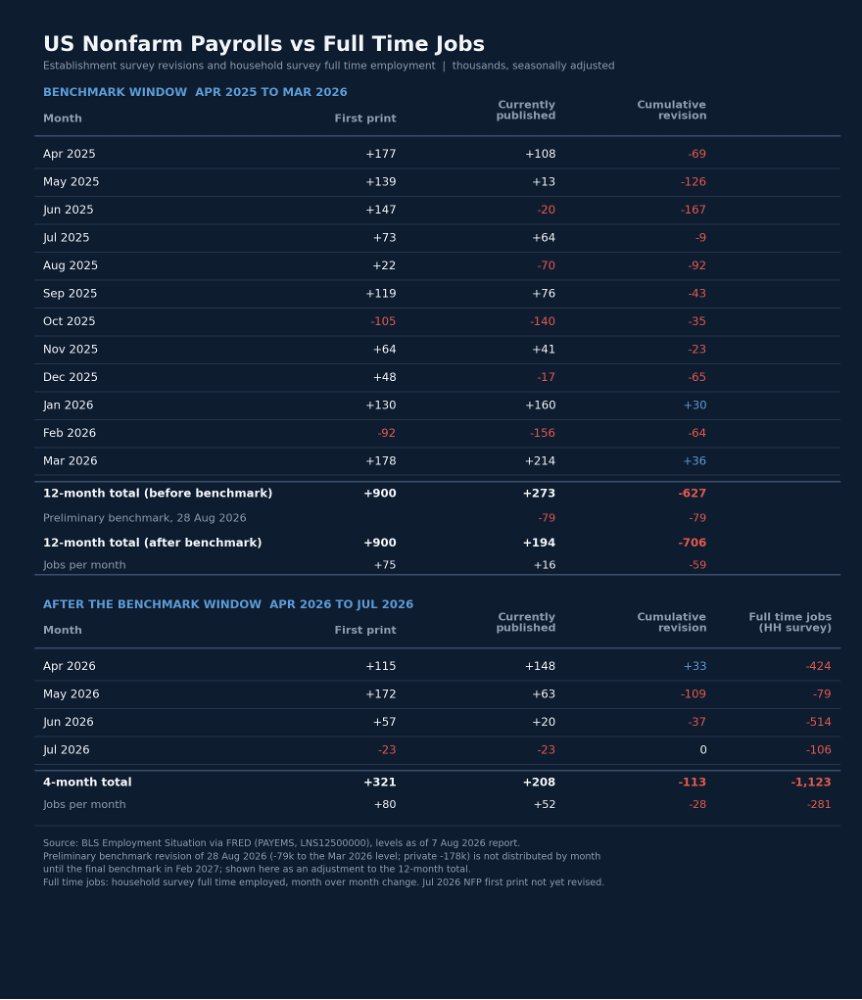
For comparison take a look at the table below.
The initial print - and the Final revision print.
And I can promise you that the economy is not generating 162K jobs per month.
https://t.co/oHxy3sA4pi
@HenrikZeberg definitely need a data source upgrade; this is dumb. I love how CNBC talks like this data is legit. companies on the Russell, Naz, ES, and YM should be required to submit a monthly jobs report that we compile.
🧵 Russia’s largest bank just announced it will accept Ethereum as collateral for loans.
Sberbank. 110 million customers. The largest bank in Eastern Europe.
Ethereum enters traditional banking. A thread:
(1/6)
Why would you post this? The Numbers do not make any sense. And anyone with a clue would notice…Dropping from 15.6% to 10% body fat with lean mass preserved only requires losing about 13 lbs, not 25.
Current state:
•Lean mass = 77.8 kg
•At 15.6% body fat, lean mass is 84.4% of total → total weight = 77.8 / 0.844 = 92.2 kg (203.3 lbs)
•Fat mass = 92.2 − 77.8 = 14.4 kg
Target: 10% body fat, assuming lean mass stays at 77.8 kg (90% of total):
•Total weight = 77.8 / 0.90 = 86.4 kg (190.6 lbs)
•Fat mass = 8.6 kg
Weight to lose: 92.2 − 86.4 = 5.8 kg ≈ 12.7 lbs