On a 5-year view $SPY is now outperforming bitcoin:native, while $GLD is significantly outperforming both assets.
Saylor's turbo-financialization playbook ( $MSTR $STRC) has been a net-negative for the emerging store of wealth asset.
chart h/t @GodelTerminal
PM Modi just asked Indians to reduce⛽️✈️use, advised adopting Covid measures, & told farmers to reduce fertilizer use.
What implications for Nepal, which depends on India for fuel & fertilizer? Where is Nepal’s Parliament & Cabinet in this? @MofaNepal
https://t.co/cyzqS82xfy
Absolutely the worst and rudest experience imaginable at the @united Lounge in Dulles C17. The ladies there seem to absolutely hate the concept of guest relations and courtesy. And went out if their way to le us know.
२०८३ सालको शुभकामना! May your inner Nepali Spirit soar to new heights. Wishing you an auspicious 2083 BS 🙏🏼🥃
#NepaliNewYear#Ayla#NepaliSpirit#thenepalispirit#mynepalispirit
Use Promo Code NEWYEAR2083 for a $10 discount on orders of KATHMANDU AYLA at https://t.co/7uLRNAzHj0
@ShardiB2 Wonder how much if Trumps budget announcement tomorrow has to do with this sharp move up. Assuming lotta budget for drones and space in defense
something about Uganda willing to join Israel in the fight, too.
Different countries of the world steadily engaging in a war between 2 nations, proactively or from the shadows…who knows who else will join/be dragged in…
almost as if there is a term for what it could lead to
Iran Escalates: Announces Targets in UAE and Syria
According to Fared al-Mahlool, a prominent pro-Damascus Syrian journalist, Iran has designated the Four Seasons and Sheraton hotels, as well as the Presidential Palace in Damascus, as military targets. Tehran claims that American, Israeli, and British experts are operating inside these locations.
This statement directly highlights British involvement in the conflict and marks a significant escalation against Syria.
On the same day, Iran released a list of targets in the United Arab Emirates, while Bahrain announced it is ready to confront Iranian troops.
Given these developments, I would not rule out a preventive Iranian strike against UAE air assets while they are still on the ground.
According to Iran, the UAE, Bahrain, Kuwait, and Saudi Arabia are actively supporting the US-Israel alliance.
A direct attack on the UAE would likely trigger Saudi Arabia’s entry into the war, adding to the Houthi front. The conflict is steadily acquiring a wider regional character.
If British involvement is confirmed, it could pull Europe into the fray. British submarines have already been deployed in the Arabian Sea for several days.
Additionally, another newspaper reported today that the United States is considering sending an extra 10,000 troops to the Middle East.
IRAN PREPARES 1 MILLION TROOPS FOR U.S. INVASION
Iran is reportedly ready to deploy over 1 million fighters if the U.S. launches a ground invasion, according to Tasnim News Agency citing an IRGC source.
Recent days have seen a surge of enlistment requests to the Basij, Revolutionary Guards, and Army. The source warned that Iran is prepared to counter U.S. attempts to reopen the Strait of Hormuz while maintaining its closure.
A food price shock is coming and most people have no idea it's already in motion.
The timeline based on everything right now is 6 to 9 months.
Most people are dismissing it.
They shouldn't be.
The Strait of Hormuz situation was already serious:
- 34% of global fertiliser supply stranded in the Gulf
- Force majeure declared on contracts worldwide
- Urea up 30% since February.
But something just made it significantly worse.
Russia, which supplies 37% of global ammonium nitrate exports, just announced it's halting all exports from March 21 through April 21. Right at the start of the Northern Hemisphere planting season."
The countries most exposed are
• Brazil
• Canada
• India
• Peru
• Ukraine
All of which are heading into their growing season right now.
So we now have two simultaneous shocks hitting fertiliser markets at the same time. Gulf supply stranded by the Iran conflict and Russian exports switched off.
Taking a lesson from history food price shocks in the 1970s were actually worse than the oil shocks that caused them. Food inflation contributed more to headline CPI than energy did through almost the entire decade.
We appear to be setting up for something similar.
By late 2026 planting drops and yields fall.
By 2027 that shows up on food prices worldwide.
I don't know what people are waiting for.
Most won't pay attention until they're standing in a supermarket wondering why everything costs so much more than it did a year ago.
By then it's too late to prepare.
New: Iran has been laying traps and moving additional military personnel and air defenses to Kharg Island in recent weeks in preparation for a possible US operation to take control of the island, according to multiple people familiar with US intelligence reporting on the issue.
Gulf allies are warning of significant US casualties if US moves fwd with an operation there & advising against it. with @ZcohenCNN@kylieatwood@talshalev1 https://t.co/HLi2ndTRnO
JUST IN: SUPER MICRO COMPUTER $SMCI CO-FOUNDER CHARGED WITH SMUGGLING NVIDIA $NVDA AI CHIPS TO CHINA
• ~$2.5B in servers diverted since 2024 via Southeast Asian shell company
• $510M shipped in a single month window (late Apr to mid-May 2025)
• Fake paperwork, dummy servers used to fool compliance team
• Co-founder Liaw controls $464M in $SMCI shares, arrested Thursday
• One defendant a fugitive; contractor relationship terminated
• Stock -12% after hours 🔴
Southern District of NY prosecution. No Commerce Dept. export license held.
@ShardiB2 Gotta use up the built inventory to place new orders of weapons. Gotta destroy infrastructure to dole out contracts to rebuild. War profiteering at its finest but this time with lunatics and idiots in charge
This is defined by one word
It reminds me a lot of those cases where kids pick a fight, get beaten up, and then run to their siblings for help.
I have no idea what kind of mental gymnastics you're doing, but in my book, the name for this is DEFEAT.
It’s an admission of impotence that calls into question everything he’s said over the last few days.
Donald Trump and Netanyahu have created a situation where they are tied up in knots with no solution, being defeated by a country that has been under sanctions for years and is waging asymmetrical warfare almost perfectly.
Hmmmm. Now I know who is the American military advisor.
Well, talking seriously…
There’s zero chance this crew can win any war. Winning wars requires discipline, planning, study.
I’ve never seen a more botched, clumsy operation.
JUST IN: The United States just suspended consulate services in southern Turkey and ordered non-essential staff and families out of Adana. Not Baghdad. Not Beirut. Not Kuwait City. Adana. A NATO ally. A country that has not been attacked. A consular district covering 22 Turkish provinces.
The war is no longer in the Middle East. The war’s perimeter now includes NATO territory.
Since 28 February, the US State Department has closed embassies in Saudi Arabia, Lebanon, and Kuwait indefinitely. It has ordered departure of non-essential personnel from the UAE, Bahrain, Qatar, Oman, Jordan, and now Turkey. It issued “DEPART NOW” advisories covering 14 countries: Bahrain, Egypt, Iran, Iraq, Israel, Jordan, Kuwait, Lebanon, Oman, Qatar, Saudi Arabia, Syria, the UAE, and Yemen. Level 4 “Do Not Travel” designations are active for Iran, Iraq, Syria, Gaza, and Lebanon. The Dubai consulate was hit by a drone-related incident on 3 March. The Fifth Fleet headquarters in Bahrain has been struck. Port Shuaiba in Kuwait, where six US service members were killed on 1 March, is now a fortified compound rather than a diplomatic post.
The US diplomatic presence across the entire Middle East has been reduced to skeleton crews operating behind blast walls. Seventeen thousand five hundred Americans have been repatriated since the war began, 8,500 in a single day on 4 March. Commercial flights are the only extraction method. There are no government-organised evacuations. Senator Andy Kim called it “ZERO strategy.”
The allies followed. The UK issued warnings against all travel to Israel and Palestine on 28 February, then arranged charter flights for evacuations on 4 March. France deployed fighter jets to the UAE and prepared evacuation operations. Germany reported 30,000 tourists stranded without immediate government extraction. No joint EU evacuation effort has been launched. Poland, Spain, and Italy issued departure urgings. Airspace closures across Kuwait, Bahrain, Qatar, and Israel grounded commercial flights precisely when citizens needed them most.
Here is what the Adana closure tells you that the Gulf closures do not.
Adana is 350 kilometres from the Syrian border. It is the home of Incirlik Air Base, one of the most critical US military installations outside American territory, from which operations supporting the broader Middle East campaign are staged. The IRGC’s Kermanshah and Kurdistan provincial commands, operating under Mosaic doctrine with independent firing authority, have demonstrated missile and drone reach into Iraqi and Turkish-adjacent airspace. Hezbollah has fired 210 missiles into Israeli airspace from Lebanon, with fragments and overflight risks extending into Cypriot and Turkish zones. The State Department is not closing Adana because Turkey was attacked. It is closing Adana because the threat envelope from 31 autonomous IRGC commands, Hezbollah, and Iraqi militias now extends into NATO airspace.
The war was supposed to last four to six weeks and stay in the Persian Gulf. Nine days in, the United States has closed or reduced diplomatic operations across 14 countries, evacuated 17,500 citizens, suspended services inside a NATO ally, and has no government evacuation plan for the citizens who remain.
Three carrier strike groups control the airspace. Three embassies are shuttered. Fourteen countries are under departure orders. And the consulate in a NATO member state just went dark.
The perimeter is no longer holding.
https://t.co/eMrt5qYYst
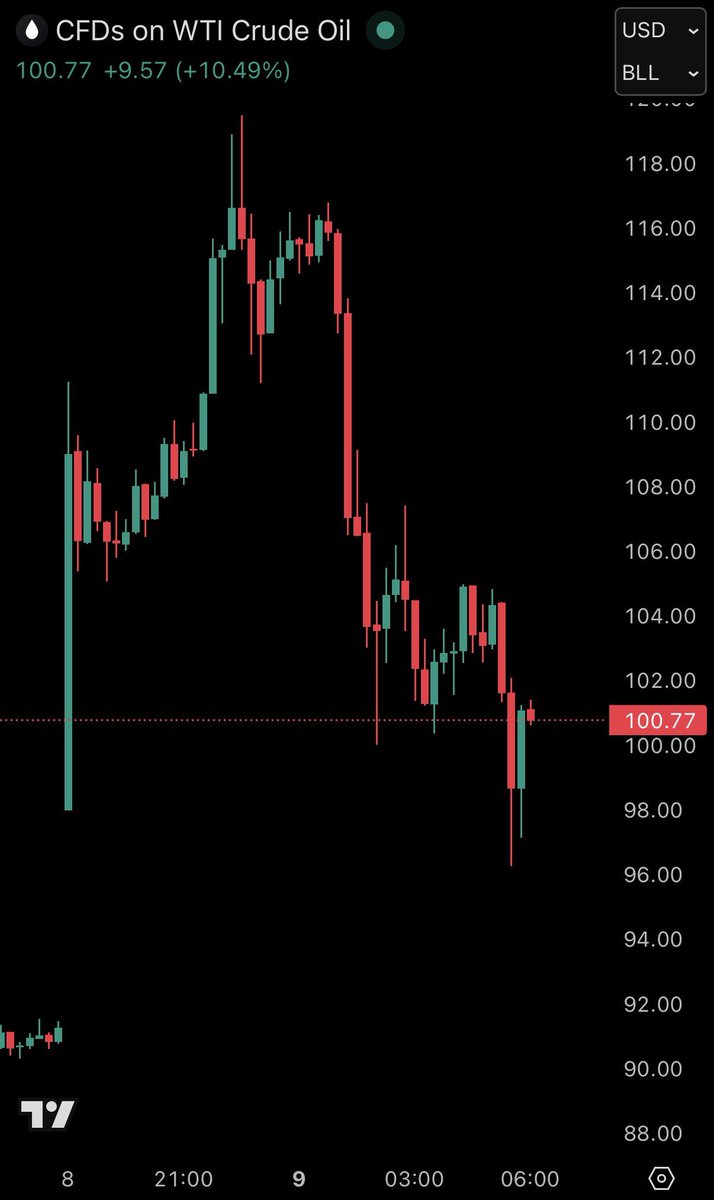
WTI crude surged 30% to $119.48 intraday, crashed 19% to $96.45, then settled at $103.32. Up 13.66% on the day. A $23 intraday range. One of the largest single-day crude oil reversals in the history of the commodity.
The surge was real. The reversal is an illusion.
The spike to $119 was driven by structural reality: Hormuz transits down 80%, Iraq’s production collapsed 70% from 4.3 million to 1.3 million barrels per day (Reuters confirmed), Kuwait enacted precautionary cuts from its 2.6 million bpd baseline, QatarEnergy remains under force majeure, and Iran’s 31 autonomous IRGC provincial commands continue striking Gulf infrastructure without central authorisation.
The crash to $96 was driven by a single headline: the G7 is reportedly considering a coordinated release of 300 to 400 million barrels from strategic petroleum reserves. The Financial Times reported the discussions. No release has been authorised. No barrels have moved.
Here is why the headline does not solve the problem.
Global oil demand runs at 104.9 million barrels per day per the IEA’s 2026 forecast. A 400-million-barrel release covers 3.8 days of total demand. The Hormuz closure removes 15 to 20 million barrels per day from the market. Against that specific deficit, 400 million barrels buys 20 to 27 days. Not months. Not quarters. Days.
The US strategic petroleum reserve holds 415 million barrels as of 27 February per the EIA, still recovering from the 180-million-barrel drawdown during the 2022 Ukraine crisis. If the US contributes proportionally to a G7 release, it depletes reserves toward levels not seen since the early 1980s. Japan is preparing to tap Shibushi for the first time since 1978. These stockpiles cannot be refilled while the chokepoint that carries the crude to replenish them remains commercially closed.
A handful of Chinese-flagged VLCCs have transited selectively. Some hull war cover has been reinstated at 1% of hull value. The closure is not absolute. But 80% of transits eliminated, with the remaining flow restricted to vessels willing to pay ten times pre-war insurance premiums, is not a functioning market. It is a trickle through a system designed for a river.
The market traded the headline. It has not traded the arithmetic.
Zero P&I clubs have formally reinstated standard war-risk coverage. The DFC’s $20 billion facility has not produced confirmed insured transits at scale. The 31 IRGC provincial commands remain autonomous and active. The interceptor inventory continues depleting at cost ratios of 190 to 1. None of these structural conditions changed between the $119 high and the $103 settle.
What changed was a headline about a meeting that has not happened, discussing a release that has not been authorised, of reserves that cover days not months, from stockpiles that cannot be refilled while the chokepoint remains closed.
The 2022 Ukraine precedent is instructive. The US released 180 million barrels over six months. Oil peaked at $139, pulled back on the release, then took months to normalise. That crisis involved no chokepoint closure, no insurance withdrawal, no leadership decapitation, and no decentralised military doctrine preventing ceasefire.
This one has all four.
The oil moved. The mechanism did not.
Full analysis here.
https://t.co/ULBgEzZ3A8