We have a PhD available on host glycan microbiota interactions:
The project aims to develop first-in-class covalent carbohydrate sulfatase inhibitors as novel therapeutics for inflammatory bowel disease and colorectal cancer #glycotime#microbiome
https://t.co/ZKGHA5GmkH
This years Biochemical Society Christmas Bioenergetics meeting will be hosted at the University of East Anglia on Tuesday 15th December.
For more details and to reserve your place please use the link below:
https://t.co/f5THKLnHHD
Always astounds me when prepping for my fall course on microbial physiology that this one little segment, about 100kb, or 2% of the E. coli genome, just about encompasses the whole course. The Dcw operon alone, the whole third row, that is... good Lord! Amazing.🤯
For 20 yrs textbook view: linear electron flow can't make enough ATP for CO₂ fixation, so plants use cyclic electron transfer (CET) to top it up. Today in @NaturePlants, we measured ATP directly inside living chloroplasts — and that story doesn't hold. https://t.co/RlPK8iUK6f🧵
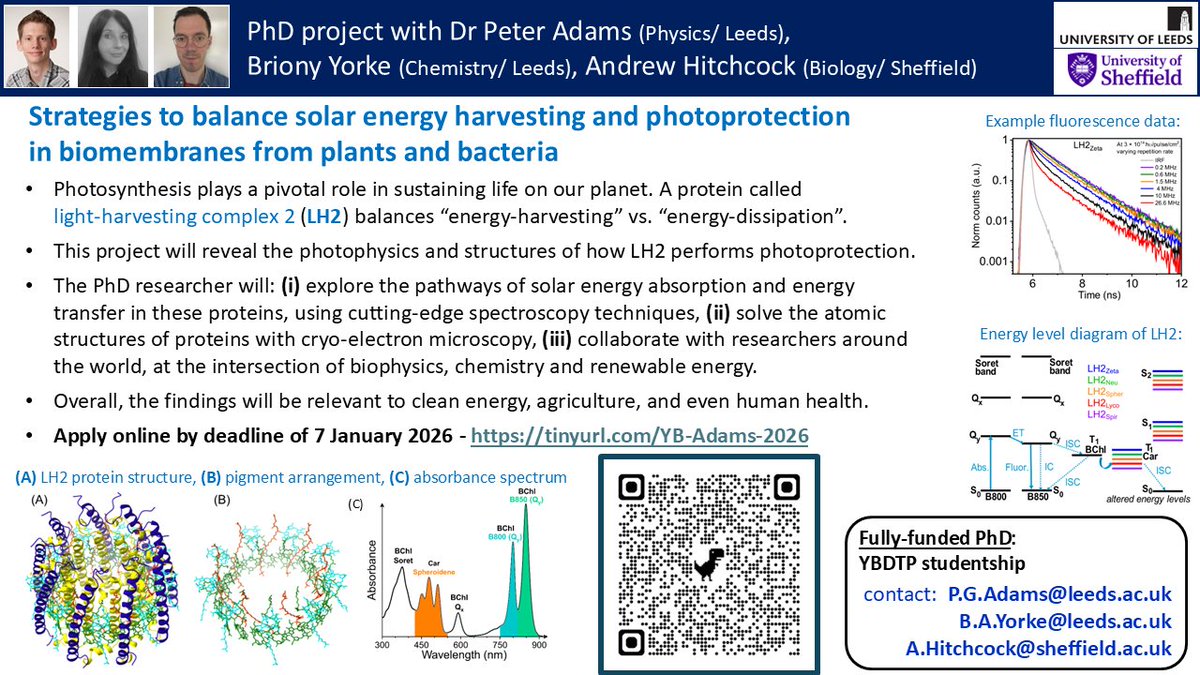
Funded #PhD studentship opportunity on optical spectroscopy and structural techniques to study #photosynthesis and #solar energy capture in purple bacteria!🌞🦠Apply by 7 Jan 2026
@HitchcockLab @BrionyYorke
Please share with UG students (Oct 2026 start)
https://t.co/jICHhGYveY
Some archaea—an ancient group of microorganisms—have an entirely novel genetic code, according to a new study in Science. Their genetic code reassigns a DNA “stop” signal to incorporate the rare amino acid pyrrolysine into their proteins.
The findings expand our understanding of how alternative genetic codes evolve and hint at new molecular tools for biotechnology applications. https://t.co/SNz70GImAi
🎓 New PhD Position Available!
We’re excited to announce a new opportunity to join our team as a PhD student.
👇 Check out all the details in our post below.
🚀 Apply now!
Please RT!
Funded position available to join my new team at @UniTurku Finland to do a PhD exploring how circadian clocks regulate extracellular electron transfer in photosynthetic cells. Application open until end of summer, start by end of year. Please share/apply https://t.co/k7EGOPgzfT
Excited to share that our preprint on the #evolution of far-red light #photoacclimation (FaRLiP) in #cyanobacteria has been published in Current Biology.
https://t.co/WenDHITsKE
Happy to have this deep dive into polysaccharide family 33 out:
https://t.co/iR2Syfadf2
We define features driving substrate specificity, catalytic mechanism, and evolutionary links with multiple lyases and epimerises #glycotime@PNASNews
Massive congratulations to the new Dr @nicky_rudling on your @NLD_BBSRCDTP PhD. We’re so lucky that you’re staying with the group @LivUniISMIB as a postdoc! Many thanks to Prof. Tom Bibby for venturing so far north to examine
I have a PhD available via the YBDTP scheme looking at host glycan cross-feeding in the human gut microbiota. What networks does this underpin? What metabolites are produnced? and how would this ultimately impact the host (humans) #glycotime:
From https://t.co/VS73cpvCnp📷
AAP lab looks for a motivated PhD student to investigate stress physiology of marine phototrophic bacterium Dinoroseobacter shibae using a combination of RNA and Transposon insertion sequencing.
https://t.co/C82MpCNKhF
Just moved online, thx to the team guided by @fraaije1 and @MatteviLab: Dehydrogenase versus Oxidase Function: The Interplay between Substrate Binding and Flavin Microenvironment | @ACSCatalysis https://t.co/TCp8NsQ2XD
Dusty ice exposed at the surface of Mars could provide the conditions necessary for the presence of photosynthetic life, according to a modelling study published in @CommsEarth. https://t.co/Rnpu3ifiYL