After photonics, I’m shifting into plasmonics..
That’s where the bottleneck is going. Not more bandwidth.. but how you actually scale 3.2T+ without hitting physics limits.
$MRVL didn’t buy Polariton for fun. That’s a signal silicon photonics alone isn’t enough.
Meanwhile the market is still stuck on $AAOI $LITE $COHR..
The interesting layer is deeper now: $MTSI on the device side, $TSEM on the foundry side, $AEHR on testing, even earlier bets like $SIVE etc..
Messy, early and not fully understood. I like it..
Same setup as early photonics.. just one layer deeper.
Even though the markets have been incredibly choppy
New leaders and emerging themes continue to show through the cracks
Drones:
$UMAC
$KTOS
$ONDS
$RDW
$RCAT
Aerospace:
$AVAV
$LUNR
$GE
$LMT
$RKLB
$FTAI
Datacenter:
$NBIS
$WULF
$HUT
$CORZ
$CRWV
Fiber optics:
$LITE
$COHR
$AAOI
$GLW
AI Hardware:
$OSS
$LPTH
$FN
$ASML
$Q
Uranium:
$UUUU
$CCJ
$DNN
$UEC
These are the strongest sectors in the market...
Every pullback can be used as a buying opportunity.
Cool new fund launched by @michaelsikand on @joinautopilot
It's a Photonics themed fund focused around the $1T AI bottleneck in connectivity
"The only solution is light"
See it below 🫡
8 WAYS ROBOTICS IS GETTING BUILT OUT ACROSS SECTORS
1. $PLTR & $PATH are the traffic controllers for the whole fleet while $NVDA, $AVGO & $QCOM are the engines & nervous system that let the robots sense and act.
2. $AVAV, $ONDS, $RCAT & $UMAC are building the UAV drone fleets that feed into the autonomous defense networks run by $LMT, $RTX & $GD
3. $TSLA, $HON & $TER drive industrial robots that automate assembly lines & heavy-duty manufacturing.
4. $GOOGL, $AMZN & $MSFT supply the AI data layer that connects every machine, while $ROK & $ZBRA provide the controls, scanners & mobile robots that keep factory lines/warehouses moving.
5. $MBLY, $LIDR, $LAZR & $INVZ supply the perception stack that lets robots see & navigate the world.
6. $ISRG, $PRCT, $SYK & $MDT bring surgical robotics that are reshaping operating rooms.
7. $RR, $OII, & $FARO push robotics into underwater, field & customer-facing service roles.
8. $AMZN deploys hundreds of thousands of warehouse robots to move & pick goods, while $SYM & $SERV build the autonomous mobile robots that power fulfillment & last-mile retail logistics.
Market Makers don't manipulate price—
we're trapped by our own hedging requirements.
When SPX drifts between long and short strikes, our systems start buying and selling futures in ways that create predictable paths.
(short thread)
Also something that stands out is May OPEX will be a GIANT call heavy expiration with about 78% of single stock May options being calls and just 22% of puts, so with those calls being more ITM now with this rally, it reduces the need for dealers to buy stock after Friday, potentially reducing a tailwind that has been helping markets. Just something to note that can produce a correction next week
Monetizing Long Vol
August was a standout month for Ambrus, primarily due to our ability to monetize a small but sharp volatility spike—without sacrificing too much of our convexity profile in case volatility fully materialized.
A question we often get is: “How do you monetize positions?”
It’s a balancing act. Take profits too early, and you risk looking foolish if volatility truly explodes. Monetize nothing, and you end up empty-handed when vol round-trips. I strongly believe in a process that blends systematic structure with discretionary insight. Leaning too heavily in either direction can be dangerous—and history is littered with long vol shops that disappeared because they didn’t strike that balance.
It all starts with infrastructure: you need a deep historical understanding of option pricing. If you can’t tell whether the 1M VIX 30c is priced in the 10th or 90th percentile over the past decade, you’re effectively trading blind. Using options without this context is like walking into a grocery store and buying apples without checking the price, over time, it erodes returns.
Once you understand where vol is priced, you can begin building a book that warehouses “cheap” convexity. And the first step of efficient monetization is buying well. That process can take days or weeks, no serious vol shop sees one line and dumps their entire exposure there. It’s inefficient, leaves a footprint, and subjects your P&L to a single path dependency.
Take the VIX 30c, for example. If it’s cheap, odds are other parts of the vol surface are cheap too. By staggering your exposure across tenors and strikes, you build a more robust book. Maybe you layer in $100K of Vega across the 25c, 30c, 50c, and 80c—creating a structured strip rather than a single-point bet.
Then one morning, vol spikes. What now?
This is where infrastructure pays off. A clear understanding of pricing helps guide which positions to monetize. Just because you hold $100K of Vega across multiple strikes doesn’t mean you reduce each equally. Say the 30c is now trading at 200 vol—an all-time high. That’s probably your signal to take a chunk of profits there, while maybe leaving the 80c untouched if it hasn’t moved much. Trimming the higher-delta, more sensitive options can help lock in gains while preserving convexity.
So—how much do you sell? How much do you keep?
This varies based on the goal of the strategy but It helps to have a structured yet dynamic framework mapped out in advance. For example: If $100K in Vega grows to $1M, monetize 20–50% to start and aim to monetize 25% more as we slide higher. But that’s just a guideline. The trader must still assess the why behind the vol move. Is it structurally driven? Is it fleeting? That discretion—knowing when to lean into or away from the framework—is where edge lives. This allows the trader to be on the higher end or lower end of that range, being disciplined yet flexible to the environment.
This process prevents two types of common errors:
1.The trader who thinks the world is ending but walks away with nothing because they didn’t monetize.
2.The one who dumps everything when vol hits 30—only to watch it run to 70.
In August, we were quick to offload our variance ($VIX) bucket back to the market and keep the S&P Vega. Today, at current pricing, we have no intention of giving that risk back. We’re more inclined to lighten up on S&P thick delta exposure instead as most of this has been an orderly delta move lower.
Think of it like this: you bet $100 on a horse that pays out 10-to-1, and it’s already a lap ahead halfway through the race. If someone offers to buy your ticket back for $100, you’d probably laugh. The same applies here—we’re not giving away convexity that’s still very much alive, just because the market’s not caught up to part of the move.
Hope this helps, have a good weekend 👊🏾
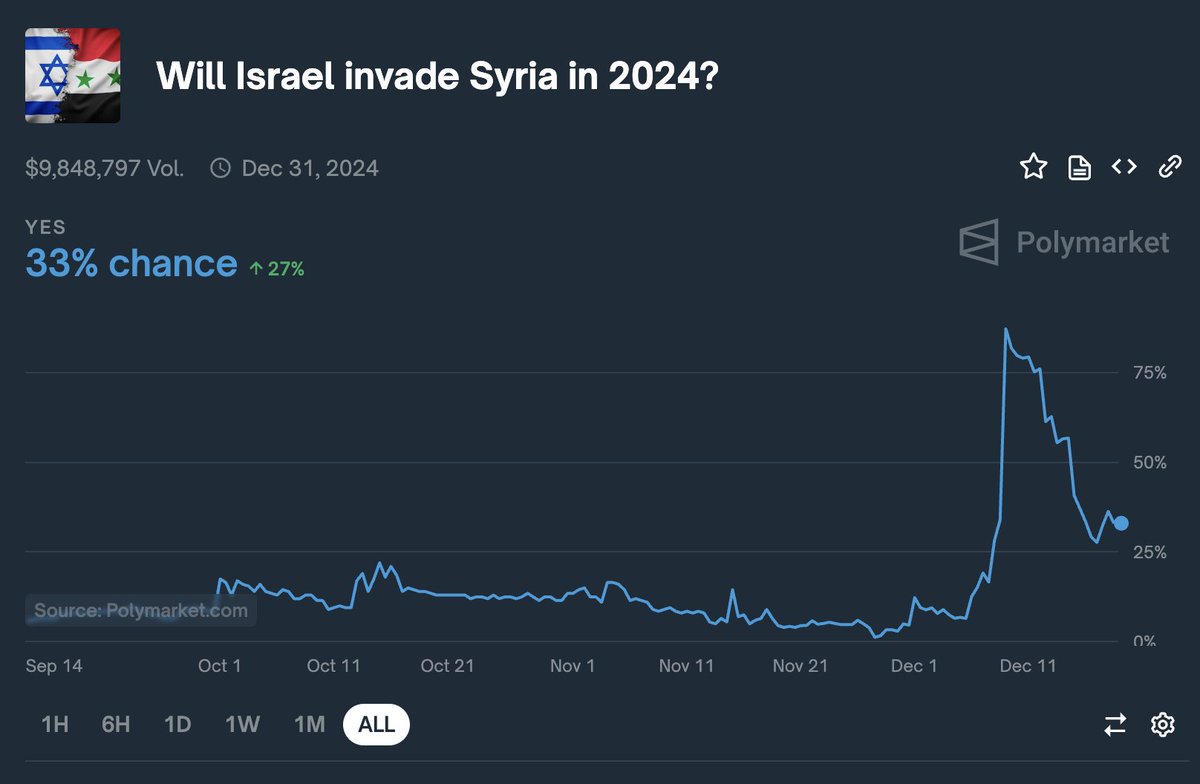
the current @Polymarket drama:
- almost $10 million in volume on this bet
- this market should have already resolved to YES
- however, the current oracle (UMA) is not resolving it
- most people in the comments suspect oracle manipulation for personal gain by UMA whales
- these markets are complicated bc small differences in wording are open to interpretation
- if this resolves to NO, we need to re-assess the fairness of bet resolutions
How I leverage AI today:
- Claude Projects for summarization
- CrewAI agents for orchestrating research agents
- Flowise AI for private doc analysis (i.e., RAG)
- Midjourney for image generation
- NotebookLM for education-related tasks
- ChatGPT Search for discovery
- Grok for finding interesting AI papers
- Google AI Studio for video transcription
- Cursor for fast code prototyping
- v0 for design work
- Anthropic console prompt optimization and evaluation
- Claude Artifacts for artifact generation like flow charts
- ChatGPT-o1-preview/canvas for reviewing/refining writing
This is a subset of my stack. When I feel performance deteriorates for any one tool or model, I switch to other alternatives. Bad idea to overcommit to one AI tool or product. I am also constantly experimenting with different models.
My work varies between writing, research, coding, product, marketing, and business operations. These tools, and many others, are simplifying the way I do work.
How about you?
How to use @cursor_ai to build production level application?
Lots video showcasing building demos, but not many dive into details of end to end process from planning, authentication, backend setup;
But it is not that hard;
Made a video showcase how to bring an idea live into the wild in 20 mins!
00:00 Intro & how to setup Cursor
05:09 How to build frontend
17:39 How to build authentication
21:30 How to build backend
40:26 How to deploy
If you have any further question or want to get deep dive into more cursor course, you can join my community where I post tips weekly: https://t.co/dS6OP1bXKt
$SOFI is incredibly undervalued no matter how you look at it. Here is the first article (one more to follow) that takes a deep dive into SoFi's valuation.
https://t.co/n4ZRRrRZtu
And just like that, $100M in Total Value Locked on @Base!
Thank you to the community for your continued support. This milestone wouldn't have been possible without you. 🌜🔵🌛