Bioinformatics, Genomics and Computational Biology.
Interested in human genomic structural variations calling.
Professor(PhD) at Harbin Institute of Technology.
Happy to share this new work, where SVs from @nanopore PromethION and @PacBio RSII were compared for two individuals from the #SweGen population. Great job by @_nazeefatima who pushed this all the way from MSc project to a final publication! https://t.co/NEMeYqfgQQ
New blog! Tao Jiang (@Cannot__Change) describes his work on the development of the structural variant (SV) caller cuteSV. Find out how the cuteSV bioinformatics pipeline works, how it performs relative to other SV callers and Tao’s future development plans
https://t.co/iD7Jz2qwOP
Now available: cuteSV, developed with nanopore long-read sequencing has 'outstanding ability to detect SVs with low coverage sequencing data, and it also has high scalability for handling large-scale datasets'
Read more: https://t.co/QIwBtvSBaA
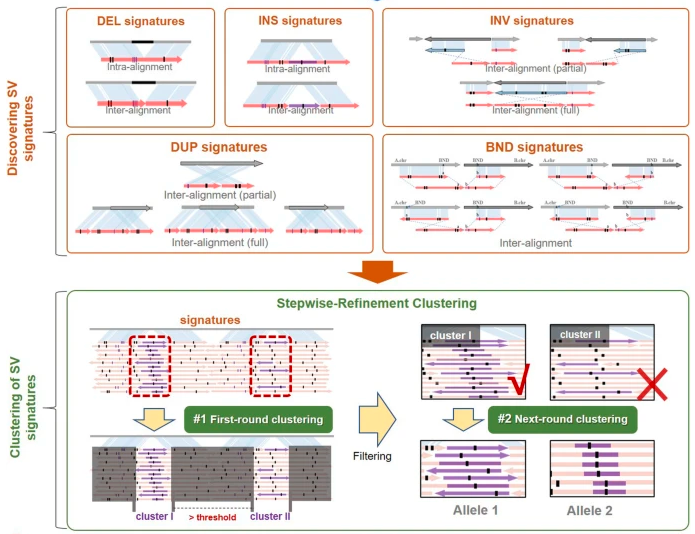
cuteSV, from Jiang, Liu, Wang and co, a tool for identifying structural variants using long reads. Different SV types have different signatures, which the method identifies. cuteSV can work with Nanopore and PacBio data. https://t.co/uEk5PPTFli
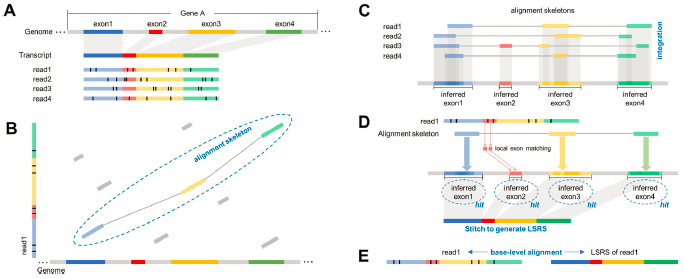
Liu, Liu, Zang, Wang and co present deSALT, for aligning long RNA-seq reads. it takes a two-pass approach, using a graph-based index to match blocks between read and genome, and then relocating short matches between read and detected exons. https://t.co/HVtdirlDt0
Ruan and Li @lh3lh3 report wtdbg2, a genome assembler that achieves comparable contiguity and accuracy to existing tools using long-read sequencing data, and is fast especially for large genomes. https://t.co/GHKbrbkI1R
@SigmaFacto Furthermore, the complex region within multi-type SVs (complex SVs) also hinders the high-quality SV calling. In a word, all the factors that can make the signature worse are the root of the performance degradation of SV detection.
@SigmaFacto Hello, I show an example of the density of SVs in my latest twitter. cuteSV give an integration insertion call rely on its signatures combination. I think the signature abundant region maybe mislead the SV caller to generate inappropriately calls.
An interesting question: how many insertions in this region? Giab gives 5 insertions here including 4 small insertions from Illumina technology and 1 large insertion from PacBio. Crazy problem!😰
@SigmaFacto I think if you want to implementation of SV calling with low coverage, pls increase the read length as far as possible when library construction and sequencing.
@SigmaFacto Meantime, the alternative read alignments generate misplacement of SV signatures, which will increase the difficulties of clustering. Both two main reasons decrease sensitivity and accuracy in SV calling.
@SigmaFacto This is a good question. Analysis and resolving repeat region is the most complicated scientific problem in genomics all the time. The higher the repeatability of these elements is, the lower the accuracy of the read alignments is. So we will miss quite a lot of SV signatures.