Responsive molecules for neuromorphic memory in organic devices
Neuromorphic computing aims to replicate the way the human brain processes and stores information, offering new routes to address the energy and speed limitations in conventional hardware. A key bottleneck is finding materials that accurately mimic how neurons and synapses handle both rapid and enduring memory under real-world conditions. By exploring small organic molecules that switch in response to optical, mechanical, and electrochemical signals, researchers hope to create hardware that captures the flexibility and efficiency of biological neural networks.
In a recent review, Chen and coauthors detail how these responsive materials can be integrated with machine learning architectures, focusing on memory diversification as a strategy to execute neural network training with multiple retention times. The authors discuss how volatile storage elements emulate short-term memory and spiking neural network behaviors, while nonvolatile elements handle longer-term updates reminiscent of artificial neural networks. A central feature is tuning the retention window from microseconds to hours by engineering parameters such as charge trapping energies and stimulus thresholds. This adjustable timescale lets the same device handle both rapid inference and stable storage, thereby simplifying training loops and cutting power demands in data-intensive tasks.
By systematically investigating how molecular switches can serve as physically configurable memory elements, the authors reveal critical design considerations for in-sensor computing and advanced inference workloads. Their findings show that combining volatile and nonvolatile organic synapses can preserve real-time adaptability while storing essential parameters for extended periods. Such devices offer a richer palette of memory states for machine learning, promising new hardware solutions that balance speed, power, and precision in future neuromorphic platforms.
Paper: https://t.co/E3pK579q1B
The idea comes from theories in neuroscience and speculative physics exploring whether dreams create vivid simulated worlds where the brain processes memory, emotion, and imagined possibilities with remarkable realism.
https://t.co/hmrOHkfXJe
A few researchers have suggested this could feel like connecting with alternate versions of ourselves but there is currently no scientific evidence that dreams are actual portals to parallel universes or the multiverse.
Scientists do agree that dreaming remains one of the brain’s most mysterious states, with consciousness becoming immersive enough to feel like entering an entirely different reality.
In the next 3 years, the most valuable employee in your company may not be human. It may be an AI Agent working 24/7.
An AI Agent doesn’t just answer questions.
It can:
• Research information
• Analyze data
• Generate reports
• Schedule meetings
• Follow up with leads
• Monitor competitors
• Create content
• Execute workflows across multiple tools
Think of it as hiring a digital team member that works 24/7.
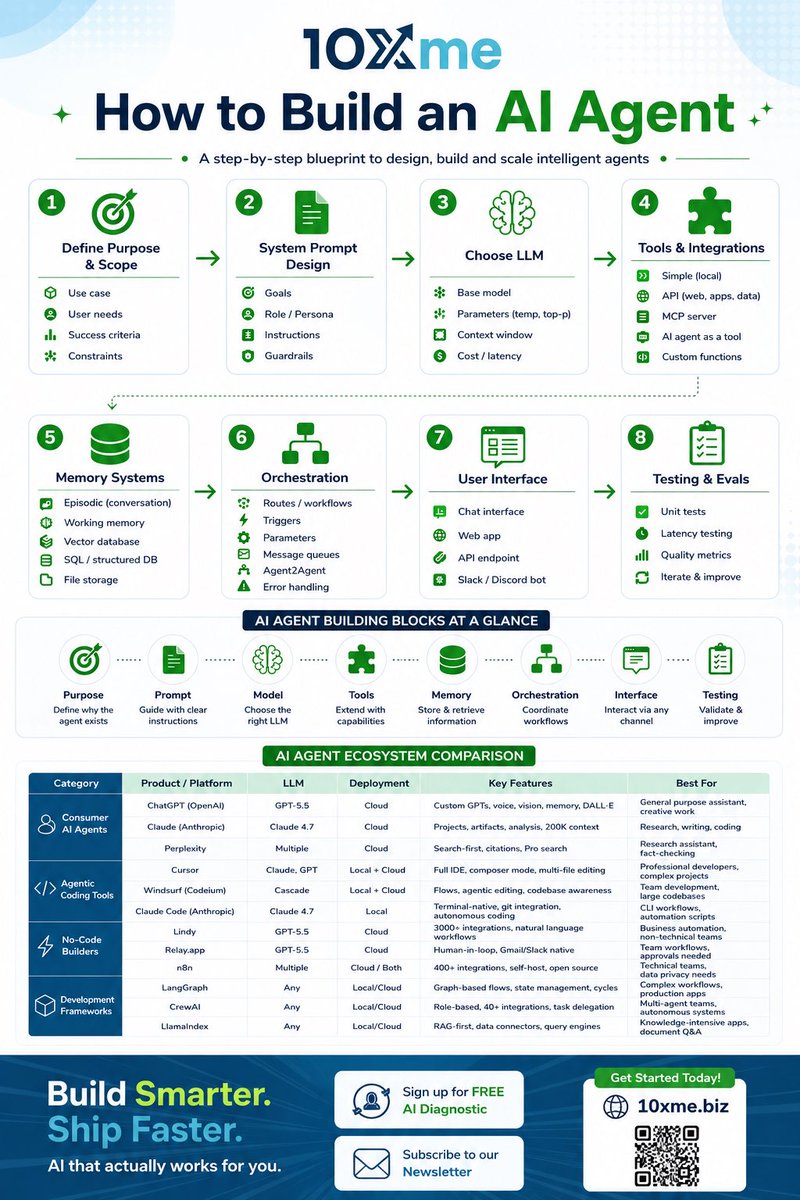
The framework is surprisingly simple:
1️⃣ Define the Purpose
What problem is the agent solving?
2️⃣ Design the Prompt
Give it clear instructions, goals, and guardrails.
3️⃣ Choose the Right LLM
Different models excel at different tasks.
4️⃣ Connect Tools
Email, CRM, databases, spreadsheets, web search, APIs.
5️⃣ Add Memory
So the agent remembers context and improves over time.
6️⃣ Build Workflows
Create repeatable processes and automations.
7️⃣ Deploy a User Interface
Chat, web app, Slack, Teams, WhatsApp, or API.
8️⃣ Test and Improve
Measure outputs, identify failures, and iterate.
The reality is that every professional will soon have an AI workforce.
The question is no longer:
“Should I use AI?”
It’s:
“How many AI employees should I have working for me?”
At @10xme_biz, we’re teaching practical AI solutions that help professionals and businesses multiply productivity, automate repetitive work, and scale faster.
🚀 Want to discover where AI can create the biggest impact in your business?
Get your FREE AI Diagnostic and subscribe to our newsletter at:
🌐 https://t.co/I4zR8aXXi5
Build smarter. Ship faster.
MIT just made every AI company's billion dollar bet look embarrassing.
They solved AI memory. Not by building a bigger brain. By teaching it how to read.
The paper dropped on December 31, 2025. Three MIT CSAIL researchers. One idea so obvious it hurts. And a result that makes five years of context window arms racing look like the wrong war entirely.
Here is the problem nobody solved.
Every AI model on the planet has a hard ceiling. A context window. The maximum amount of text it can hold in working memory at once. Cross that line and something ugly happens — something researchers have a clinical name for.
Context rot.
The more you pack into an AI's context, the worse it performs on everything already inside it. Facts blur. Information buried in the middle vanishes. The model does not become more capable as you feed it more. It becomes more confused. You give it your entire codebase and it forgets what it read three files ago. You hand it a 500-page legal document and it loses the clause from page 12 by the time it reaches page 400.
So the industry built a workaround. RAG. Retrieval Augmented Generation. Chop the document into chunks. Store them in a database. Retrieve the relevant ones when needed.
It was always a compromise dressed up as a solution.
The retriever guesses which chunks matter before the AI has read anything. If it guesses wrong — and it does, constantly — the AI never sees the information it needed. The act of chunking destroys every relationship between distant paragraphs. The full picture gets shredded into fragments that the AI then tries to reassemble blindfolded.
Two bad options. One broken industry. Three MIT researchers and a deadline of December 31st.
Here is what they built.
Stop putting the document in the AI's memory at all.
That is the entire idea. That is the breakthrough. Store the document as a Python variable outside the AI's context window entirely. Tell the AI the variable exists and how big it is. Then get out of the way.
When you ask a question, the AI does not try to remember anything. It behaves like a human expert dropped into a library with a computer. It writes code. It searches the document with regular expressions. It slices to the exact section it needs. It scans the structure. It navigates. It finds precisely what is relevant and pulls only that into its active window.
Then it does something that makes this recursive.
When the AI finds relevant material, it spawns smaller sub-AI instances to read and analyze those sections in parallel. Each one focused. Each one fast. Each one reporting back. The root AI synthesizes everything and produces an answer.
No summarization. No deletion. No information loss. No decay. Every byte of the original document remains intact, accessible, and queryable for as long as you need it.
Now here are the numbers.
Standard frontier models on the hardest long-context reasoning benchmarks: scores near zero. Complete collapse. GPT-5 on a benchmark requiring it to track complex code history beyond 75,000 tokens — could not solve even 10% of problems.
RLMs on the same benchmarks: solved them. Dramatically. Double-digit percentage gains over every alternative approach. Successfully handling inputs up to 10 million tokens — 100 times beyond a model's native context window.
Cost per query: comparable to or cheaper than standard massive context calls.
Read that again. One hundred times the context. Better answers. Same price.
The timeline of the arms race makes this sting harder. GPT-3 in 2020: 4,000 tokens. GPT-4: 32,000. Claude 3: 200,000. Gemini: 1 million. Gemini 2: 2 million. Every generation, every company, billions of dollars spent, all betting on the same assumption.
More context equals better performance.
MIT just proved that assumption was wrong the entire time.
Not slightly wrong. Fundamentally wrong. The entire premise of the last five years of context window research — that the solution to AI memory was a bigger window — was the wrong answer to the wrong question.
The right question was never how much can you force an AI to hold in its head.
It was whether you could teach an AI to know where to look.
A human expert handed a 10,000-page archive does not read all 10,000 pages before answering your question. They navigate. They search. They find the relevant section, read it deeply, and synthesize the answer.
RLMs are the first AI architecture that works the same way.
The code is open source. On GitHub right now. Free. No license fees. No API costs. Drop it in as a replacement for your existing LLM API calls and your application does not even notice the difference — except that it suddenly works on inputs it used to fail on entirely.
Prime Intellect — one of the leading AI research labs in the space — has already called RLMs a major research focus and described what comes next: teaching models to manage their own context through reinforcement learning, enabling agents to solve tasks spanning not hours, but weeks and months.
The context window wars are over.
MIT won them by walking away from the battlefield.
Source: Zhang, Kraska, Khattab · MIT CSAIL · arXiv:2512.24601
Paper: https://t.co/Z1w6mk0EHd
GitHub: https://t.co/Ko36uDE5XO
🚨 BRAIN NETS FOUND KEY TO MEMORY RECALL.
New research shows that perineuronal nets in the brain’s retrosplenial cortex help keep memory signals steady. Scientists found that removing these nets disrupts how the hippocampus and retrosplenial cortex communicate. This weakens spatial memory and throws off the brain rhythms needed for coordination. The study highlights how these nets help time and organize brain activity during memory retrieval.
NEW: Oxford study shows the brain uses brief, slow rhythms to organise how memories are formed, stored and later recalled.
Find out more ⬇️
https://t.co/eBGtCO4bS9
Perplexity CEO Aravind Srinivas told CNBC that the company best positioned to win the AI race long-term will be the one that maximizes "value per watt per user" — the ratio of economic output to energy consumed. "Whoever is able to maximize this particular objective, by balancing accuracy, latency, cost, privacy and intelligence all together — they're going to win," Srinivas said. His argument is that companies currently generating high revenue from expensive models are capturing short-term gains, not durable advantage. The real competition, he says, is an efficiency problem. Perplexity's answer is what it calls orchestration: a system that automatically routes AI processing to whichever model and location — cloud or on-device — best suits a given task. The company launched Personal Computer, an orchestration tool now available on both Mac and Windows, that connects to apps like Word and Outlook as well as local files. Srinivas describes the broader shift as "the data center coming to your laptop." Perplexity, last valued at approximately $22.6 billion as of January 2026, is significantly smaller than OpenAI and Anthropic by valuation — but the company has seen rapid revenue growth, with estimates suggesting it surpassed $500 million in annualized revenue by April 2026, up from $232 million in 2025. Srinivas attributed part of this growth to advances in the frontier models integrated into Perplexity's products — which include systems from Anthropic, OpenAI, and xAI, among others, as part of a multi-model approach.
#AI #Perplexity #TechNews #Energy
Microsoft has unveiled Majorana 2, its next-generation topological quantum chip. The new chip's qubits are 1,000 times more reliable than the previous generation, with a mean lifetime of 20 seconds — and some lasting up to a minute. Built using a lead-based superconductor instead of aluminum, and developed with the help of agentic AI through Microsoft Discovery, the chip puts Microsoft on track for a scalable quantum computer by 2029.
Distance metrics help quantify how similar or different data points or sets are. This image shows visual examples of nine popular ones used across data science and machine learning.
It covers Euclidean, cosine, Hamming, Manhattan, Minkowski, Chebyshev, Jaccard, Haversine, and Sørensen-Dice, each with a simple diagram of how the calculation works.
These metrics sit at the core of clustering algorithms, nearest-neighbor methods, recommendation systems, natural language processing tasks, and geospatial analysis.
La "Golden Age Thesis" de Marc Andreessen est probablement le take le plus intéressant sur l'IA en ce moment, et personne n'en parle assez.
L'idée centrale : l'IA n'arrive pas trop tôt, elle arrive pile au bon moment. Les économies développées font face à deux murs simultanés 1) déclin démographique (population vieillissante, taux de natalité en chute, pénurie de main-d'œuvre qui arrive) et 2) stagnation de la productivité depuis 20 ans.
Sans IA, on allait droit dans le mur : moins de travailleurs, pas de gains de productivité pour compenser, donc effondrement mécanique du niveau de vie.
L'IA renverse complètement l'équation. Là où le débat public se polarise sur "l'IA va tuer les emplois", Andreessen pointe que le vrai problème de fond, c'était l'inverse : pas assez de bras pour faire tourner la machine. L'IA arrive comme une force de travail élastique au moment exact où la force de travail biologique se contracte. Le timing est presque suspect tellement il est bon.
Deuxième couche de l'argument : l'IA n'est pas juste un outil de plus, c'est un superpouvoir cognitif distribué. Tout le travail répétitif et à faible valeur ajoutée (celui qu'on faisait par défaut parce qu'il fallait bien que quelqu'un le fasse) devient automatisable. Le capital humain se redéploie vers le créatif, le stratégique, le relationnel. Ce n'est pas une destruction d'emplois, c'est une réallocation massive vers ce que les humains font réellement mieux.
Troisième point: l'analogie n'est pas l'internet ni le cloud, c'est le microprocesseur. Un nouveau type d'ordinateur. Ce qui veut dire que tout ce que les ordinateurs font aujourd'hui va être reconstruit. Pas optimisé — reconstruit. Les 30 prochaines années de création de valeur économique sont devant nous, pas derrière.
Si Andreessen a raison (et empiriquement, regardez les courbes de productivité des équipes qui ont adopté les agents sérieusement) on est au début d'un âge d'or comparable à la révolution industrielle. Pas malgré l'IA mais grâce à elle.
Le pessimisme ambiant sur l'IA est compréhensible mais il rate le contexte macro. Le bon réflexe en ce moment n'est pas de se demander "qu'est-ce que je vais perdre" mais "qu'est-ce que je vais pouvoir construire que je n'aurais jamais pu construire avant".
La thèse d’Marc Andreessen est cohérente sur le diagnostic (vieillissement + faible productivité), mais plus incertaine sur la conclusion.
Oui, l’IA peut compenser un manque de main-d’œuvre et augmenter la productivité. Mais historiquement, ces transitions sont lentes, inégales et créent des déséquilibres avant les gains.
Le vrai enjeu n’est pas la puissance de l’IA, mais la vitesse d’adoption et la répartition des gains.