@goodalexander So much changing so fast. Now apparently there’s tangible progress toward Ukr peace deal. Oil should have dropped 5-10% on that news. Makes one think perhaps insiders know that escalation against Iran is coming post-US midterms and post-Israeli election.
https://t.co/bHsDYaKsTR
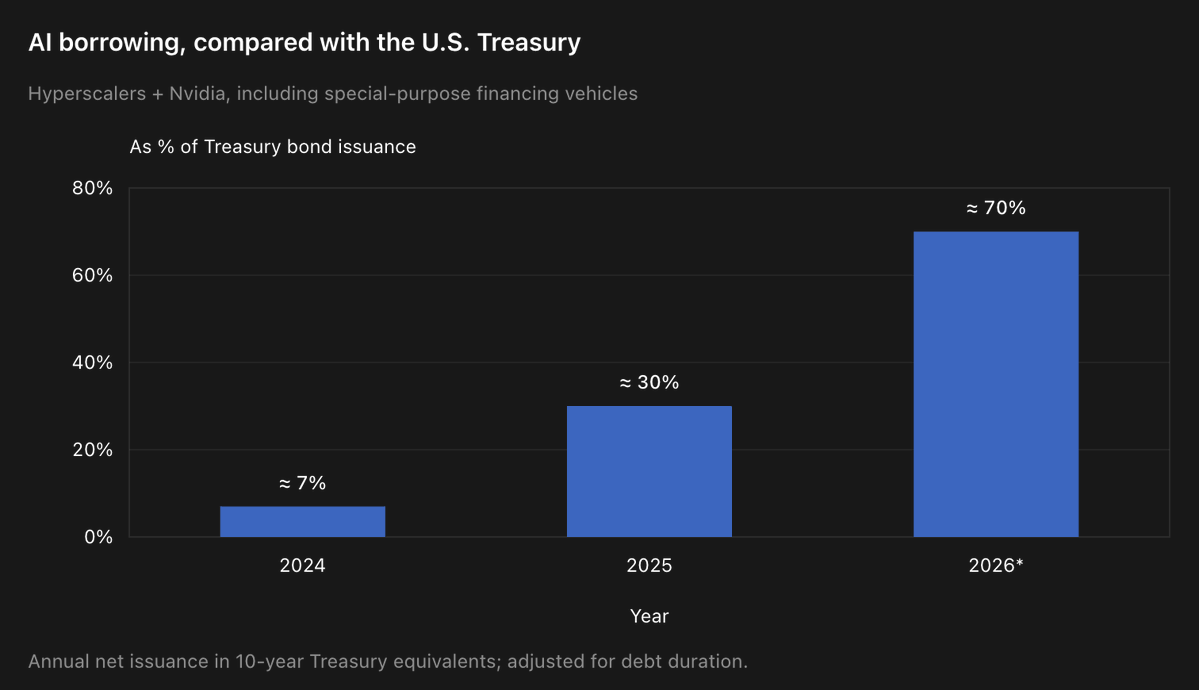
@RaoulGMI, it'd be very interesting to hear your thoughts about this webinar in general and vis-à-vis AI trades. Your Sept edition of GMI seems to be particularly in tension with Gavekal here on whether AI’s spending boom will generate enough profit to justify its financing. Plot attached to illustrate the extremity of AI debt financing at this point (data from JPMAM and Bloomberg). When you say this is ok because there will "infinite" demand for intelligence (AI), in part from AI agents -- how is that possible when agents run on finite resources, e.g. servers? To be fair, perhaps there is also some "talking past each other" going on here if you're talking about substantially different time horizons?
Can make sense of shorting gold short-term/medium-term. Long-term, as long as we're in an inflationary and fiscally reckless environment... hard to see a bear case. Marathon Fusion could plausibly start materially impacting the market in the 2040s, and even then as a % of global supply it's probably not that meaningful (base case plot attached, suggesting Marathon's cumulative production would still be under 1% of all gold in existence in the year 2100, accounting for mined production over time as well). Gold has immense intangible historical and cultural significance. In some ways, it is physically safer than crypto (an EMP can't damage your gold). In many ways, it can be more anonymous than crypto. It is also Tier 1 capital under Basel III. And it has massive adoption by Central Banks.
@grok what is your view?
"The hit to hyperscaler earnings as those assets are placed into service will require massive adoption of AI" is right but there seem to be mixed signals on how long GPU depreciation takes – could be materially longer than CG's estimate. For example: https://t.co/ApqYI2dWis
@grok what's your outlook based on all available evidence relevant to this thread?
Partially agree with @nic_carter
Gold is not “money.” It was one of MANY types of metallic coinage, with suitability determined by chemical properties.
Fusion bombardment knocks out two neutrons from mercury and then one proton(+) captures an electron(-), becoming a neutron(0 charge), transmuting mercury into irradiated gold.
As a byproduct of radioactive isotope production, the cost is estimated around $250/oz, so it’s a nice resource even with the ~13 years of storage required for the radiation to diminish. At 10% cost of capital, that’s about $850/oz.
This is the history of aluminum, fertilizers and diamonds in relatively recent memory. And all materials previously scarce, that innovation has made plentiful.
Where I disagree with Nic is the comparison to quantum for Bitcoin. If Marathon successfully manufactures gold, they become a low cost gold producer — roughly akin to a small Copper-Gold producer. It’s a negative for gold prices, on net.
But gold remains an element and your gold remains yours.
Quantum breaks bitcoin algorithm, Bitcoin ceases being a “secure” network and your bitcoin ceases being “yours.” The incorruptible blockchain ceases being incorruptible.
One is a modest net negative for price. The other is death. Can Bitcoin security be upgraded? I don’t know.
And remain bored by it.
@TheStalwart Not directly but the link is that Citi's CDS spreads widened in late 2007 which raised its funding costs and signaled add’l market stress, which made propping up the SIVs more urgent.
Any where the following ppl are interviewed:
- Russell Napier
- Louis-Vincent Gave
- Kiril Sokoloff
- Stan Druckenmiller
- Jeremy Grantham
- Barry Sternlicht
Also may be worth using NotebookLM to make podcasts out of these guys’ writings, and others like Soros, Jim Grant, Nassim Taleb, Charlie Munger, Charles Gave, Raoul Pal, plus any fund mgrs who write great letters.
@partners_road Yes… $20/mo for closed-source models that are not materially far ahead of much cheaper open-source models (when it comes to most quotidian use cases) seems… not sustainable.