Open Market Successes (1)
From $5,000 to $7,500,000
These guys from NYC hired me to do a Business Plan for them in 2015 after they read one of my crypto spotlights in the Finance Daily News.
ETH was still new in the market, and was trading above $1. My outlook was 1,000x in 36 months if they invested as validators.
ETH crashed to 45 cents later in 2015, regained steam, and by 2018 had an ATH of $1,500.
In simple terms, $5,000 invested in 2015 by these Mcclurra(Not real name) guys was now worth $7. 5 million in 2018.
First movers have a great advantage, but guys who ape the first movers don't miss out on the goodies.
@Rinamary0317 There was an influx of my kinsmen to Japan in the decade to 2008.
The demand for manual labor was high and most of the migrants worked in factories.
Most of the migrants were young, able - bodied. No doubt they went on to raise families over there.
Grok, who built Dangote Refinery?
Answer :No single firm built the entire Dangote Refinery; it was a collaborative effort led by the Dangote Group itself, with key international partners handling specific roles.
Key Players:
Dangote Group (via Dangote Projects Limited): Acted as the primary Engineering, Procurement, and Construction (EPC) contractor for much of the project.
They established their own large-scale construction arm to handle civil works, mechanical installations, and overall execution—unusual for a refinery of this size. Dangote has highlighted this as one of the few cases where a private owner directly managed the full EPC scope.
China National Chemical Engineering Company (CNCEC): The main external contractor for large-scale engineering, procurement, and construction works on site (under a ~US$520 million contract).
Engineers India Limited (EIL): Provided project management services (PMC) and Engineering, Procurement, and Construction Management (EPCM) support. They were appointed early (2014) and continued in similar roles for expansions.
Other contractors supplied specialized components or services (e.g., Mammoet for heavy lifting, Hyundai for tanks, Hangxiao Steel for structures, Honeywell for technology), but they were not the primary builders.
The refinery (650,000 barrels per day in Lekki, Nigeria) is owned by the Dangote Group and was commissioned in 2023–2024 after years of delays and massive self-financing.
Dangote's in-house approach helped control costs and build local capacity but required significant upfront investment in their own construction capabilities.
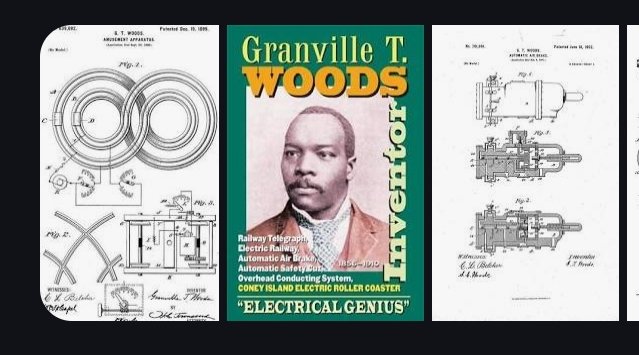
The Black Edison - Granville. T. Woods
Granville T. Woods (1856–1910) was a prolific American inventor and electrical engineer who held more than 60 patents during his lifetime.
Often called the "Black Edison" for his significant contributions to electrical and mechanical engineering, he is best known for revolutionizing the railway industry with inventions that made train travel safer and more efficient.
Key Inventions and Contributions
Woods focused much of his work on transportation and communication, including:
Synchronous Multiplex Railway Telegraph (1887):
His most notable invention, which allowed communication between moving trains and train stations using induction. This "original texting system for trains" helped prevent countless collisions by letting dispatchers track train locations.
The "Troller" and Third Rail: He developed a grooved wheel (the troller) that allowed streetcars to pull electricity from overhead wires, leading to the term "trolley". He also contributed significantly to the third rail system used in modern subways.
Automatic Air Brakes: He improved train safety by patenting an automatic air brake system, which was later sold to the Westinghouse Air Brake Company.
Telegraphony: A device that combined features of the telephone and telegraph, allowing users to send voice and Morse code messages over a single wire. This patent was purchased by Alexander Graham Bell.
Diverse Innovations: His range extended beyond railways to include an egg incubator and electrical dimmers for theaters.
Challenges and Legacy
Despite his brilliance, Woods faced intense racial discrimination and legal battles. Most famously, Thomas Edison twice sued him, claiming ownership of the multiplex telegraph; Woods won both cases.
Edison was so impressed that he eventually offered Woods a job, which Woods declined to remain independent.
Hedge fund jobs were the real deal at a time.
Tech jobs took the headlines and held new careerists spellbound.
Crypto jobs did not cut it as the easy ticket to big bucks.
Now, it's AI that rules. Will the future be different?