Matteo Berrettini ran after Stan Wawrinka to give him a Wimbledon towel to remember his last match at Wimbledon 🥹
“He’s a legend. He showed it today. Unbelievable player. Unbelievable competitor. I remember in 2014 I was playing the juniors here. I snuck in on Centre court and he was playing against Roger. I had the big honor to play against him here, court 1. I feel so honored. That’s why I ran after him. I wanted to give him the last towel that he played here.”
Class. ❤️
Bill Ackman literally gave a 44-minute masterclass that explains money better than any business school.
1. Starting early is the single biggest advantage you have. If you save $10,000 at age 22, never add another penny, and earn 10% a year, you have $600,000 by retirement. wait until 32 to start, and the same money only grows to $232,000. The decade you lose at the beginning costs you more than any decade later because compounding does its heaviest lifting at the end.
2. The return rate matters even more than most people grasp. That same $10,000 at 22 earning 10% becomes $600,000. At 15% it becomes over 4 million. At 20%, the rate Warren Buffett has achieved, it becomes 25 million. Einstein called compound interest the most powerful force in the universe. Ackman's lecture is essentially a demonstration of why.
3. Avoiding losses matters as much as chasing returns. if you reach for a 20% return but lose half your money every 12 years from bad decisions or a rough patch, your 25 million collapses to 1.8 million. Buffett's rule one is never lose money. Rule two is never forget rule one. the math of recovery is brutal, so protecting the downside is not caution, it is strategy.
4. Debt is safer, but the upside is capped. Equity is riskier, but the upside is unlimited. In the lemonade stand example, the lender who put up $250 earns a steady 10% and gets paid back first if the business fails. the equity investor who put up $500 earns over 100% if it succeeds but gets wiped out if it fails. The equity holder earns more precisely because they took the risk the lender refused.
5. The risk that matters is permanent loss, not price movement. most people think risk is the stock price bouncing up and down every day. Ackman says ignore that. the real risk is whether you will permanently lose your money. Short-term volatility is noise. the question that matters is whether you get your capital back with a return over the long run.
6. Avoid startups and complicated businesses. You do not need 100% a year to build a fortune. you need 10 to 15% over a long period. so skip the lemonade stands and unknown ventures. Invest in public companies that are established, liquid, and have to clear real hurdles before going public. If you cannot understand how a business makes money, avoid it no matter how good its track record. Ackman cites Enron, a business almost nobody actually understood.
7. Invest in a business you could own forever. if the stock market closed for 10 years, you should not be unhappy holding it. Coca-Cola is his example. easy to understand, sells a syrup and earns a profit on every drink, the population keeps growing, and it is nearly impossible to disrupt with new technology. McDonald's is another. People have to eat, the food is cheap, and they keep growing. find a business you would be comfortable holding through anything.
8. You want products people are loyal to and will pay a premium for. People buy generic flour and sugar without caring about the brand. but they want the Hershey bar, the Cadbury bar, the see's candy specifically. you do not want to sell a commodity that anyone can sell cheaper. You want something unique that customers refuse to substitute even at a 20% discount.
9. Low debt is a safety feature. In the lemonade stand example, $250 of debt was manageable. But if it had been $1,000 and the business hit a rough patch, it could have gone under and wiped out the shareholders. Find companies with little debt or so much profit relative to their interest payments that a bad year cannot sink them.
10. Barriers to entry protect your returns. You want a business that is hard for someone to compete with tomorrow. Coca-Cola's market presence is so strong that you expect to get a Coke at any restaurant. Pepsi has coexisted with it for decades, but neither can put the other out of business. If a competitor can show up next year with a better version and steal the customers, the business is not worth owning long term.
11. The best businesses are immune to outside factors you cannot control. Coca-Cola has survived 120 years through world wars, nuclear weapons, and every kind of crisis, and each year it makes slightly more money. You want companies that do not depend on commodity prices, interest rates, or currency moves. A business that keeps earning regardless of what is happening in the world is the kind you hold forever.
12. Low capital intensity is one of the most underrated qualities. The worst businesses require massive reinvestment to grow. The auto industry has to build enormous factories and buy machine tools before selling a single car, and those tools wear out. GM's stock barely moved over 40 to 50 years for exactly this reason. Coca-Cola, by contrast, sells a formula and collects a royalty. American Express takes a few percent of every dollar spent on its card. a business that earns a royalty on other people's capital is one of the best things you can own.
13. Pay down debt and build a cushion before you invest. If you have high-interest credit card debt, paying it off is a guaranteed return equal to the interest rate. same logic, to a lesser degree, with student loans at 6 or 7%. and you want 6 to 12 months of expenses in the bank so that losing your job tomorrow does not force you to sell. You can only handle market volatility if you do not need the money.
14. Be a buyer when everyone is selling and a seller when everyone is buying. The natural human tendency is the opposite, a lemming-like instinct to sell in a crash and buy in a bubble. people sold into the 1987 crash when they should have been buying. The only way to resist this is to be financially secure enough that the money at risk does not affect your life, so you can withstand the swings without panicking.
15. The stock market is a voting machine in the short term and a weighing machine in the long term. Ben Graham's idea, which Ackman repeats. short-term prices reflect the whims and emotions of investors. long term, prices reflect the actual value of the underlying businesses. If you buy good businesses at reasonable prices and hold them while they grow, you make money over time as long as you are never forced to sell at the wrong moment.
16. A stock is just a bond where you do not know the coupon. Flip a price-to-earnings ratio over, and you get an earnings yield. A stock at 10 times earnings is a 10% earnings yield, which you can compare directly to a 3% treasury. the difference is the bond's coupon is fixed and the stock's coupon, its earnings, moves up and down. Ackman wants an earnings yield higher than a treasury that will also grow over time, so he does not need to be right about explosive growth to earn a good return.
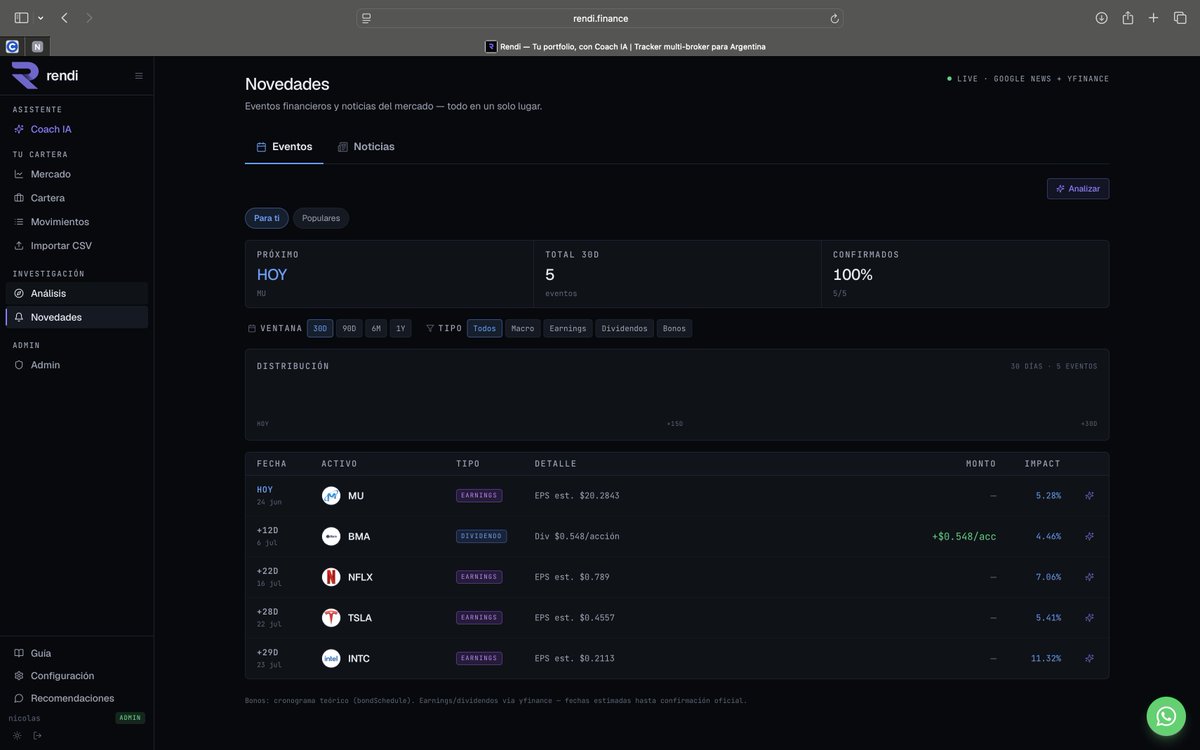
Hace 4 años que invierto en acciones, CEDEARs y cripto. Y nunca tuve claro cuánto estaba ganando de verdad. Por eso construí Rendi. Subís el historial de tu broker y en 2 minutos tenés:
→ Todas tus posiciones en un solo lugar, en pesos y en dólares
→ Tu rendimiento real, ajustado por inflación y comparado vs S&P 500
→ Métricas de tu comportamiento: concentración, comisiones, drawdown
→ P&L calculado por FIFO (real, no estimado)
→ Un chat con IA que analiza tu cartera y te dice qué mejorar
Todo desde una plataforma, Gratis. https://t.co/jNUmJEq6Dq
@gneffa Gustavo, te faltó agregar que las hyperscalers que están impulsando esta fiebre de inversión en CAPEX cotizan a múltiplos muy bajos. No coincido para nada en tu view, el índice puede aparentar caro, pero si buscas por dentro te vas a sorprender…
@CarlosMaslaton Carlos, crees que Israel pueda seguir con tantos frentes activos en medio oriente sin el apoyo de los EEUU? Si se va USA se acaban las excursiones de Bibi.
Los saludos para Stan Wawrinka:
Roger Federer
Rafa Nadal
Novak Djokovic
Gael Monfils
Carlos Alcaraz
Jannik Sinner
❤️ Eso es ser una verdadera leyenda de este deporte.
🔥 “FUE EL MEJOR PARTIDO DE MI VIDA”
Es un gran momento para recordar la final de Roland Garros 2015, cuando Stan Wawrinka derrotó a Novak Djokovic por 4-6, 6-4, 6-3 y 6-4.
El suizo jugó un tenis absolutamente DESCOMUNAL.
🤔 ¿Qué opinan de este consejo de Toni Nadal a Alexander Zverev?
🗣️ "Hay dos jugadores que son extraordinarios, Jannik Sinner y Carlos Alcaraz... A Alexander Zverev le aconsejé que hay que aceptar que ellos están un poco por encima de él".
🗣️ "Le puse el ejemplo de que, estando Rafael, Federer y Djokovic por encima de sus rivales, Andy Murray ganó tres Grand Slams y Stan Wawrinka ganó otros tres".
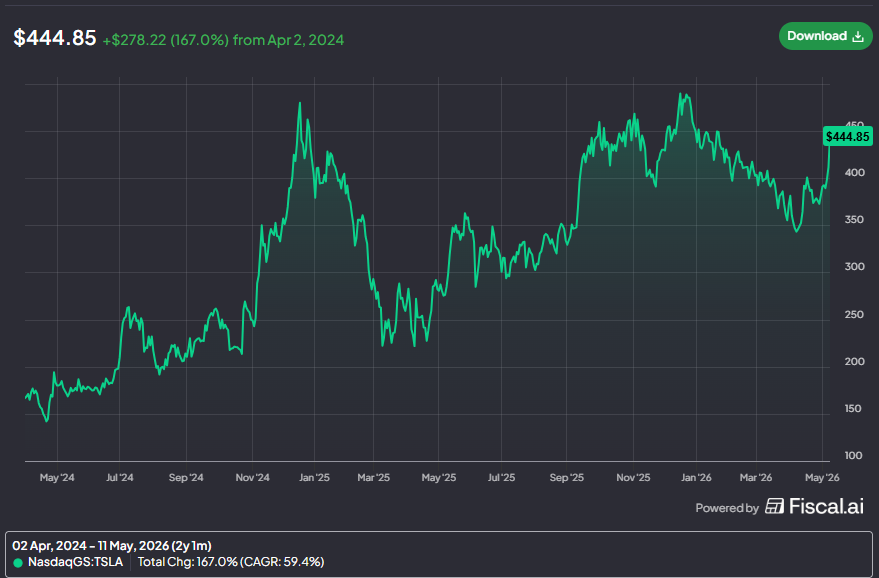
Retrocedamos el reloj 2 años atrás. $TSLA costaba $ 166, acumulaba 33% de baja YTD y una corrección del 59% desde su ATH del 2021. Llegó a caer 41.5% YTD en el 2024 cuando reinaban las malas noticias.
La narrativa era muy fea, en sintonía con la cotización.
Cuando un activo corrige fuerte casi todo el mercado le ve poco atractivo. "No sirve mas, es una burbuja, no puede valer mas que todas las automotrices juntas, Elon nunca cumple, hay que shortearla, ya el mercado no quiere autos eléctricos, todo lo bueno ya está en precios" y cientos de etc. Suelen predominar las noticias negativas cuando una acción performa mal en un período relativamente corto y es habitual que se pierda contexto sobre el valor de largo plazo del negocio.
Algo similar ocurre por ej. con $MELI en estos tiempos con el negocio en mi opinión disociado de cómo le va a la cotización.
Dos años despúes $TSLA cuesta 167% mas y quedó a un 11% de suba para volver a máximos históricos. Curiosamente dejaron de verse noticias negativas a diario pero tampoco se leía que era oportunidad de compra, sinó todo lo contrario. Es difícil el mercado. Por eso mi recomendación es alejarse del ruido de corto plazo y poner mas foco en cómo le va al negocio. El tiempo suele remunerar bien la espera cuando a la empresa le va bien. Mis dos centavos.