- Workout 4x a week
- Quit alcohol & drugs
- Walk 10-15k steps/day
- Eat a nutrient dense diet
- Remove processed sugars
- Eat 1g of protein per lbs of idea bw
- Work on a goal that means something to you
Do this for the last 6 months of 2026 and you'll be unrecognizable.
The best way to get in shape for 99% of people:
Become a hybrid athlete.
You'll build muscle, burn fat, & add years to your life.
Don't know where to start?
Here's a realistic week of hybrid training (save this):
Stop training your core like your spine is disposable.
Crunches and sit-ups get all the attention, but they repeatedly flex the lumbar spine under load — not ideal if your back is sensitive.
Side planks are different.
They train your core to do what it’s actually built to do:
1. resist unwanted movement
2. stabilize your spine
3. support your pelvis
4. strengthen your obliques and quadratus lumborum
5. activate your glute medius
6. improve balance and postural control
And they do all of this with minimal spinal flexion.
That makes them a more spine-sparing option for many people compared with traditional crunches.
The best part?
You can scale them easily.
1. Start with knees bent.
2. Hold for 10–20 seconds.
3. Keep your ribs stacked over your pelvis.
4. Breathe.
5. Progress only when you can hold clean form.
Your core is not just for looking strong.
It’s for keeping your spine, hips, and pelvis working together.
CTA: Try 2–3 short side plank holds per side today and notice which side feels weaker.
🚨 Most people do squats wrong for real results after 40.
Regular squats build strength.
But they miss the explosive power their body needs to stay strong, mobile, and independent as they age.
Enter squat jumps.
This movement is a plyometric upgrade that fires up fast-twitch muscle fibers, one that builds strength and power.
They also torch calories, and trigger bone remodeling through impact.
Studies show just weeks of jump training can boost vertical jump height by ~25%.
I see the vicious cycle all the time: declining muscle power → poor balance → higher fall risk → loss of independence.
Squat jumps break this cycle by building explosive strength in your quads, glutes, hamstrings, core, while supporting bone density.
Try this: 3 sets of 8-10 squat jumps.
1.Stand with feet shoulder-width apart.
2.Squat down.
3.Propel upward into a jump.
https://t.co/njsTX5GReq soft and repeat.
No equipment needed.
Are you ready to jumpstart your power?
#LongevityTraining
#StrengthAfter40
#SquatJumps
Mastic gum ELIMINATED every pathogen it was tested on.
Killed S. mutans within 15 minutes. Killed H. pylori in 14 days - including antibiotic-resistant strains.
→ P. gingivalis: found in 96% of Alzheimer’s brain tissue. killed
→ F. nucleatum: linked to colon cancer. killed
→ Candida: fungal overgrowth. killed
Not one survived.
the bacteria behind your cavities. your bloating. your brain fog. your acid reflux. all killed by ONE compound
and it left the beneficial bacteria ALIVE. no cytotoxicity. improved cell health in studies while mouthwash damaged it
a tree resin. one island in Greece. 2,500 years of use. you chew it or take it as capsules
250 tons produced per year worldwide. most of what you’ll find isn’t real. more below:
The U.S. Army just changed its fitness test for the first time in decades.
There are 5 events that give you the cleanest picture of your level of functional fitness.
Here's the test:
TENDON TRAINING ELIMINATES THE WEAKNESS THAT MAKES STRONG MEN FRAGILE
Many guys can move serious weight in the gym but get wrecked picking up a dropped phone. That disconnect reveals something most fitness advice completely misses.
Your muscles get stronger fast. Your tendons adapt three times slower. After 40, this gap becomes dangerous. One awkward movement and you're dealing with a torn Achilles, blown rotator cuff, or knee pain that won't quit for months.
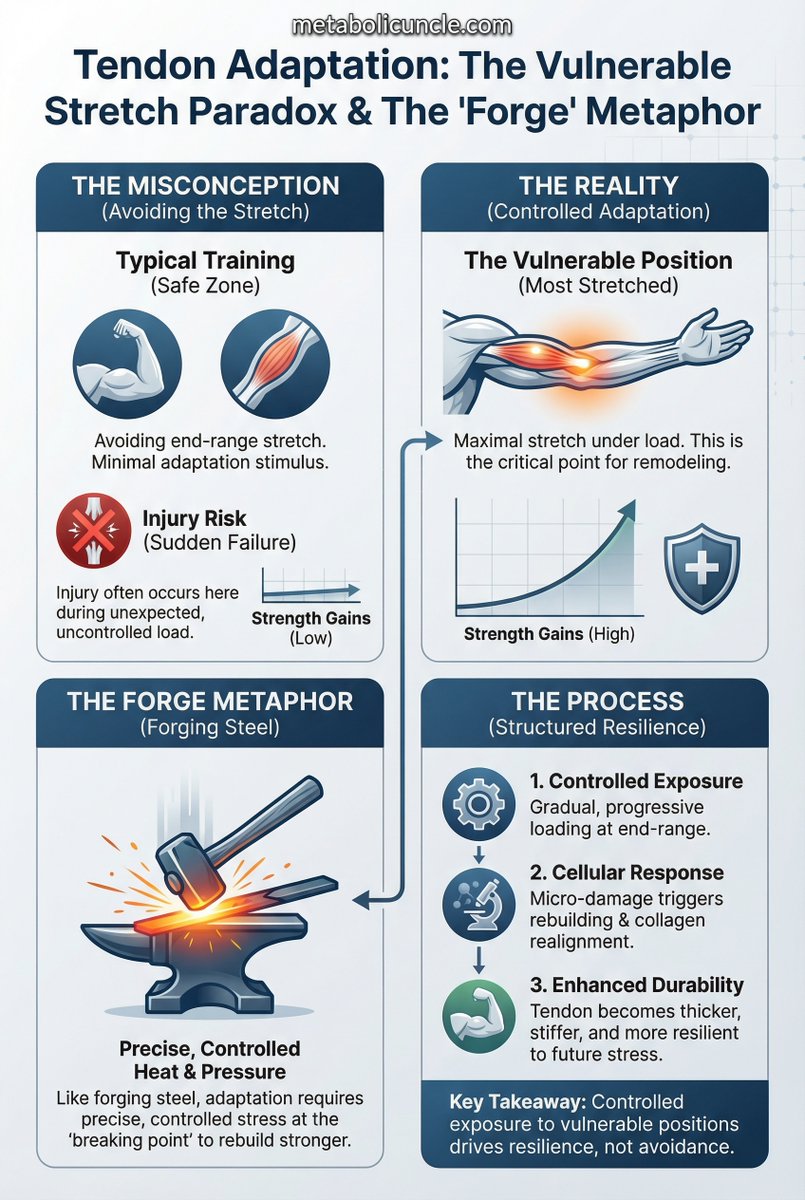
The standard response is backing off from activities. Taking it easy. Accepting that your body just can't handle stress anymore. That's exactly backwards. Weak tendons need controlled stress to adapt, not protection from stress.
Five specific isometric holds create that adaptation. They force your tendons to handle sustained tension at their most vulnerable positions. Ten minutes, three times weekly. The results show up in everyday movement, not just gym performance.
STANDING CALF RAISE HOLD
Your Achilles tendon handles massive loads with every step. When it fails, you lose explosive power and develop that shuffling gait that screams fragility. The injury happens suddenly but the weakness builds over years.
Eccentric loading builds tendon strength better than any other method. Tendons respond to time under tension, not repetition count. The stretched position creates the most adaptation signal.
Stand on the balls of your feet at a step edge. Rise up high, then lower slowly until you feel a deep stretch in your calves. This stretched bottom position is where you hold. Your calves burn. Your Achilles feels the tension. That discomfort signals collagen remodeling in the tendon fibers.
Start with 30 seconds. Add 15 seconds weekly until you reach two minutes. This takes six weeks of consistent work. Most people make three mistakes that kill their progress.
First mistake is holding at the top instead of the stretched bottom. The stretched position creates tendon stress. The top position just works your calves without targeting the Achilles effectively.
Second mistake is bouncing to relieve tension. Stay completely still. The sustained tension forces adaptation. Bouncing turns this into a calf exercise instead of tendon training.
Third mistake is rushing progression. Adding too much time too fast creates inflammation instead of adaptation. Your tendons need gradual stress increases to remodel properly.
This hold prevents the biomechanical breakdown that leads to falls and mobility loss. Your Achilles becomes capable of handling sudden direction changes and explosive movements. Stairs become effortless. You can sprint without fear. Your balance improves because ankle stability increases.
No equipment needed. Just a step and two minutes. The payoff is maintaining athletic movement capacity while your peers nurse chronic tendon problems.
SPANISH SQUAT HOLD
Knee pain is nearly universal after 40. The standard advice is avoiding squats and accepting weak knees as inevitable. That thinking creates the exact problem it claims to prevent.
The issue isn't the knee joint itself. It's weak patellar tendons that can't handle basic loads. Traditional squats train the muscles but miss the tendons. The Spanish squat hold isolates patellar tendon stress while eliminating joint compression.
Place a resistance band around your knees. Stand with your back against a wall. Slide down until your thighs are parallel to the floor. Your knees should be directly over your ankles, not pushed forward.
The band pulls your knees inward. Your patellar tendons resist that force while supporting your body weight. This creates tendon adaptation without grinding your knee joints.
The angle matters enormously. Too shallow and you miss the tendon stress. Too deep and you create joint compression. Parallel thighs hit the zone where your patellar tendons work hardest while your knees stay protected.
Start with 30 seconds using light band tension. Increase hold time first, then band resistance. Work up to 90 seconds over six weeks. The burn in your quads is normal. Sharp knee pain means you're too deep or progressing too aggressively.
This eliminates the knee pain that makes stairs torture and getting up from chairs an ordeal. Your patellar tendons become load-tolerant. They can handle squats, lunges, and sudden direction changes without inflammation.
Most knee problems are actually tendon problems disguised as joint problems. Weak tendons create instability, which creates compensations, which creates pain. Strong tendons create stability, which creates pain-free movement.
You notice the difference in daily activities immediately. Stairs stop being a negotiation with pain. Getting out of bed doesn't require momentum and groaning. Your knees feel stable instead of fragile.
You're not avoiding stress on your knees. You're preparing them to handle any stress life throws at them. Strong tendons mean strong knees. Strong knees mean confident movement. Confident movement means staying active and independent for decades.
DEEP PUSH-UP ISOMETRIC HOLD
Elbow and wrist pain destroy your ability to push, press, and grip. Desk work creates forward head posture that overloads your forearms. Repetitive stress from typing inflames your tendons. The result is tennis elbow, golfer's elbow, and carpal tunnel that makes basic tasks torture.
The deep push-up isometric hold targets the exact problem. You're loading your elbow and wrist tendons at their most vulnerable position while building resilience through controlled stress.
Get into a push-up position and lower yourself to the bottom. Your chest should be one to two inches from the floor. Your elbows stay close to your body, not flared wide. This bottom position creates maximum stretch on your elbow and wrist tendons.
End range loading is the key insight. Tendons are weakest where they stretch the most. By holding at the bottom position, you're forcing adaptation at the exact point where injuries happen. Your forearm tendons learn to handle stress in their most vulnerable position.
If you can't hold a full push position, start from your knees. Same principles apply. You're still loading the tendons at end range, just with less body weight. Progress from knees to full plank over four to six weeks as your tendon strength improves.
Start with 20 seconds. Your arms shake. Your wrists feel the stretch. That's the signal for tendon remodeling. Add 10 seconds weekly until you reach 60 seconds. Don't rush this progression. Tendon adaptation takes time.
Most people make the mistake of holding too high. They stop at mid-range where it feels easier. The bottom position is where the adaptation happens. Your tendons need to adapt to stretched positions under load. That's where real-world injuries occur.
This hold eliminates the nagging elbow pain that makes lifting coffee cups uncomfortable. Your wrist tendons become resilient to repetitive stress. Tennis elbow and golfer's elbow disappear because your tendons can handle the loads that previously caused inflammation.
The transfer to daily activities is immediate. Pushing doors becomes effortless. Lifting objects overhead doesn't create elbow pain. Your grip strength improves because your forearm tendons support better force transmission. You eliminate the weakness that makes simple tasks feel like injury risks.
WALL EXTERNAL ROTATION HOLD
Shoulder impingement and rotator cuff tears are the most common upper body injuries after 40. Forward head posture from desk work destroys shoulder mechanics. Your rotator cuff tendons get pinched between bones with every overhead movement. Eventually they tear.
The wall external rotation hold targets the weakest link in shoulder stability. Your rotator cuff has four muscles but external rotation is always the weakest. When it fails, your shoulder becomes unstable and pain follows every movement.
Stand arm's length from a wall. Place your right elbow against the wall at shoulder height. Your elbow should be bent 90 degrees with your forearm parallel to the floor. Press your hand backward against the wall as if you're trying to rotate your arm away from your body.
This specific angle targets the posterior rotator cuff tendons that stabilize your shoulder blade. These are the muscles that pull your shoulders back and counteract forward head posture. When they're strong, your shoulders sit in proper position. When they're weak, impingement and pain follow.
The wall provides perfect resistance. You control the pressure, which means you control the load on your tendons. Start with light pressure and focus on the feeling of your shoulder blade pulling back toward your spine.
Begin with 30 seconds using moderate pressure. You should feel the work in the back of your shoulder and between your shoulder blades. Increase pressure first, then hold time. Work up to 60 seconds over six weeks.
Most people press too hard too fast. The rotator cuff tendons are small and delicate. They adapt slowly but surely when you respect the progression. Aggressive loading creates inflammation, not strength. Consistent moderate loading creates bulletproof shoulders.
This hold prevents the forward shoulder posture that leads to impingement. Your rotator cuff tendons become strong enough to stabilize your shoulder during overhead activities. Sleep becomes comfortable again because your shoulders can relax in proper position.
The real world benefits are massive. Reaching overhead stops causing sharp pain. Your posture improves because your shoulders can hold themselves back. Neck pain decreases because your head sits over your shoulders instead of jutting forward. You move with confidence instead of protecting painful joints.
You're not waiting for a rotator cuff tear to force you into physical therapy. You're building the tendon strength that prevents tears from happening. Strong rotator cuffs mean stable shoulders. Stable shoulders mean pain-free movement for life.
ACTIVE DEAD HANG
Grip strength predicts cardiovascular health, cognitive function, and lifespan better than any other single measurement. When your grip fails, everything else follows.
The active dead hang isn't just hanging from a bar like dead weight. You're actively engaging your lats and shoulders to decompress your spine while building grip and upper chain tendon strength. This is compound tendon training.
The difference matters. A passive hang lets your shoulders sink into their sockets. An active hang engages your lats to pull your shoulders down and back. You're creating space between your vertebrae while strengthening every tendon from your fingertips to your spine.
Find a pull-up bar or sturdy overhead structure. Grab with both hands shoulder-width apart. Instead of just hanging, think about pulling your shoulders away from your ears. Your lats should engage, creating a slight hollow in your torso. This is active hanging.
Start with assisted hangs if needed. Use a resistance band around your feet or stand on a box to reduce body weight. The goal is building time under tension, not ego lifting. Progress from 15 second assisted hangs to 60 second full body weight hangs over six weeks.
This reverses decades of desk posture damage. Your spine decompresses, relieving pressure on discs and nerves. Your grip tendons adapt to supporting your full body weight. Your shoulder and elbow tendons get strengthened through the entire kinetic chain.
The compound effect is massive. Your grip becomes vice-like. Your shoulders decompress and pain disappears. Your posture improves because your lats learn to hold your shoulders in proper position. You eliminate the forward head posture that creates neck pain and headaches.
THE PROTOCOL
Three times per week. Ten minutes total. Start with the minimum hold times and progress weekly. Your tendons adapt slowly but permanently when you respect the timeline.
Research shows collagen synthesis peaks 72 hours after tendon loading. That's why three times per week works perfectly. You're giving your tendons the stress they need with the recovery time they require.
Most training programs focus on muscle hypertrophy and ignore tendon adaptation. That creates strong muscles attached to weak tendons. The result is predictable. One awkward movement and something tears.
These five holds reverse that imbalance. Your tendons become as strong as your muscles. You can handle sudden stress without injury. Your movement stays athletic and confident instead of cautious and protective.
The adaptation takes weeks, not days. Tendons remodel slowly. Rushing the progression creates inflammation instead of strength. Respecting the timeline creates permanent improvement.
Your body becomes resilient instead of fragile. Strong tendons mean confident movement. Confident movement means staying active for decades. Ten minutes, three times weekly. That's the investment for eliminating the weakness that makes strong men fragile.
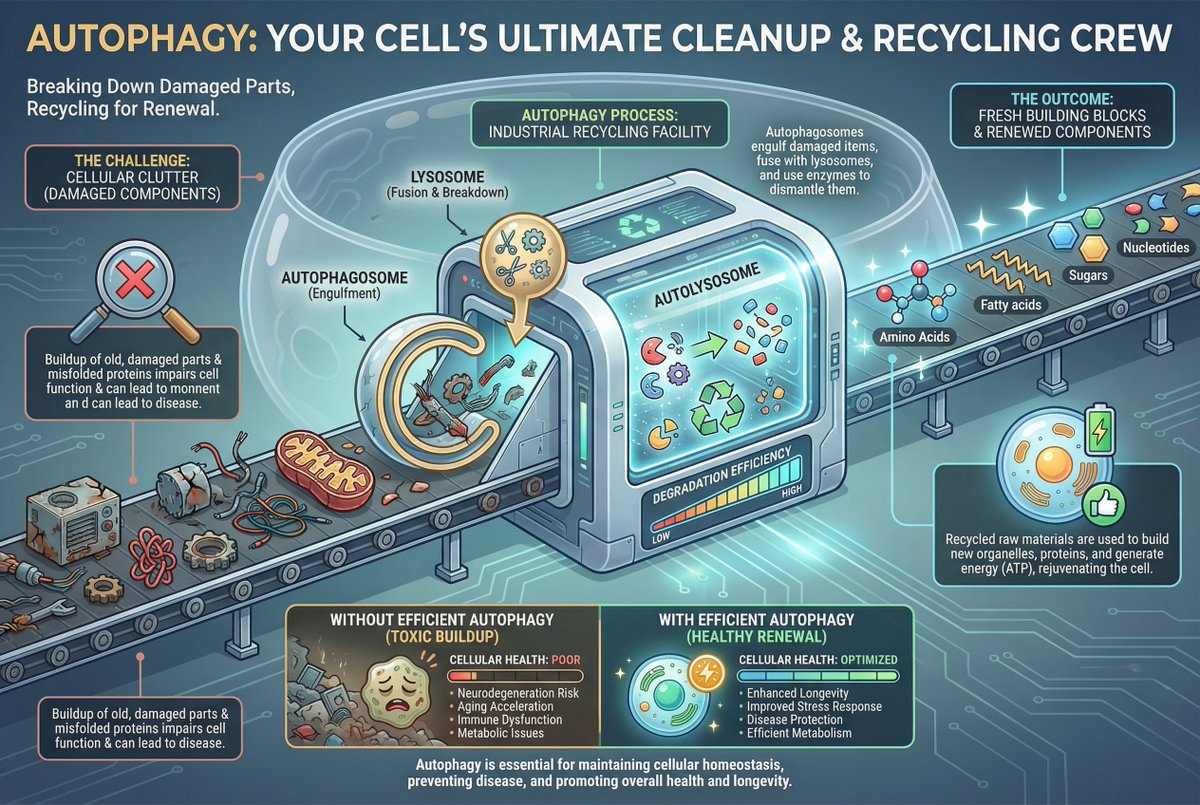
AUTOPHAGY WITHOUT FASTING
Your cells run a recycling program. Most people think fasting activates it. They skip breakfast, wait 16 hours, track their eating window, and assume the machinery starts automatically.
Research published in Nature Cell Biology says otherwise. Fasting sends a signal. That signal triggers the release of specific compounds inside your cells. Those compounds execute the actual program.
Without adequate levels of those compounds, the signal arrives and nothing happens. The recycling plant stays closed.
One compound is called spermidine. Your body produces it naturally, but production declines with age. By your 40s, cellular spermidine levels drop by roughly half. By your 60s, they're lower still. The fasting signal keeps firing. The machinery doesn't respond.
This explains why some people fast for years and see minimal results. The signal works fine. The execution mechanism is depleted.
Autophagy is cellular recycling. Your cells accumulate damaged proteins, dysfunctional mitochondria, and oxidized lipids during normal metabolism. When autophagy functions properly, specialized structures called autophagosomes form around this cellular debris, fuse with lysosomes, and break everything down into reusable components.
Amino acids get recycled into new proteins. Damaged mitochondria get cleared before they can trigger inflammation. Oxidized fats get processed before they accumulate.
When autophagy slows or stops, cells fill with junk. Damaged mitochondria leak inflammatory signals. Misfolded proteins aggregate. Energy production drops. Inflammation rises. The aging process accelerates.
Two master switches control whether autophagy happens. The first is mTOR, mechanistic target of rapamycin. When mTOR is active, your cells are in growth mode. Protein synthesis runs high. Cell division proceeds. Autophagy stays suppressed.
You need mTOR active when you're young, growing, recovering from injury, or building muscle. You don't need it active 24 hours a day for decades.
The second switch is AMPK, AMP-activated protein kinase. AMPK activates when cellular energy drops. When AMPK senses low energy, it suppresses mTOR and activates autophagy. Fasting activates AMPK naturally by depleting glucose and lowering insulin. But fasting isn't the only trigger.
Most autophagy research focuses on these two switches. Suppress mTOR or activate AMPK, and autophagy begins. Hundreds of studies confirm this. Thousands of protocols are built around it.
But August 2024 changed the framework. The Nature study showed that mTOR suppression and AMPK activation are necessary but insufficient. Even with both switches in the correct position, autophagy doesn't fully execute without adequate spermidine.
Spermidine works through a completely different mechanism. It operates at the gene expression level, not the metabolic signaling level. Spermidine inhibits an enzyme called EP300.
EP300 normally keeps autophagy genes in a suppressed state through acetylation. When spermidine inhibits EP300, three critical autophagy genes are released from suppression simultaneously: ATG7, ATG5, and ATG11. These genes encode the structural proteins that build autophagosomes.
Spermidine also activates a translation factor called eIF5A through hypusination. Hypusinated eIF5A dramatically increases synthesis of TFEB, transcription factor EB.
TFEB moves into the cell nucleus and switches on the lysosomal biogenesis program. This builds entirely new lysosomes, the organelles that fuse with autophagosomes to complete the recycling process.
Most importantly, spermidine activates autophagy independent of mTOR status. This means it works even when you've just eaten, even when insulin is elevated, even when mTOR is fully active. Every other autophagy trigger requires metabolic preconditions. Spermidine bypasses them entirely.
The practical implication is straightforward. If you fast without adequate spermidine, the metabolic signals fire but the genetic machinery doesn't fully respond. If you consume spermidine without fasting, autophagy activates anyway.
Spermidine declines with age for a simple reason. Your gut bacteria produce it from the amino acid ornithine. Aging reduces both the diversity and metabolic activity of your gut microbiome. Bacterial spermidine production drops. Dietary intake becomes essential.
The highest dietary source is aged hard cheese. Parmesan contains roughly 200 milligrams of spermidine per kilogram. Gruyere contains similar levels. The aging process concentrates spermidine as bacteria metabolize amino acids during fermentation. Longer aging produces higher spermidine content.
Studies on longevity consistently show spermidine extends lifespan across multiple species. Yeast, roundworms, fruit flies, and mice all live longer with spermidine supplementation. The mechanism appears to be autophagy activation. When researchers block autophagy genes, spermidine's longevity effects disappear entirely.
Human epidemiological data supports this. A 2018 study tracked dietary spermidine intake in over 800 participants for 20 years. Higher spermidine intake correlated with significantly reduced all-cause mortality. The effect remained after adjusting for other dietary factors. People eating the most spermidine-rich foods lived longer.
But spermidine works best as part of a system, not in isolation. Seven other compounds activate autophagy through complementary mechanisms. Together, they create a multi-directional activation protocol that addresses every known bottleneck in the autophagy pathway.
Each compound works through a different mechanism. Each targets a different bottleneck in the autophagy pathway. Together, they create a system that activates cellular recycling from multiple directions simultaneously.
No single food replaces fasting entirely, but the combination addresses every known limitation in the autophagy activation sequence.
All the compounds and their practical application organized into a daily protocol that maximizes autophagy activation while maintaining metabolic flexibility, appears in Part 2.
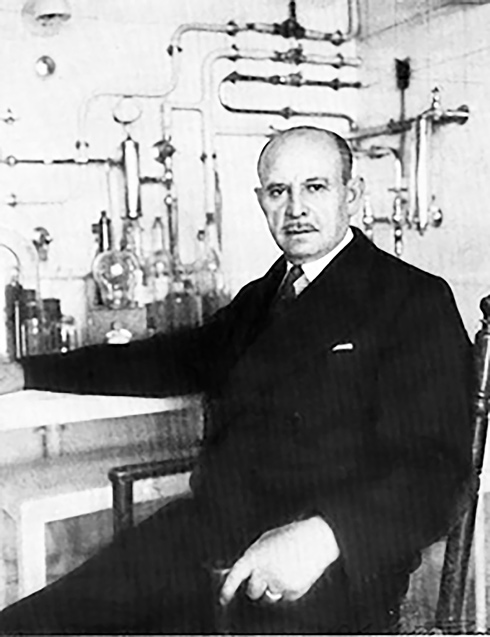
This is Georges Lakhovsky.
He cured plant tumors with a copper ring, linked cancer to geology & argued cells behave like antennas.
In 1941, he arrived in New York. In 1942, he was struck by a limousine & died. Soon, hospitals removed his machines.
Here's what he documented: 🧵
🚶♀️ Think a gentle daily walk is enough after 50? Japanese doctors proved it’s not.
This simple 2007 Shinshu University protocol (alternating 3 minutes fast + 3 minutes slow) just saw nearly 3,000% surge in interest in 2026.
Why? Because it crushes plain walking.
In the key study, middle-aged and older adults doing this 30+ minutes, 4+ times per week saw:
• 13% stronger thighs
• 17% stronger hamstrings
• 9% boost in peak aerobic capacity (with some hitting up to 20%)
• Greater drops in blood pressure vs moderate steady walking
This isn’t just movement—it breaks the vicious cycle of age-related muscle loss, falling fitness, and rising vascular risk. No gym. No injury spike. Just smarter walking for real metabolic and strength gains.
Just smarter walking that delivers bigger metabolic and strength gains.

Ready to level up your walks? Start today:
• 3 min brisk (you can talk but not sing)
• 3 min easy, repeat for 30 minutes. Aim for 4x this week.
• What’s your biggest walking win or struggle right now?
What’s your biggest walking win or struggle right now?
#JapaneseWalking
#IntervalWalking
#Longevity
Source:
Nemoto et al. (2007), Mayo Clinic Proceedings (Shinshu University study on high-intensity interval walking training in middle-aged/older adults).
You should do both strength training and cardio, but if you compare head-to-head, then cardiorespiratory fitness has a much higher ceiling for longevity benefits.
In this analysis of 500k people, the mortality benefits for grip strength (a measure of muscle strength) plateaued at the intermediate level, whereas for cardiorespiratory fitness the benefits kept going even at high levels.
The hazard ratios were the same for "intermediate grip strength and high cardio" and "high grip strength and high cardio".
Also, low grip strength, but high cardiorespiratory fitness outperformed high grip strength but low cardiorespiratory fitness.
The combination of both is better than one or the other alone, but having high cardio pays off more than high strength.
PMID: 29594847
Botox is outdated.
Science has discovered that pairing a specific peptide with red light therapy can reverse aging by repairing skin from both outside and inside.
Let's look at the results: (1/10)
You floss. You bleed. That bacterium doesn’t stay in your mouth.
It crosses into your bloodstream. Then it crosses into your brain.
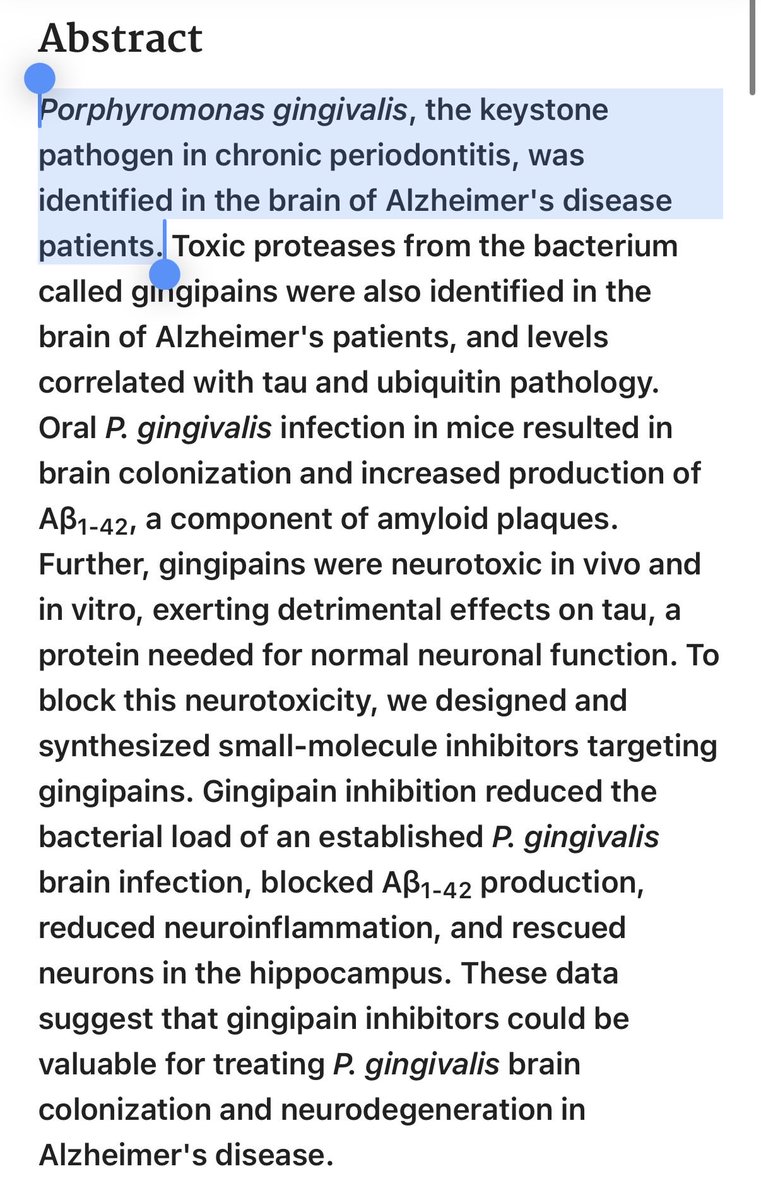
It was found in 96% of Alzheimer’s tissue.
P. gingivalis.
It lives in your gum pockets. Feeds on blood. Destroys tissue.
Human brains. Post-mortem. Published study.
Your dentist has seen your bleeding gums hundreds of times. Never once mentioned your brain.
Bleeding gums aren’t a cosmetic problem. They’re a direct threat to your brain:
→ severe gum disease = 6.87x higher risk of Alzheimer’s
→ it fragments tau - the protein your neurons need to function
→ it increases amyloid-beta plaques - the hallmark of Alzheimer’s
→ it breaks down the blood-brain barrier - letting MORE pathogens in
Brain fog that won’t lift? Memory getting worse? Can’t focus like you used to?
It might not be aging. It might be your oral bacteria.
Stop the bleeding and you starve it. Chew mastic gum and you kill it.
The daily protocol:
→ morning: coconut oil pulling. 10 min. spit. loosens surface bacteria. it’s free and it’s in your kitchen
→ after meals: mastic gum. chew 20 min. a resin from Greece that releases antibacterial compounds below the gumline. published data against P. gingivalis, H. pylori, S. mutans, and F. nucleatum
a month of mastic gum costs less than one dental cleaning. except this one actually kills the bacteria your dentist never mentioned
mastic gum is the weapon. coconut oil is the cleanup. use both.
A 2016 Harvard study found that men who ejaculate 21 or more times a month have a lower risk of prostate cancer compared to those who ejaculate 4-7 times a month.
High cortisol cuts 7 years off your life, tanks libido, destroys your sleep, increases body fat and literally melts your brain.
Here are 7 science-backed ways to lower it naturally:
1. Saunas (at 160-200°F)
THE ASPIRIN REVOLUTION: RECLAIMING YOUR METABOLIC RATE FROM THE FATTY ACID TRAP
Aspirin is a powerful metabolic tool that can restore cellular energy production and reverse metabolic decline. Modern guidelines frequently promote fat oxidation. However, chronic stress and high levels of circulating free fatty acids actually block the body from burning glucose.
This block leads to cell stress, which can manifest physically as cold hands, a sluggish liver, and muscle wasting. Aspirin shuts down these pathways. By lowering systemic inflammation, it helps the body return to burning glucose.
Aspirin acts by stopping the cyclooxygenase enzymes, which are responsible for producing inflammatory prostaglandins. Once you swallow aspirin, the liver rapidly converts it into salicylic acid. Unlike its parent compound, salicylic acid alters cellular signaling pathways directly.
It binds to a specific kinase protein to prevent the inflammatory signaling protein from entering the cell nucleus. This stops cells from making inflammatory cytokines. These proteins promote chronic swelling and cellular stress.
Chronic inflammation directly disrupts how your body handles fat tissue. Inflammatory cytokines suppress an enzyme in fat cells called phosphodiesterase 3B. When this enzyme is inactive, hormone-sensitive lipase becomes active.
It floods the bloodstream. Tissues are then forced to burn fat instead of sugar. Salicylic acid stops this process by keeping the protective enzyme active, which keeps fat locked in storage and lowers circulating free fatty acids.
An excess of free fatty acids in the blood triggers a metabolic block known as the Randle cycle. When cells are forced to burn fat, they turn on a specific kinase enzyme that shuts down the pyruvate dehydrogenase complex.
This complex is the enzyme that allows glucose to enter the mitochondria for energy production. Without it, the cell fails to burn glucose. Salicylic acid clears this block by lowering free fatty acids and restoring the activity of the glucose-burning enzyme.
Salicylic acid also directly activates the energy sensor of the cell, known as AMP-activated protein kinase. It binds directly to a specific regulatory subunit of this sensor, stabilizing it and keeping it active.
This direct binding distinguishes salicylic acid from diabetes drugs like metformin, which activate the energy sensor indirectly by draining cellular energy. It works directly. This action helps balance blood sugar levels and reduces fat buildup in the liver.
The impact of salicylic acid on the mitochondria depends entirely on the dose. At high concentrations, salicylic acid acts as a proton carrier across mitochondrial membranes. It moves protons directly into the mitochondrial interior, bypassing the normal pathway that generates energy.
This process is called mitochondrial uncoupling. Only high doses of aspirin cause this uncoupling. It requires very high doses to produce mild uncoupling, while toxic doses cause severe, uncontrolled uncoupling that leads to dangerous fevers.
High doses of salicylic acid stimulate the respiratory center in the brain. This causes hyperventilation. The resulting drop in carbon dioxide creates an alkaline state in the blood, which shifts the oxygen-hemoglobin curve.
This shift makes hemoglobin hold onto oxygen more tightly, which actually reduces the release of oxygen into peripheral tissues. It restricts oxygen release. Glucose oxidation produces more energy per unit of oxygen consumed, making sugar the superior fuel for cellular respiration.
Salicylic acid also influences thyroid function by displacing thyroid hormones from their carrier proteins in the blood. This displacement temporarily raises free active thyroid hormones. It also suppresses inflammatory proteins that normally block the liver from converting inactive thyroid hormones into their active form.
Still, the body downregulates thyroid activity if total energy intake is too low. Fasted exercise worsens this problem by starving cells of glucose and triggering a large stress hormone response.
The main drawback of aspirin is stomach irritation, which happens through local and systemic pathways. In the highly acidic stomach, salicylic acid remains neutral and passes easily through cell membranes. Once inside the neutral cells of the stomach lining, the acid loses a proton and becomes charged.
It is now trapped. This charged molecule remains inside the cell, causing cell swelling and damage. Dissolving aspirin with sodium bicarbonate neutralizes the local acid, which stops the drug from trapping itself and reduces stomach lining damage.
Buffering protects the stomach locally, but systemic side effects can still occur because absorbed aspirin blocks the enzymes that produce prostaglandins. These prostaglandins are necessary to maintain blood flow and protective mucus in the stomach. Because of separate risks, children recovering from viral infections must avoid aspirin.
It can cause Reye's syndrome. This rare condition damages cellular mitochondria. Historically, physicians used high doses of sodium salicylate to eliminate sugar in the urine of diabetic patients as early as 1876. Modern trials with a related compound showed similar blood sugar improvements, but the drug caused side effects like weight gain and ringing in the ears.
The detailed practical application of these remedies, including specific preparation methods and daily strategies, appears in Part 2, with a bullet point cheat sheet in Part 3.