West Virginia’s premier free-market policy research organization. Developing solutions that promote liberty, opportunity, and prosperity for all Mountaineers.
West Virginia spends $4.1 billion a year on education and while outcomes remain unacceptably low.
Nine state reviews, nine districts, one pattern: financial mismanagement, falsified records, unsafe facilities.
When this much money buys this little, the problem isn't the budget. It's the system.
Our research, in two minutes. ⬇️
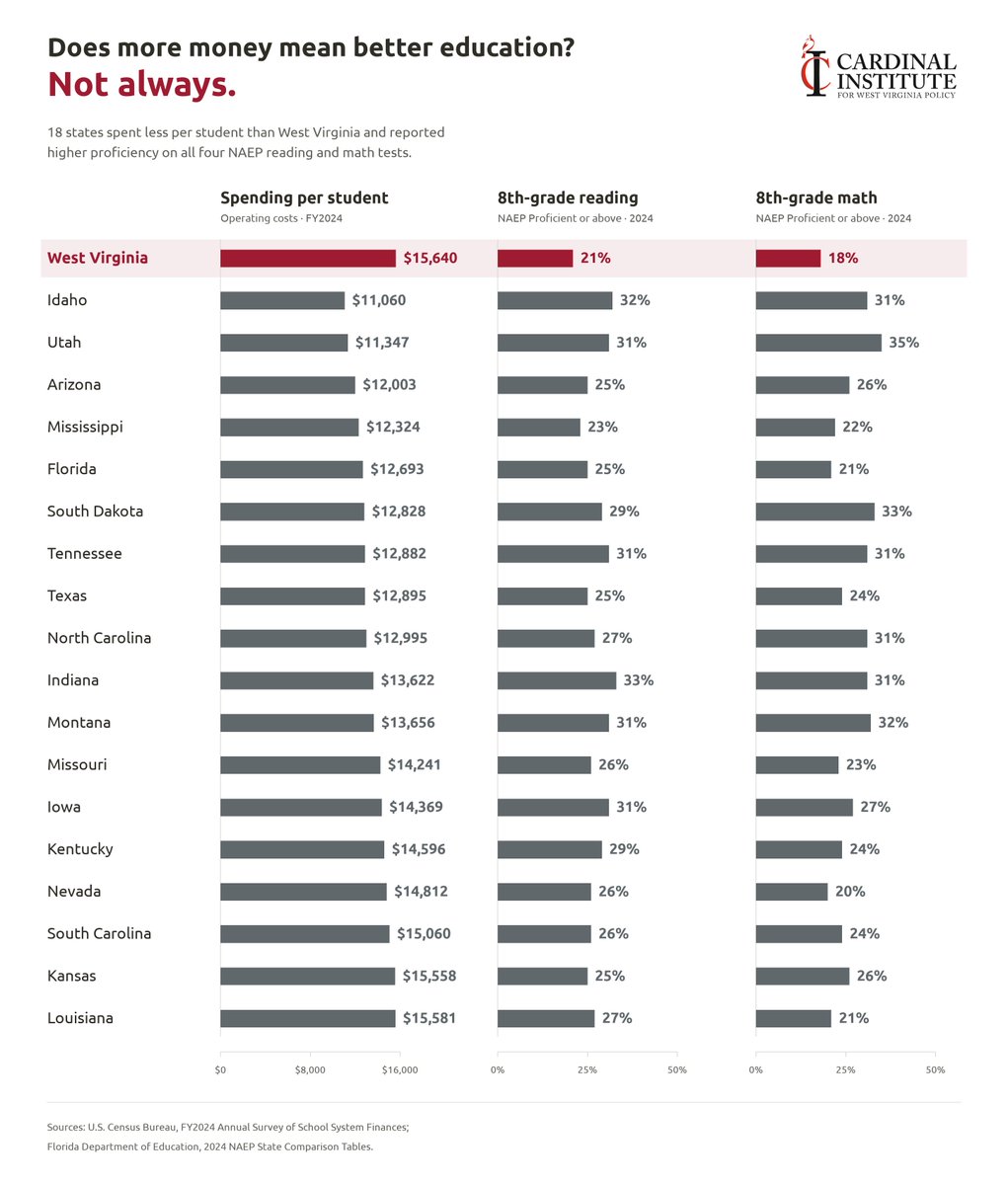
18 states spent less per student than WV in FY2024 and reported higher proficiency in 4th- and 8th-grade reading and math on the 2024 NAEP.
Any request for more education funding should include a clear plan to improve student learning.
To West Virginia’s veterans and all who have served: thank you for your service, your sacrifice, and your commitment to protecting our freedom. We are grateful today and every day.
Rights precede government. Laws exist to protect what was already ours, not to define what we're permitted to have. That principle drives every healthcare, tax, and regulatory reform we advocate for in West Virginia
West Virginia ranks 42nd in @ArchbridgeInst 2026 child care regulations index.
Two caregivers, one group of 3-year-olds:
WV permits 20 children. Kentucky allows 24.
West Virginia should review rules that limit safe expansion.
https://t.co/n9r26CQVMr
It’s very important for people to have accurate information about government policies that impact them. Thanks to Cardinal Institute for clearing this issue up. I hope this helps the press inform readers and viewers exactly what is happening.
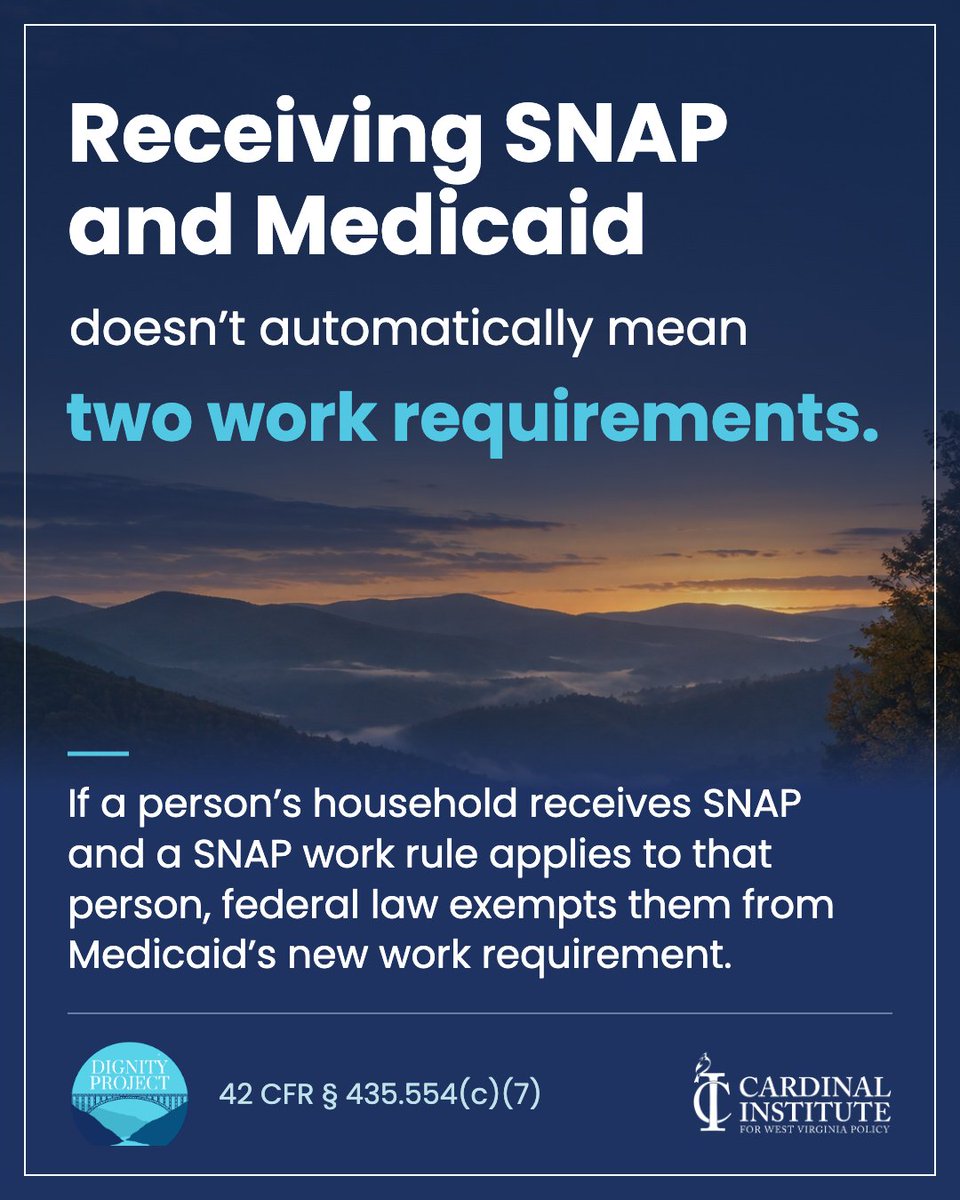
West Virginians in households receiving SNAP are exempt from Medicaid’s new work requirement if SNAP already applies a work requirement to them. The state doesn’t have to verify their SNAP work hours to apply that exemption.
That distinction matters when reporting on families who rely on both programs.
Public schools retain funding when students choose Hope.
School leaders have a responsibility to manage those dollars as enrollment changes.
Families deserve the freedom to choose an education that works for their children.
https://t.co/CgpHbZLK0M
Families like Therese Crowley's deserve to keep using the education savings account for their children's education. That's why EdChoice Legal Advocates is stepping in to defend the program in West Virginia, so families don't have to worry about their kids' educational futures.
Bobby shares her experience finding educational options for her children with special needs, including homeschooling and Hope.
Hear one parent’s story on the We Have Hope Podcast: https://t.co/AEjUJYSb7h
Help should lead somewhere.
From support to skills. From skills to work. From work to opportunity.
WorkFIRST can help build that path for more West Virginians.
https://t.co/BtA7i5y7sQ
Opponents are still choosing the data that makes their side look good, without holding public education to the same standard. Let’s walk through it: 🧵 https://t.co/2vqQL3S2Y5
Equal treatment under the law is a floor, not a ceiling. Attempting to engineer equal outcomes is something else entirely—and the record of that experiment is not encouraging.
West Virginia works when West Virginians can work.
WorkFIRST can help connect support, skills, and employment so more people have a path to stable work.
https://t.co/BtA7i5y7sQ
Hope is still accepting new applications for 2026-27.
Applications submitted by Nov. 30, 2026, are eligible for the 50% annual scholarship window. Eligibility and program requirements apply.
Learn more:
https://t.co/QH0IUBT3mP
A first paycheck. Then what?
How does a parent keep the job, arrange childcare and navigate health coverage? Mason Bishop and Jessi Troyan discuss the transition into work and pathways through education and careers.
Revisit the conversation:
https://t.co/cU9pHy9Cob
Yeah, and it did a lot of good. West Virginia spent 60% of $1.1B in one-time ESSER money on salaries, benefits and property, despite warnings NOT to build permanent costs on it. Either way, since 2017, spending rose as enrollment fell by 30,000+. Our result: 8th-grade reading 21% proficient, math 18%. 48th nationally.
@kellakelWV That’s fair context. But after subtracting reported COVID-funded spending and adjusting for inflation, total spending per student was still about 6.7% higher than in 2015–16.