Keeping you up to date in cardiology, devices, tech & artificial intelligence | Views are our own | By @SaharSamimiMD & @DonnchadhOSull | #DigitalHealth#AI
@crfheart@RobertHermanMD@PMcardioApp@jgschwartzmd A modeled scenario suggested an average 57-min reduction in time to balloon, but that benefit has not yet been tested prospectively.
Promising early signal. The next question: can AI-guided alerts safely speed reperfusion in real-world emergency care?
Full manuscript pending.
@crfheart@RobertHermanMD@PMcardioApp First up: SUBZERO, presented by @jgschwartzmd, asked whether AI could flag OMI on the first ECG-even when it was read as non-diagnostic.
In this retrospective, multicenter registry of 1,008 patients with subsequent ECG-confirmed OMI, the model was AI+ on the initial ECG in 70%
Grateful to @NEJM_AI for having me on Grand Rounds. The barrier to building has dropped, but the barrier to building safely hasn't. Closing that gap is what we do every day at @AbridgeHQ.
The website is live at https://t.co/2xHwccsYPD and the github is at https://t.co/GZDCqmjmdY
It was really fun to make the free movement - the video doesn't do it justice, but you can free move both the TTE and TEE probe and it'll generate the 2D image in according to the 3D model.
There's a couple of chapters on common echo concepts and common diseases. Would love feedback!
Our clinical trial of AMIE, a patient-facing AI system, was just published in The Lancet.
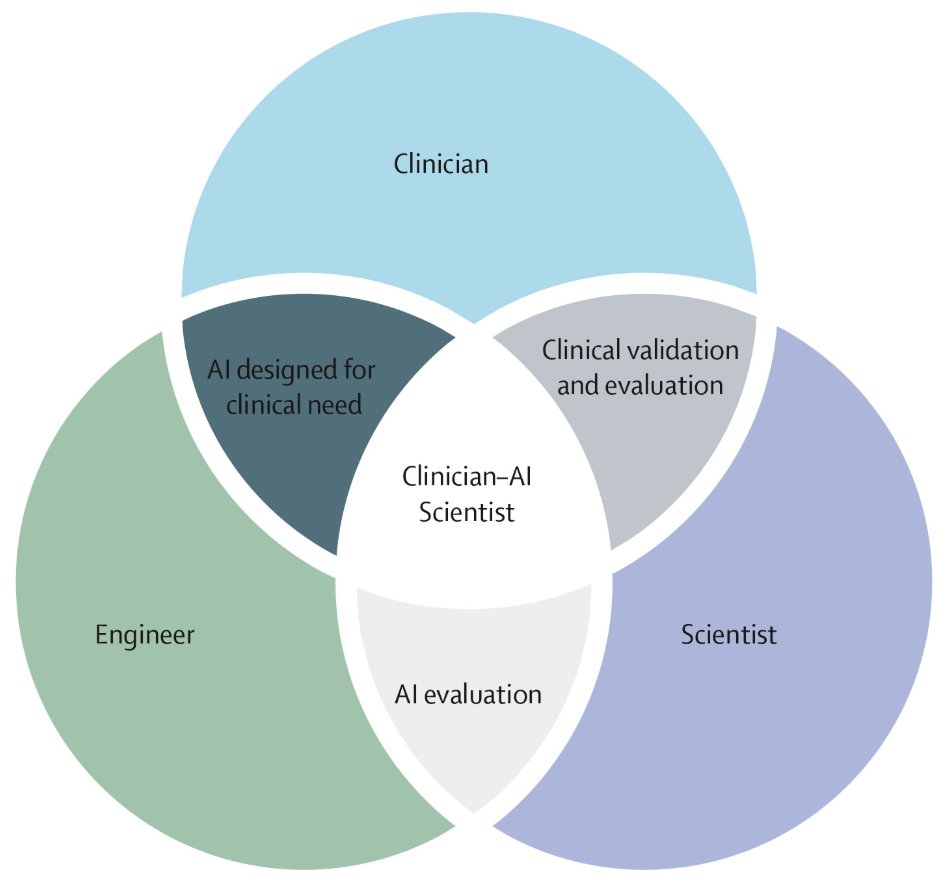
I want to explain what *I* think this study ACTUALLY means.
It's about a fundamental question: how do we know that clinical AI works?
🧵⬇️
https://t.co/5Ue2CrjSpY
I built an interactive echocardiography tutorial with Claude Code.
Chapter 07: a 3D heart, the standard imaging views, the probe position, and simulated ultrasound video.
One of the scarcest resources in healthcare is time. We’re building @almanac_health so physicians have more time to care for patients.
After spending the last few months building, we’re thrilled to be launching Almanac, the first milestone in our mission to improve healthcare delivery. Almanac is a collaborative agent that works across your EHR and workspace to help you delegate work, explore research directions, and more!
We’ve raised a total of $12M, starting with a $2M pre-seed led by @generalcatalyst, and a $10M seed led by @FPrimeCapital with participation from General Catalyst and @lightspeedvp.
We're just getting started, and we can't wait to build the future of care alongside the physicians who use Almanac every day
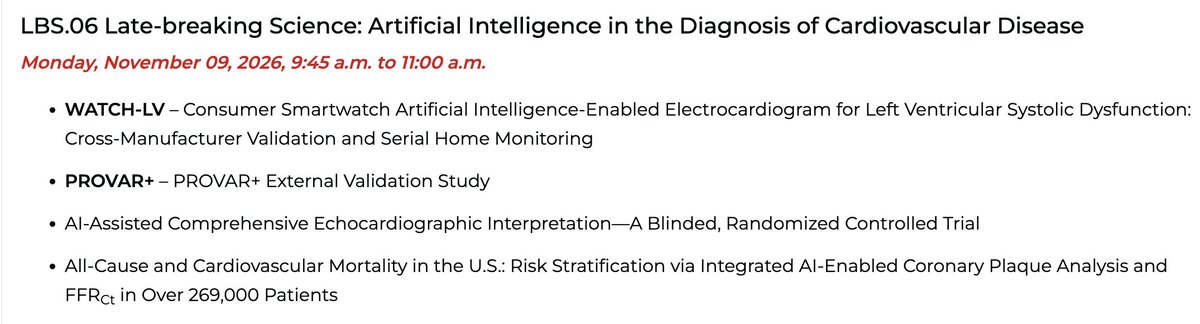
Late Breaking Science: We are excited to present our blinded, randomized trial of comprehensive echo interpretation by AI at @AHAScience#AHA26 on Monday November 9th.
Key takeaway: where and in whom we test an AI model matters. Before using AI-ECG for broad screening, we need to understand how performance changes across populations, and what happens after a positive result.
Full manuscript: https://t.co/ejF4BORiK2
#Cardiology#CardioX@djc795
🚨 When an #AI-ECG model moves from the hospital to the community, does its performance hold up?
This JACC study tested EchoNext, an AI model designed to detect structural heart disease from a routine ECG, in 2,402 adults aged 65–85 from the PREVUE-VALVE study.
The key finding: its AUC fell from 0.83 in the hospital cohort to 0.71 in the community cohort. Structural heart disease was much less common in the community (7.5% vs 42.8%).
🚨 Can AI turn routine mammograms into cardiovascular risk tools?
This European Heart Journal study evaluated AI-based quantification of breast arterial calcification, or BAC, on screening mammography.
In 123,762 women across Emory and Mayo Clinic, a transformer-based neural network quantified BAC in mm² and classified severity as zero, mild, moderate, or severe.
The key finding: higher BAC severity was associated with a stepwise increase in major adverse cardiovascular events and mortality, even after adjustment for PREVENT risk score.
Full manuscript: https://t.co/bqPr8CLAPx
#CardioTechX #Cardiology #AIinMedicine #AIinCardiology #DigitalHealth #WomensHealth #PreventiveCardiology #Mammography #MachineLearning #EHJ #MedEd
Could AI create an LGE-like cardiac MRI without gadolinium?
Our latest Journal Club episode covers virtual native enhancement (VNE), a generative AI model that combines cine imaging, native T1 maps and underlying T1-weighted data to visualize myocardial scar contrast free.
The catch? Unsurprisingly, image quality matters. When lower-quality scans were included, performance declined.
Our takeaway: VNE is not ready to replace LGE universally, but it may provide a practical contrast-free pathway, reserving it for uncertain or complex cases.