You've called it before. The election. The game. The thing everyone swore wouldn't happen.
You were right. You just had no way to cash in.
Now you do.
Type your prediction in plain english. We turn it into a real trade. No charts, no jargon, just say what you think happens next.
Live now: https://t.co/x80xYcyqqe
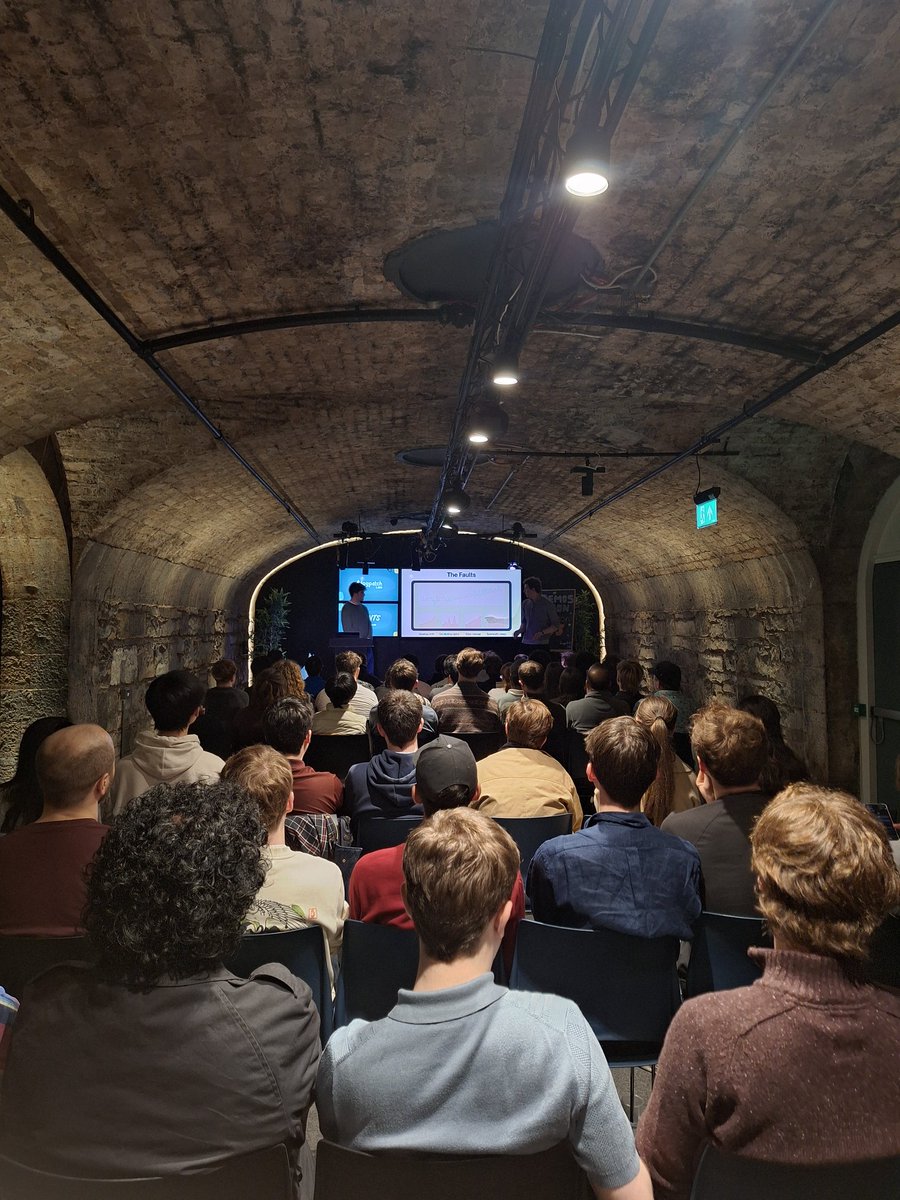
HUGE session last night for the 55th edition of https://t.co/lwCdi6ddyA. 70+ ppl!
- @CarknerWill & Johnny talked about PAT testing & developing custom hardware for office power strips
- Rathe demo'd how Gemell procedurally generates photorealistic digital twins of textiles directly from production data & CAD files
- Leon & Charlie talked about using in-room radar and edge-ML to detect falls and long-lies in care homes
thank you to @AkashBajwa96 from @EarlybirdVC for making this session possible 🙌
if you'd like to join us next time, dm me :)
@adityajoi 👊 on to the next one
Excited to release new repo: nanochat!
(it's among the most unhinged I've written).
Unlike my earlier similar repo nanoGPT which only covered pretraining, nanochat is a minimal, from scratch, full-stack training/inference pipeline of a simple ChatGPT clone in a single, dependency-minimal codebase. You boot up a cloud GPU box, run a single script and in as little as 4 hours later you can talk to your own LLM in a ChatGPT-like web UI.
It weighs ~8,000 lines of imo quite clean code to:
- Train the tokenizer using a new Rust implementation
- Pretrain a Transformer LLM on FineWeb, evaluate CORE score across a number of metrics
- Midtrain on user-assistant conversations from SmolTalk, multiple choice questions, tool use.
- SFT, evaluate the chat model on world knowledge multiple choice (ARC-E/C, MMLU), math (GSM8K), code (HumanEval)
- RL the model optionally on GSM8K with "GRPO"
- Efficient inference the model in an Engine with KV cache, simple prefill/decode, tool use (Python interpreter in a lightweight sandbox), talk to it over CLI or ChatGPT-like WebUI.
- Write a single markdown report card, summarizing and gamifying the whole thing.
Even for as low as ~$100 in cost (~4 hours on an 8XH100 node), you can train a little ChatGPT clone that you can kind of talk to, and which can write stories/poems, answer simple questions. About ~12 hours surpasses GPT-2 CORE metric. As you further scale up towards ~$1000 (~41.6 hours of training), it quickly becomes a lot more coherent and can solve simple math/code problems and take multiple choice tests. E.g. a depth 30 model trained for 24 hours (this is about equal to FLOPs of GPT-3 Small 125M and 1/1000th of GPT-3) gets into 40s on MMLU and 70s on ARC-Easy, 20s on GSM8K, etc.
My goal is to get the full "strong baseline" stack into one cohesive, minimal, readable, hackable, maximally forkable repo. nanochat will be the capstone project of LLM101n (which is still being developed). I think it also has potential to grow into a research harness, or a benchmark, similar to nanoGPT before it. It is by no means finished, tuned or optimized (actually I think there's likely quite a bit of low-hanging fruit), but I think it's at a place where the overall skeleton is ok enough that it can go up on GitHub where all the parts of it can be improved.
Link to repo and a detailed walkthrough of the nanochat speedrun is in the reply.
the bottom line: if you believe in more electricity, you must believe in better wires and smarter grids. transmission is the underrated chokepoint.
for some more in-depth thoughts, check out my recent post at https://t.co/Pq8L4E7mOA
THE TRANSMISSION AGENDA
electricity transmission is increasingly becoming difficult across the world, especially at home here in Ireland.
more power means more prosperity. but generating electrons is only half the battle. the real challenge? moving them.
a 🧵