New paper on #loneliness and the nature of friendship. Thinking through some of our ideals and practical realities, and what a moral-psychological framework for positive social connection might look like. Also a conversation about virtue ethics and Kant
https://t.co/QIrfCdxp2C
My new book, The Honesty Crisis: Preserving Our Most Treasured Virtue in an Increasingly Dishonest World, will be published May 19 and is now available for preordering!
"Christian Miller's The Honesty Crisis diagnoses this problem across a range of social phenomena, drawing on his years of research, and makes the case that the stakes are higher than we realize. Proposing concrete solutions, Miller's urgent and timely book will interest anyone concerned about the moral character of our world, and its future."
Link in the comment below.
MH Conversations and Connections Series (Contemporary Issues in Bioethics) – Webinar
We are delighted to welcome Professor Kimberley Brownlee @UBCPhilosophy from The University of British Columbia (@UBC) who will deliver a webinar titled: “𝐻𝑜𝑤 𝐷𝑜 𝑊𝑒 𝑀𝑖𝑡𝑖𝑔𝑎𝑡𝑒 𝑀𝑒𝑛’𝑠 𝑅𝑒𝑝𝑟𝑜𝑑𝑢𝑐𝑡𝑖𝑣𝑒 𝐷𝑒𝑝𝑒𝑛𝑑𝑒𝑛𝑐𝑦?”
Dr Olivia Ngan (@OliviaNgan1) will join the discussion, and Prof Carl Hildebrand (@CarlHbrand) will moderate the session.
Date: 23 April 2026 (Thursday)
Time: 12:30 – 1:45 pm Hong Kong Time
(Vancouver Time - 22 April 2026; 9:30-10:45 pm)
Format: Online Webinar via Zoom
🔗 Register for the webinar:
https://t.co/GzQkmTqqH0
#Conversations #Connections #Webinar #HumanReproduction #Ethics #ReproductiveRights
//Importantly, we would like to be able to inspire humanity. Amidst technological innovation, we must remember that medicine and health is about humans. As AI and technology advance, we must uphold medical ethics.//
Just like our Dean suggested, #MEHU promotes medical ethics and the humanities to remind us that medicine is about being human—where doctor and patient traverse suffering and healing together. 🫶
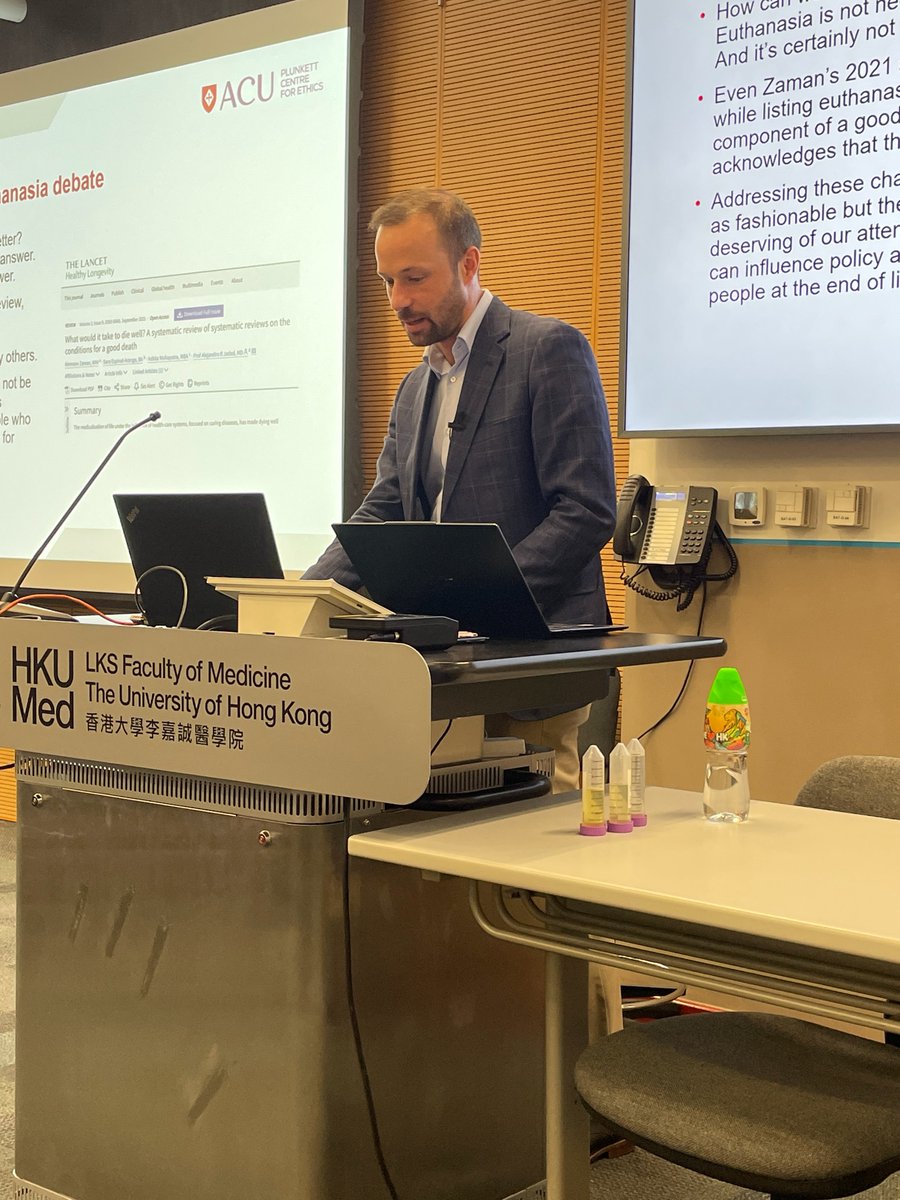
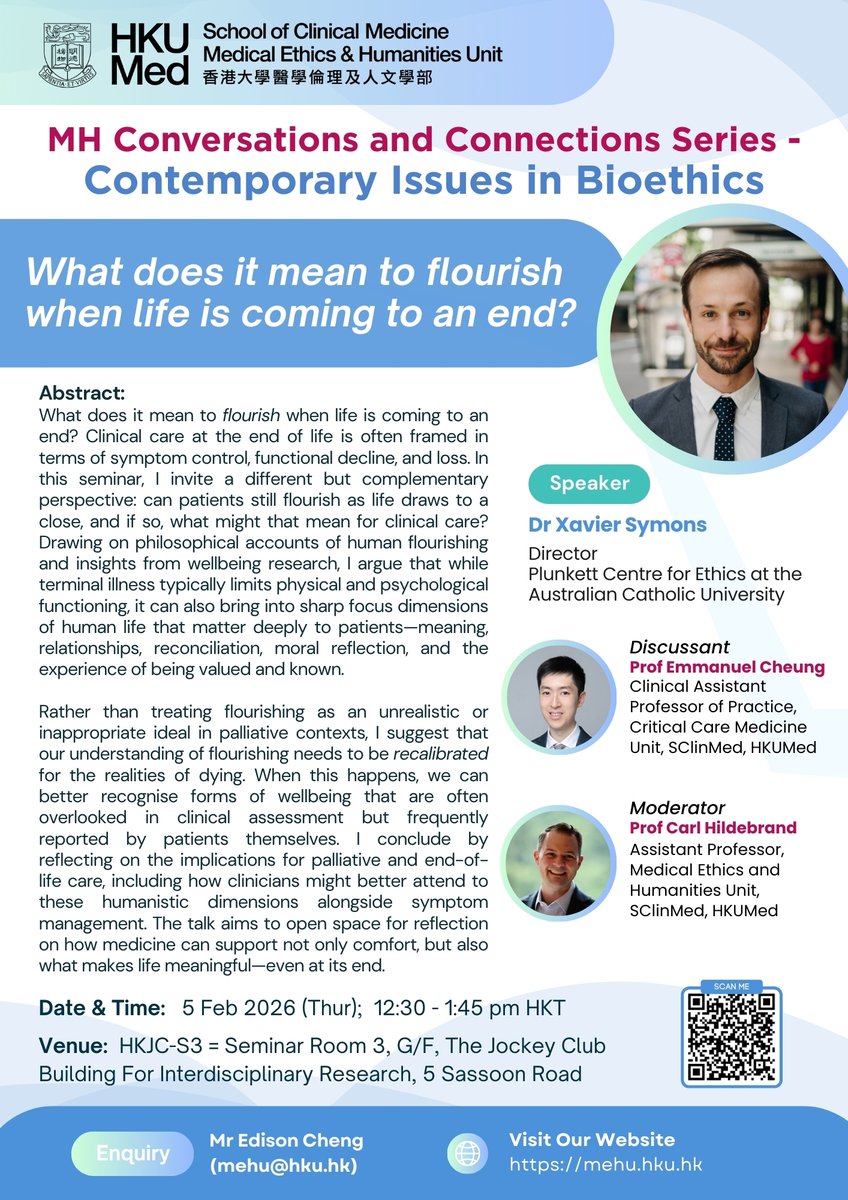
✨ Last week, we were delighted to welcome Dr Xavier Symons (@xaviersymons) from The Plunkett Centre for Ethics (@PlunkettCentre) at Australian Catholic University (@ACUmedia) to #HKUMed/ #MEHU for a lunchtime seminar on "What does it mean to flourish when life is coming to an end?" We were also joined by Prof Emmanuel Cheung, who shared valuable insights from a clinician’s perspective.
❓ Together, we explored pressing questions around end‑of‑life experiences, the possibilities for meaning and moral growth at the end-of-life, and some suggestions for improving clinical practice.
🌱 It was a truly flourishing discussion—thoughtful, inspiring, and deeply human.
@hku_mehu@hkucmel@hkumed@HKUniversity
#MEHU #Conversations #Connections #MeaningOfLife #Flourish #EndOfLife #EndOfLifeCare #Bioethics #Ethics #Humanities #MedicalHumanities
MH Conversations and Connections Series (Contemporary Issues in Bioethics) – Lunchtime Seminar
✨ What does it mean to flourish when life is coming to an end?
In the upcoming seminar, Dr Xavier Symons (@xaviersymons) , Director of The Plunkett Centre for Ethics (@PlunkettCentre) at Australian Catholic University (@ACUmedia) will share his views that although terminal illness typically limits patients’ physical and psychological functioning, it can also bring into sharp focus dimensions of human life that matter deeply to patients—meaning, relationships, reconciliation, moral reflection, and the experience of being valued and known.
Through this sharing, he hopes to create space for reflection on how medicine can support not only comfort, but also what makes life meaningful—even at its end. Prof Emmanuel Cheung, an #ICU physician with a special interest in end-of-life care, will also join the discussion. The session will be moderated by Prof Carl Hildebrand (@CarlHbrand).
📅 Date: 5 February 2026 (Thur)
🕐 Time: 12:30-1:45 pm HKT
📍 Venue: HKJC-S3 = Seminar Room 3, G/F, The Jockey Club Building For Interdisciplinary Research, 5 Sassoon Road
👉 Register now: https://t.co/e5LbEKobQl
🔗 More details: https://t.co/v5fmUXOK7i
@hku_mehu@hkumed@HKUniversity
#MEHU #Conversations #Connections #MeaningOfLife #Flourish #EndOfLife #EndOfLifeCare #Bioethics #Ethics
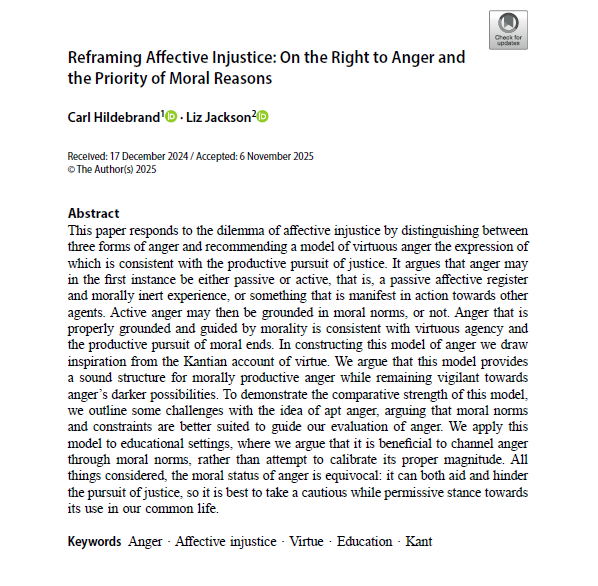
Prof Carl Hildebrand (@CarlHbrand) and Prof Liz Jackson recently published a journal article on anger. Drawing inspiration from the Kantian account of virtue, they argue that the Kantian model is well suited to guiding the process of educating anger.
🔗 Read the open‑access article here:
https://t.co/bLAJXw7czD
Hildebrand, C., Jackson, L. Reframing Affective Injustice: On the Right to Anger and the Priority of Moral Reasons. Res Publica (2025).
@hku_mehu@HKUCMEL@hkumed
#Anger #AffectiveInjustice #Virture #Education #Kant
Prof Carl Hildebrand(@CarlHbrand) ’s latest work dives into the complex relationship between loneliness and friendship.
In this work, Prof Hildebrand argues that goals and duties can coexist with genuine concern in acts of friendship, offering a more inclusive understanding of human relationships. This perspective supports the language of rights and duties related to loneliness while providing a normative-psychological framework for fostering meaningful connections. While friendship is not primarily goal-oriented, the presence of goals and duties does not negate its authenticity.
📖 Read the full article:
Hildebrand, C. (2025). The problem of loneliness and the place of teleological action in friendship. 𝐼𝑛𝑞𝑢𝑖𝑟𝑦, 1–20. https://t.co/daKFJ881x3 (Open access)
@hku_mehu@HKUCMEL@hkumed@tandfonline
#Friendship #Loneliness #Love #Virtue #VirtureEthics
Prof @CarlHbrand recently attended a Kant conference titled "From A colonial Past to a Universal Future: Kant in the East Asian Pacific Region", organized by the Department of Philosophy at @Tsinghua_Uni. He presented on "Developing a Duty to Love" Reflections on Kantian Friendship".
It was a packed yet highly fruitful three-day programme, where scholars explored a wide range of Kantian themes—including metaphysics, political philosophy, cosmopolitanism, ethics, and cross-cultural perspectives. The event examined how Eastern and Western philosophies can engage and interact, offering deeper insights into Kant’s ideas within a global context.
#MEHU #Kant #Philosophy #Friendship #DutyToLove
New paper on #loneliness and the nature of friendship. Thinking through some of our ideals and practical realities, and what a moral-psychological framework for positive social connection might look like. Also a conversation about virtue ethics and Kant
https://t.co/QIrfCdxp2C
My hunch (hope) is that people will progressively realize that life online is hardly life at all, and begin to protect and cultivate real-world, offline experiences and relationships in the years ahead. There is an alternative future to this thinning out
https://t.co/yH0SGvvV3k
Medical approach to regulating miners and merchants of dopamine. "Rather than chase corporations as they shape-shift, regulators should focus on that pea-size bundle of neurons where feedback loops of pleasure and pain get twisted into addiction"
https://t.co/ju8Woj0pMK
"Economists may soon start to think of brainrot as a means of theft. Increasingly, the discipline is modelling attention as a resource, alongside land, labour and capital"
https://t.co/5Z9nWbdOVu
"Changing one's mind in response to a challenge or a dissenting peer can be a mark of virtue. But it can also manifest or breed vice." https://t.co/rPPmXL3jau
Several student suggestions for alternative assessment. "Many of us are so accustomed to outsourcing that we’re dulling the very instincts that we need to prevail in life: grit, critical thinking, and the ability to function smoothly under stress"
https://t.co/XXyihYl7vM
Three sentimental revolutions and a defense of the power of "sloppy emotions" for mobilizing social change, contra Wilde, Lawrence, and Baldwin
Soft by Ferdinand Mount | Book review https://t.co/BqM3CNk6Gi
Parents, peers, social buffers. “Up until puberty, your parents are actually physiologically scaffolding you,” Then that changes. “Parents are supporting you [in adolescence], but they’re not in your hypothalamus anymore. They’ve moved out of your body”
https://t.co/nDortIHcTT
"Talking, listening and reading have been part of academic culture since the beginning, but written assignments — the five-paragraph essay, the research paper, reading responses — were not"
https://t.co/Neq3YIKzC0
Can love help us confront our deepest flaws? In Fully Alive, Elizabeth Oldfield explores how virtues like humility and love can transform isolation into connection.
Learn more here: https://t.co/tmRjSVCCz4