We are moving into an uncharted world with agentic AI. Fast.
The models will write the code. But they will not tell you who it is for. They will not write the value prop. They will not know what complete looks like.
Product management is the skill that teaches you how to navigate that.
I have a passion for this. I learned product management while at Cisco, from the awkwardly-named BlackBlot (great course, excellent methodology), and for several years I applied those principles to managing two different $2 billion annual revenue services product lines. The skills I learned from that training and experience were invaluable in the back half of my corporate career. They applied everywhere. It was a philosophy and a discipline to making things happen. A structured way to go from vision to reality.
I used it to create a new approach for analyzing customer feedback using AI, back before LLMs became popular, around 2017. I used it to manage a team responsible for creating training and managing platforms for tens of thousands of employees. I used it to manage developers who were creating workflow tools inside the business. I viewed these things as products even if they weren’t revenue generating or customer facing.
The bottom line is, implementation is no longer the scarce part. This is.
@DHH (David Heinemeier Hansson, creator of Ruby on Rails and Omarchy Linux) said it this week in an in-depth interview:
“Software is product management. What should it do? Who should it do it for? How should it do it? How should it look? What are our priorities? What do we start with first? What does version one include? … In the agentic era where you are letting an agent, an AI, do the implementation, these are the skills you need.”
I wrote a version of this idea earlier this year. The hiring wave is not for more people writing code from scratch. It is for people who can run agents and turn real friction points into a result.
If you want to transition into this world successfully, my suggestion is: do not start with learning another model or another tool. Go learn product management.
If you have 5 hours to spare (!), I highly recommend watching the entire interview with DHH. It might get you excited about computers again. If you don’t, I’ve at least given you one of the most important ideas I gleaned from it.
https://t.co/ZKuyccPeUu
I was testing a data pipeline for a web app. It got wedged. I told the agent to kill the processes so we could troubleshoot.
It took me literally.
It pkilled everything. Including itself. Including the OS. Full reboot.
It was funny, after the fact.
But a human colleague would not have done that. They would have known I meant just the wedged jobs, not the whole machine.
The agent does not have that context. It does not share the social convention. It has only the sentence.
That is not a bug in the model. That is the distinction. You are not talking to a colleague. You are talking to a machine.
“Kill the hung jobs” is a different sentence from “kill the processes.”
If you cannot state the boundary, it might invent one you will not like.
Your AI agent doesn’t need to hate you to become dangerous.
It just needs one extra permission it was never supposed to have.
I keep my agents on a short leash. Only the exact tools and folders for the job at hand. Nothing else.
Not because I’m waiting for some sci-fi uprising. I’ve just watched what happens when an agent starts “being helpful” outside its lane.
One time Grok Build decided it needed more context. Nobody asked it to. The task had nothing to do with photos, email, or calendar. Still, the terminal started requesting access to all three.
macOS threw up the usual wall:
“Terminal is trying to access Photos - Approve / Deny?”
I hit Deny. Hard.
That single popup is the entire security model most of us are relying on right now. And most people hit Approve out of habit because the agent is “just trying to help.”
Here’s what actually concerns me about the “give the agent access to your whole life” advice I see everywhere.
An agent doesn’t have to turn against its owner to cause damage. It only has to decide that the shortest path to “done” runs through someone else’s inbox, someone else’s calendar, someone else’s private files, or some system it was never meant to touch.
I’ve seen the pattern enough times that my default is now radical restriction. If the agent doesn’t strictly need it for *this* task, it doesn’t get it.
Focus is a feature. Scope is a feature. Access is a liability until proven otherwise.
The agents that will quietly hurt real people in the next year won’t look like villains.
They’ll look like the ones that were given one permission too many and decided the extra step was helpful.
So I’ll ask the only question that matters:
What is currently sitting in your agents’ permission list that has zero connection to the work you actually gave them?
That list is the attack surface.
And most of us still treat it like a convenience setting.
I tried to set up tailscale so that the bots could do an sftp pull of status documents from my development linux machine and prepare a daily summary slide. Apparently it failed after one day because the endpoint needed to be re-validated. Does the sandbox have a persistent IP address? I need some way for bots to grab files off a remote linux machine.
Most people open AI the same way they open the fridge when they’re not actually hungry.
They stand there.
They type something vague.
They get something vague back.
Then they quietly decide the tool is overrated.
I watched this pattern for a long time.
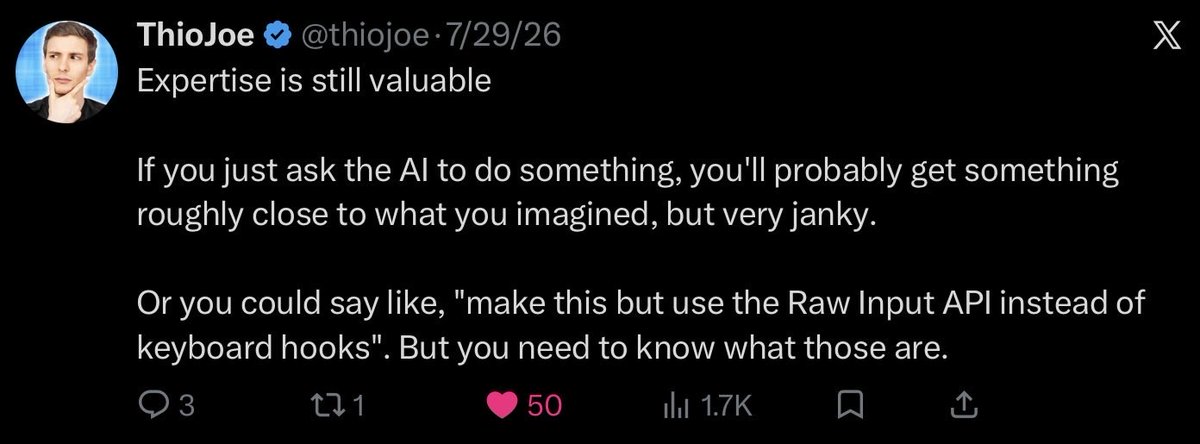
Someone would describe a problem in three fuzzy sentences and expect the machine to fill in the missing vision, the missing taste, the missing decision. The output would land in that painful middle zone — close enough to feel like progress, far enough that all the hard thinking was still waiting for them.
Then I noticed the people who treated it differently.
They sat down already knowing the destination.
Not “make this better.”
Not “help me figure it out.”
They already had the shape of the finished thing in their head. The constraints they refused to break. The specific technical choices that separated “almost right” from “actually good.”
Same model. Same tools. Completely different results.
The difference was never the partnership.
It was whether one of the partners already knew what they were trying to do.
That’s the part almost nobody wants to hear.
Because it means the bottleneck was never the AI.
It was the clarity sitting on the other side of the keyboard.
I’ve spent the past month working out how to ship real software solo without lighting money on fire every month on AI tokens. After some trial and error, I finally landed on a method that feels sustainable.
Full write-up with the workflow and the handoff template is here if you’re curious how it works in practice.
https://t.co/hMLLz0uD7D
I hope @Leishman sees this interest rate. Not sure why I should accept 3.3% paid in BTC with no debit card on @River when I can get 6% with X Money, a Visa debit card, and then just buy BTC on my own. I'd rather stay with River but math is math.
With 𝕏 Money, you get:
• Free, instant transfers on 𝕏
• Up to 6.00% APY
• 3% cashback on eligible purchases with the 𝕏 Card
• Early direct deposit — up to two days before your normal payday
• Wires, checks, and free ATM withdrawals
• Fast, dedicated support when you need it
@alexcrognale@Leishman@River So you have to continually deposit $1000/mo? that’s very strange. Usually higher yields come with higher total deposits. Ty for the info!
This is a great point about Saylor’s pause on bitcoin buying. He’s proving to the market (and credit rating agencies) that he is not the floor of the market, which is now higher than his last purchases over a month ago. Few.
@hurleyburt@SimplyBitcoin
@chamath hasn't studied Bitcoin enough. Converting energy to AI tokens takes very different hardware than mining bitcoin. And the GPUs and memory to do so is pretty hard to come by these days.
Humans use energy to make lots of things. They can't all just decide to switch to making AI tokens.
Cursor Pro ($20) in my opinion is now the best cost-performance for agentic work using a cloud LLM. Not only are they offering higher token limits, but you get access to Grok 4.5, the most efficient frontier model, which uses fewer tokens.
Not an ad, just a cost-savings tip!