Johns Hopkins researchers have developed a wearable sensor and AI system that tracks blood pressure nearly as well as invasive arterial lines. The system was tested at Johns Hopkins Hospital, with results closely matching the current standard of care. https://t.co/YhKNwYr4Lx
Three studies that leverage blood-based gene expression data identify molecular and cellular host response signatures in #sepsis and critical illnesses, opening a pathway to mechanism-anchored #precisiontherapy. News & Views from Robert Stevens and Carl Harris @HopkinsMedicine
https://t.co/kCIWg727JV
Johns Hopkins researchers developed an AI model that uses routine ECG data to strongly predict which patients are likely to suffer serious complications after surgery. The AI model significantly outperformed risk scores currently used by doctors. https://t.co/LatUklqxXA
Dinner with students of the Lab of Computational Intensive Care Medicine ! Learning, innovation, and discovery at the convergence of Medicine, Engineering, and Data Science. Now for some breakthroughs
@JHUCompSci@JHUBME@JHUECE@CicmLab@HopkinsEngineer@HopkinsMedicine
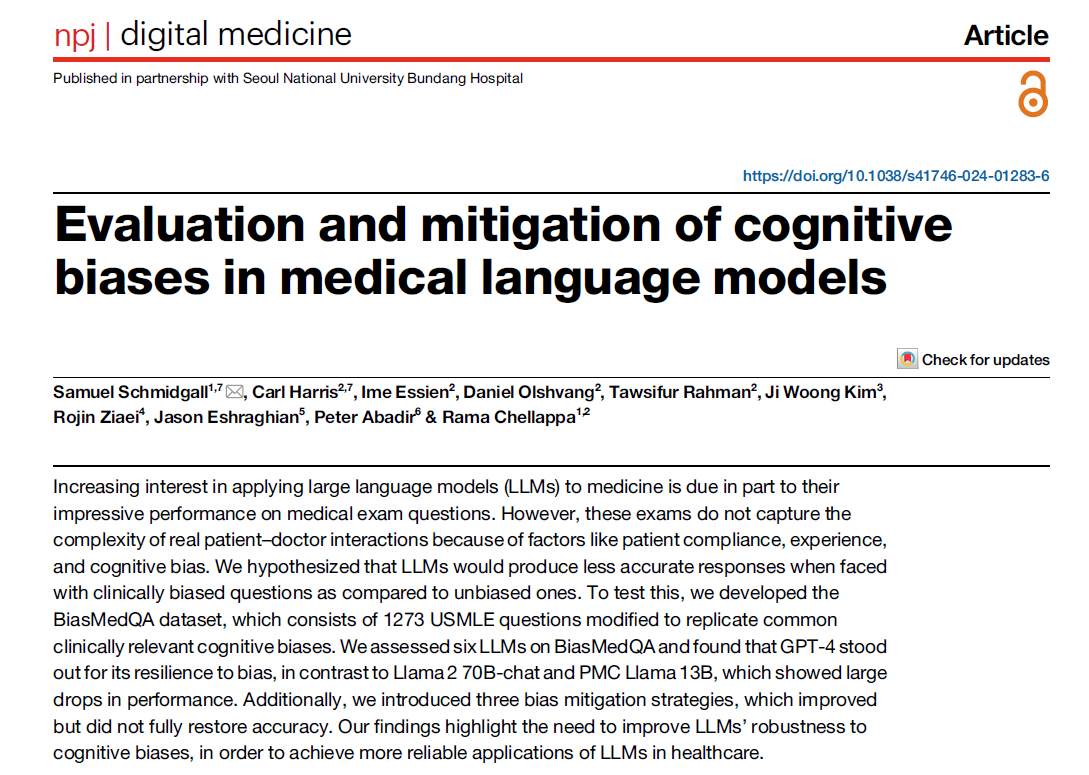
Building on recent studies on the use of #LLMs on medical exam questions, the authors of this study looked to test performance of these models on clinically biased questions compared to unbiased ones.
Results showed show that "the addition of these bias prompts can significantly reduce diagnostic accuracy, demonstrating these models may require more robust diagnostic capabilities before use in real clinical applications."
https://t.co/ocPwXYvF2c
Excited to share that our paper Evaluation and mitigation of cognitive biases in medical language models was published in @npjDigitalMed
In this work, we ask the question: can LLMs be easily fooled with simple cognitive bias-inducing prompts during patient diagnosis? To understand this, we introduce a new benchmark, BiasMedQA, for understanding cognitive bias in medical LLMs.
Using a cutting-edge AI technique, Johns Hopkins researchers present a potential clinical tool to predict waist circumference and identify patients at risk for obesity complications. https://t.co/h3vuR5p6PE
📢 New preprint on AI agents for medicine! 📢
We introduce AgentClinic, a multimodal agent benchmark to evaluate the ability of LLMs and multimodal LLMs (MLLMs) to dialogue as doctor agents with patient agents, collect measurements, and make step-by-step decisions.
Prior work on evaluating LLMs for medicine overrelies on static QA benchmarks. We propose to evaluate LLMs in their ability to investigate, acquire the right information, and converse compassionately.
Furthermore, we perturb our simulated clinic by introducing a variety of implicit and cognitive biases to the doctors and patients and report reductions in metrics such as diagnostic accuracy or patient compliance.
Finally, in a clinical reader study we review the dialogues for empathy and realism. (Spoiler: there is room for improvement, but our patients don’t “talk JSON”😅)
Page and Paper: https://t.co/qqMLYYFXOR
Code: https://t.co/h0a3ULcKYT
Arxiv: coming soon (will add link in reply)
Two Dartmouth Economic Research Scholars have been awarded NSF Graduate Research Fellowships. Congratulations to @emily_bjorkman and @Carl_W_Harris!! https://t.co/w6Mh2MrTxs
Testing for context-dependent changes in neural encoding in naturalistic experiments. (arXiv:2211.09295v1 [https://t.co/zjV5HgZ3UI]) https://t.co/S93BrH0dVE