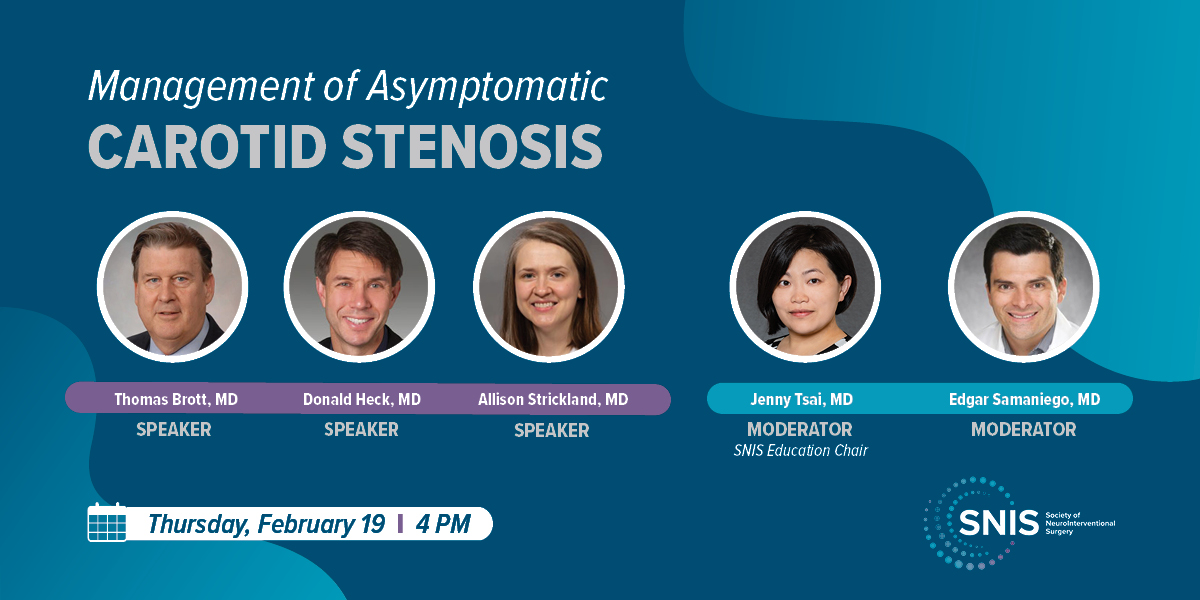
UPDATE: The next #SNISInsights webinar “Management of Asymptomatic Carotid Stenosis” is 2/19 at 4PM ET. Panelists @ThomasBrott, Donald Heck, MD, & Allison Strickland, MD will sit down with SNIS Education Chair @JPTsaiMD & @esamaniego to discuss.
Register: https://t.co/cBIJlJ8MjV
Want the latest on #CAA?
Join our webinar unpacking the new WSO Scientific Statement, fresh in IJS👉https://t.co/x5GiAPgf7M
🔍Key points
🧠CAA Dx & Treatment
🎙️Expert talks + Q&A
🗣️Dr van Etten, @a_charidimou, Dr Werring, @SMGreenbergNeur
Registration👉 https://t.co/R0X6TabWB7
The 90s called & wants its carotid imaging back!
It’s been 30 years--are you still on NASCET?
Feeling vulnerable about plaque vulnerability?
This month’s @theAJNR SCANtastic has what you need to know about carotid plaque
https://t.co/5tTqrJr2mS
Carotid disease not only harms by stenosis but also by serving as a source of emboli.
We can use carotid plaque-RADS, which has been adapted for CTA to identify high-risk plaques!
Type 1 = no plaque.
--Remember bc the number 1 looks like a smooth straight vessel with no plaque!
Type 2 = plaque thickness < 3mm & no signs of vulnerability (ulceration)
--Remember this bc 2 is < 3 & the curve of the number 2 mimics a smooth, non-ulcerated plaque.
Type 3 = plaque thickness >3mm or ulceration
--Remember 3 is greater than 3! And the scooped out part of the number 3 looks like scooped out ulceration!
Type 4 = plaque hemorrhage or intraluminal thrombus
--Remember pointy part of the number 4 looks like pointy thrombus pointing into the lumen
--Remember also the number four has a hole in the middle—just like the hole blasted in a plaque by intraplaque hemorrhage!
In this month’s @theAJNR, Saba et al. found that this scoring system was highly reproducible among intermediate & experienced readers.
But like all things radiology—there was a learning curve for inexperienced readers.
So go beyond NASCET!
Hopefully, now you’ll never feel vulnerable about vulnerable carotid plaque!
Follow @theAJNR and check it out for yourself:
https://t.co/5tTqrJr2mS
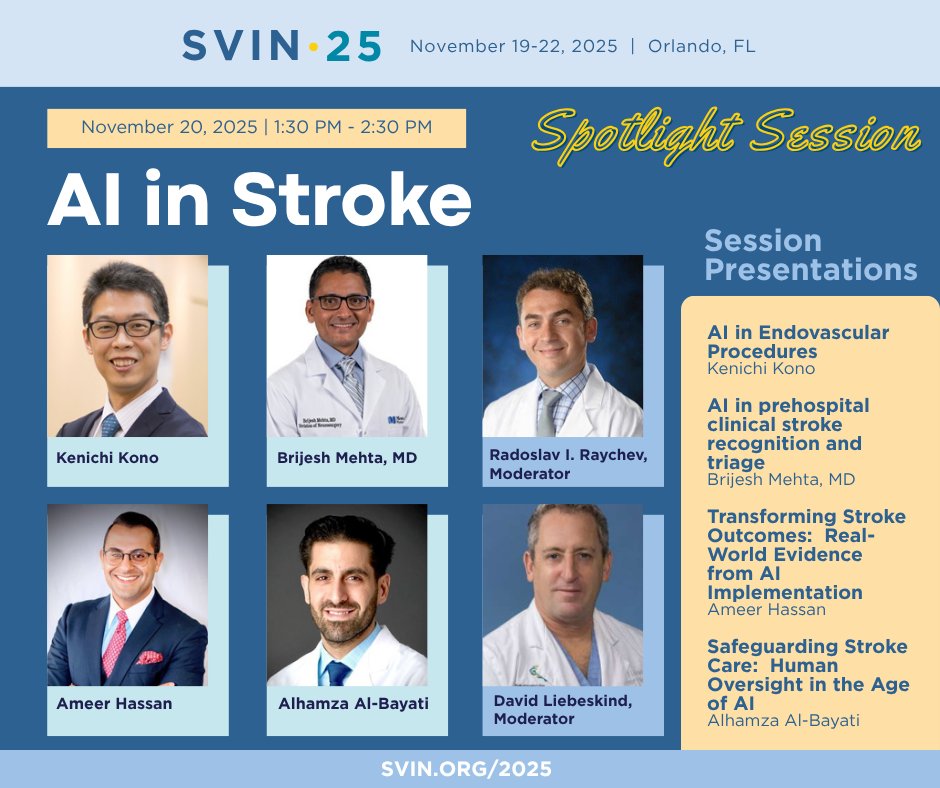
Join us at #SVIN2025 for AI in Stroke — Learn about the latest developments on AI, from pre-hospital AI triage to endovascular directed AI assistance + important ethical issues with the use of AI in stroke care: https://t.co/lwHfv5eD46
@radoraychev@dliebesk@CeoImed@neuroinx@AmeerEHassan@AlAlBayati1
#SVIN #SVIN25 #SVINAnnualMeeting #StrokeCare #VascularNeurology
#STROKE: In a multicenter cohort of patients with acute mild basilar artery occlusion (NIHSS<10), EVT was linked to better 90-day functional independence vs. BMT, but carried a higher risk of symptomatic ICH, with no mortality difference. #AHAJournals https://t.co/hVB6MhDsOn
Con ilusión buscamos neurólogo(a) que se una a nuestro equipo para formarse con nosotros en #Neuroinmunología y #EsclerosisMúltiple.
Somos un grupo humano joven y dinámico que amalgama la perspectiva clínica junto con la investigación básica.
II Curso de Neurosonología para Unidades de Ictus organizado por el laboratorio de neurosonología del Hospital Universitario de Girona Dr Josep Trueta.
14 y 15 de Junio. Plazas limitadas! Inscripciones al correo [email protected]
Have you tried the plunger technique for EVTs? All you need is a 60cc syringe! 😉 Check out our latest technical video by Dr. Froehler! https://t.co/CoYSUZ8ENG
A 50yo female patient with recurrent epistaxis. She was hospitalised in our Stroke Unit due to an acute ischemic R-MCA stroke.
In the physical exam she presented skin and mucosa lesions.
A study revealed Black women who report experiences of racism may have a 38% higher chance of experiencing all types of strokes! The study followed over 48K Black women and identified over 1.5K cases of strokes! https://t.co/rvEoquMUSG
A 76yo F patient with HBP and AF presented an acute LVO (R-MCA ASPECTS 10 NIHSS 12) treated with IVT and MT (good recovery with NIHSS 2). Right Carotid US during hospitalization showed these findings: