@LevAkabas the name is ADAM SILVER. That's why Luka was traded, Brown was traded, the ridiculous referees' work in Playoffs, etc etc. The league push for the trades yet NBA is a business and needs these kind of scenarios where everyone talks about NBA (marketing).
🚀¡Qué auténtica barbaridad!
🇰🇪El keniano Sebastian Sawe se ha convertido en primer atleta en bajar de las 2 horas en el maratón estableciendo un récord del mundo estratosférico en Londres (1 hora 59 minutos y 30 segundos)
☝️Respectfully disagree
👉Inflammation is not the “missing piece” in coronary disease—it is a secondary response, not the primary driver.
1️⃣ The causal pathway is already well established: apoB-containing lipoprotein retention initiates atherosclerosis; inflammation follows.
2️⃣ Decades of trials targeting inflammation have largely underdelivered, with inconsistent or null effects on hard cardiovascular outcomes.
3️⃣ Even when inflammation is reduced (e.g., CRP lowering), clinical benefit is absent or marginal—hardly a compelling therapeutic target.
4️⃣ The concept of “residual inflammatory risk” is conceptually attractive, but clinically weak; many patients with events have low CRP levels.
5️⃣ We are mistaking timing for mechanism: treating end-stage disease and blaming inflammation for failure is a convenient but flawed narrative.
6️⃣ The real problem is cumulative exposure to apoB over decades—still insufficiently addressed in most patients.
7️⃣ Shifting focus toward inflammation risks diluting efforts from what actually works: early, intensive, and sustained lipid lowering.
☝️In short: inflammation matters biologically—but as a therapeutic target, it remains an underperforming hypothesis.
@society_eas@nationallipid@Drlipid
In 3 large prospective cohorts of US women and men, we found that higher butter intake was associated with increased total and cancer mortality. https://t.co/mrmKlDjG2v
👉 We spend decades arguing about how low to push LDL-C
👆 Almost no one asks the obvious question:
🤔 How much LDL-C did our ancestors actually have?
The evidence exists — five independent lines, all converging on the same uncomfortable answer.
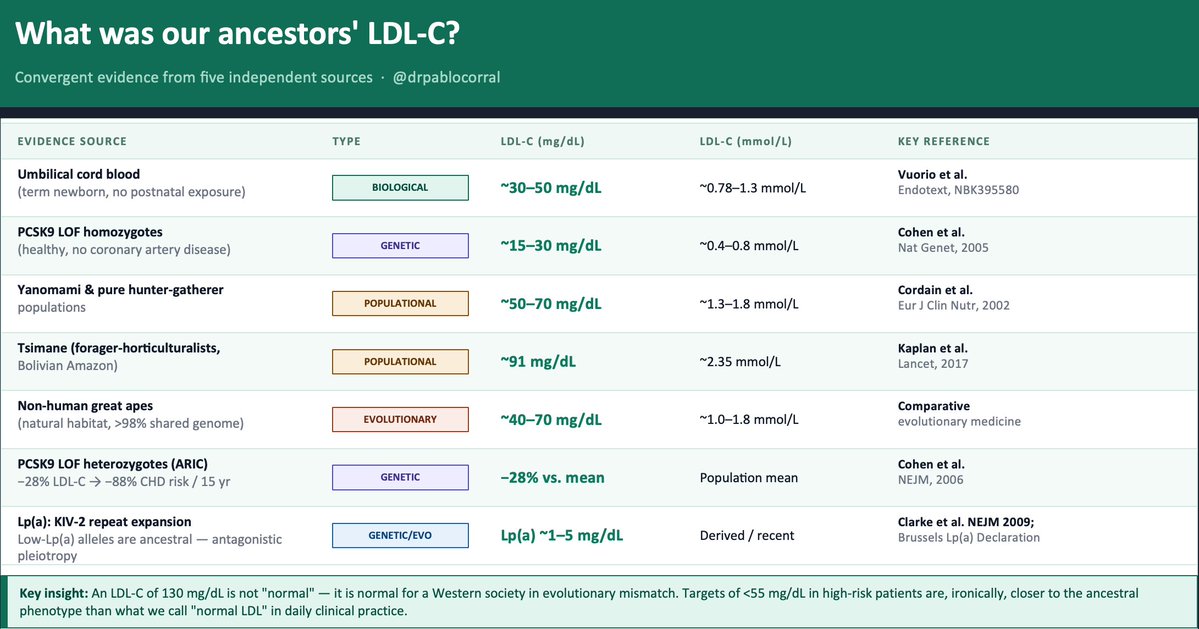
1️⃣ The term newborn. Before any dietary or metabolic influence, a healthy neonate arrives with LDL-C of ~30–50 mg/dL. That is the LDLR operating without environmental interference. Everything that rises after birth is acquired.
2️⃣ The Tsimane (Kaplan et al., Lancet 2017) — forager-horticulturalists of the Bolivian Amazon — have a LDL-C between 70 to 90 mg/dL and the lowest prevalence of coronary atherosclerosis ever recorded in any human population. Five times less than the U.S. in adults over 75. And their LDL is rising as roads and processed food arrive.
3️⃣ PCSK9 loss-of-function variants. African American carriers of nonsense mutations (Y142X/C679X, ~2% frequency): −28% LDL-C and −88% CHD risk over 15 years (Cohen et al., NEJM 2006). Homozygous LOF carriers live with LDL-C of ~15–30 mg/dL. Perfectly healthy. Nature already ran the trial.
4️⃣ Evolutionary genetics. Recent positive selection signals exist on gain-of-function PCSK9 variants that raise LDL-C — likely adaptive in food-scarce ancestral environments. Modern hypercholesterolemia is not "normal." It is an ancestral survival advantage turned pathological by evolutionary mismatch.
5️⃣ Great apes in natural habitat: ~40–70 mg/dL LDL-C. Same genome. Different environment.
👆 Bonus — Lp(a). The KIV-2 repeat expansion that raises Lp(a) is a derived, recent variant. Low-Lp(a) alleles are ancestral. Elevated Lp(a) is a textbook antagonistic pleiotropy signal — possibly protective against bleeding early in life, atherogenic over decades
📍The convergent estimate: ancestral LDL-C was ~30–70 mg/dL.
📍An LDL-C of 130 mg/dL is not "normal." It is normal for a Western society in evolutionary mismatch. Targets of <55 mg/dL in high-risk patients — which still feel aggressive to many clinicians — are, ironically, closer to the ancestral phenotype than what we call "normal LDL" in daily practice.
🤔 The question is not "is it safe to lower LDL this much?"
The question is: why did we let it rise this high?
@society_eas@nationallipid
☝️LDLc is cumulative. Not episodic.
👉 Atherosclerosis = lifetime exposure to apoB particles
👉 The artery integrates risk → “plaque-years”, not snapshots
👉 Same LDLc today ≠ same risk (depends on decades of exposure)
📍What the curves show:
•Higher lifelong LDLc → earlier, steeper risk
•Lower lifelong LDLc → delayed disease, flatter trajectory
•Earlier reduction beats late intensity
📍 Modifiers don’t replace LDLc:
•Diabetes, hypertension, smoking → shift the curve left
•They accelerate injury, but LDLc remains the substrate
☝️Bottom line:
If you wait for “high risk” to act, you’re late.
Treat exposure, duration, and trajectory—not just LDLc.
🔗 https://t.co/fXon8xqOAd
@society_eas@nationallipid
NEW PAPER
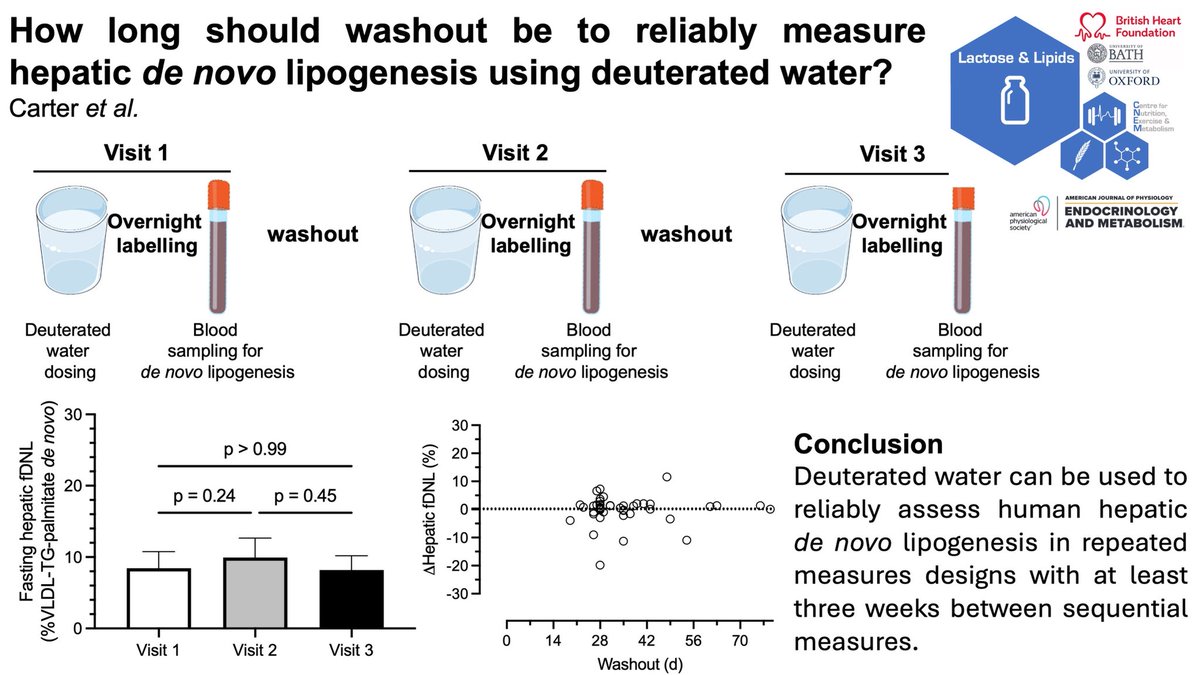
How long should washout be for reliable assessment of de novo lipogenesis (DNL)?
Our data suggest washout can be as little as 3 weeks without biasing estimates of hepatic DNL in the overnight fasted state
Why is this important?…
🔗 https://t.co/XsTnBTYds6
It’s out 🔥🔥🔥
The great dietary guidelines debate with @TyBealPhD@GardnerPhD in person in our new LA studio.
The US Dietary Guidelines Debate: Science, Politics & Ultra-Processed Fo... https://t.co/WLUToNsbYv via @YouTube
Enjoy
- Simon
What if we performed a fecal microbiota transplantation from @TamauPogi to an amateur cyclist like me?
Would I become as strong as him?
This strange, but fascinating question started an 8 year scientific journey. 🧵
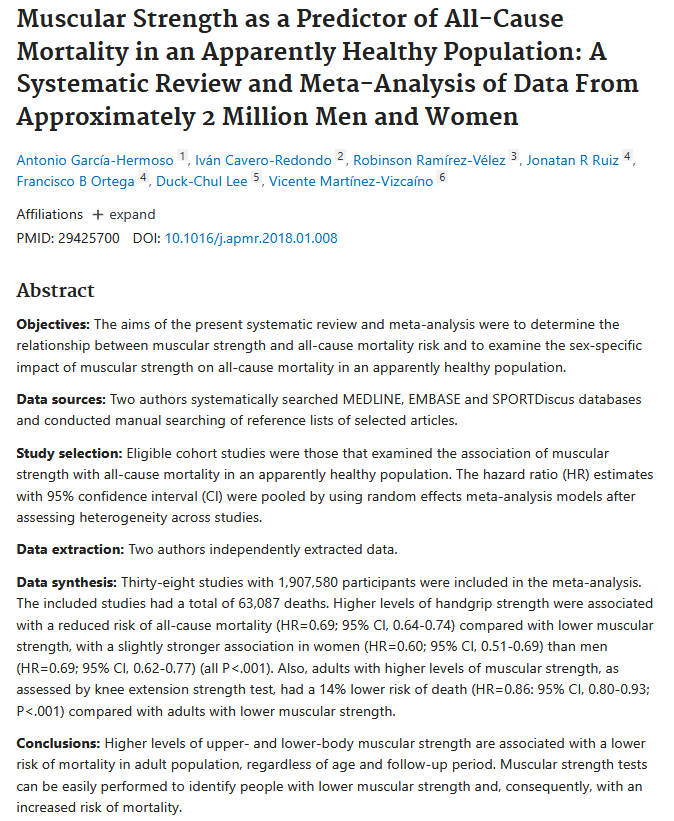
Muscular Strength as a Predictor of All-Cause Mortality in an Apparently Healthy Population: A Systematic Review and Meta-Analysis of Data From Approximately 2 Million Men and Women
https://t.co/fvz3JmNi7e
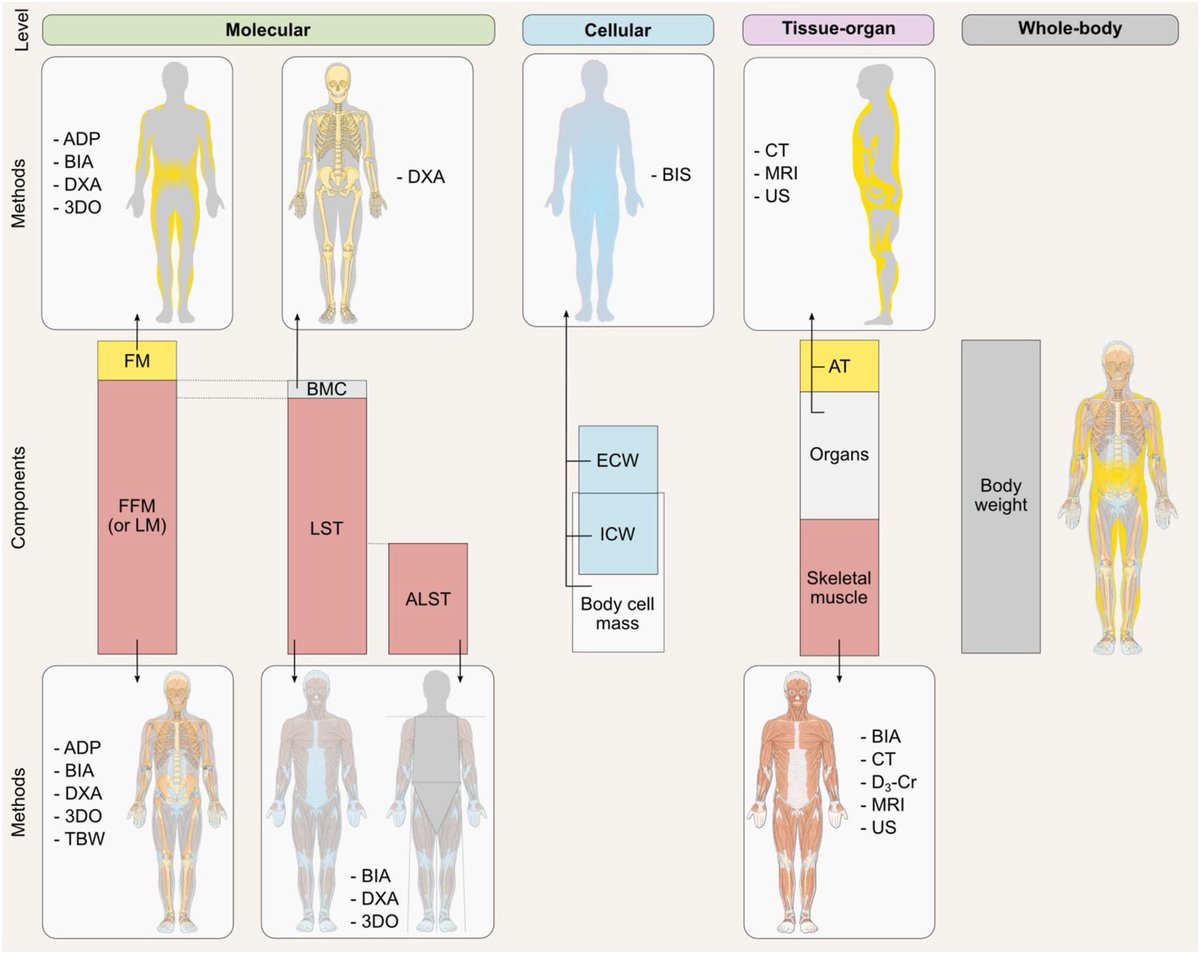
“Methodological standards for body composition: an expert-endorsed guide for research and clinical applications: levels, models, and terminology". @AJCNutrition
https://t.co/5VkZmfCUWy
Despite the widespread use of body composition in research and clinical practice, confusion around basic terms is common and negatively impacts accurate interpretation and application. Our new expert-endorsed guide directly addresses this issue, and we are proud that it was selected as an Editor’s Choice article, and accompanied by an editorial.
This publication was designed for both researchers and clinicians, including non-specialists and is one step toward ensuring clarity, precision, and consistency in the use of body composition data across disciplines. We hope it supports researchers, clinicians, and educators in elevating the rigor and impact of their work.
We ask journals, societies, editors, reviewers, and colleagues across disciplines to endorse and adopt these standards in their publications and practices.
Semester start approaching, and it's fitting that basic physiology is being discussed. The idea that carbs are a more efficient fuel is not hypothetical - it's something with 100+ years of research supporting it.