Anthropic engineer:
"You're not supposed to prompt Claude. You're supposed to build a system that prompts itself."
In 45 minutes she breaks down how Anthropic builds agents that remember, learn from their mistakes, and get smarter with every run.
Worth more than any paid course you'll find on building agents.
Watch the session, then read the guide on building loops below.
I recently contributed a practical AGT writeup around this exact question, and the main thing that stood out is that the mapping to the EU AI Act is strong in some places and still incomplete in others.
Runtime enforcement and audit trails help a lot on risk management, logging, oversight, and parts of Article 50. The harder work is deployer instructions, Annex IV evidence, and keeping the documentation alive after deployment.
This is one of the more relevant open source releases for teams facing regulated deployment.
I recently contributed some practical AGT material from the EU AI Act side, and the interesting question now is how teams turn these runtime controls into compliance evidence for logging, oversight, transparency, and technical documentation.
What I like here is that governance moves into runtime instead of staying in a slide deck.
I went deep on how AGT maps to EU AI Act obligations like risk management, logging, oversight, deployer transparency, and Article 50 in a practical checklist that came out of the AGT community work:
https://t.co/jfYZUKusAz
@openlayerco Important point.
A lot of non EU teams still treat this as a Europe only issue, but scope discussions change fast once the system is placed on the EU market or used in the EU. The biggest gap I see is still documentation plus monitoring, not awareness.
@aiact50 Agreed.
Article 50 looks simple on paper, but the operational part is where teams struggle: making disclosure consistent across product UI, APIs, generated files, and downstream content flows.
@numbersprotocol This deadline is still badly underestimated.
One thing many teams miss: model safety is not the same as agent governance. Runtime controls, audit trails, human oversight, and disclosure flows are where a lot of the real implementation gap will surface.
If you want a deeper practical example, here is my checklist for AI agent developers under the EU AI Act, using Microsoft’s Agent Governance Toolkit:
https://t.co/I79CeqJPkv
August 2, 2026 is closer than most AI teams think.
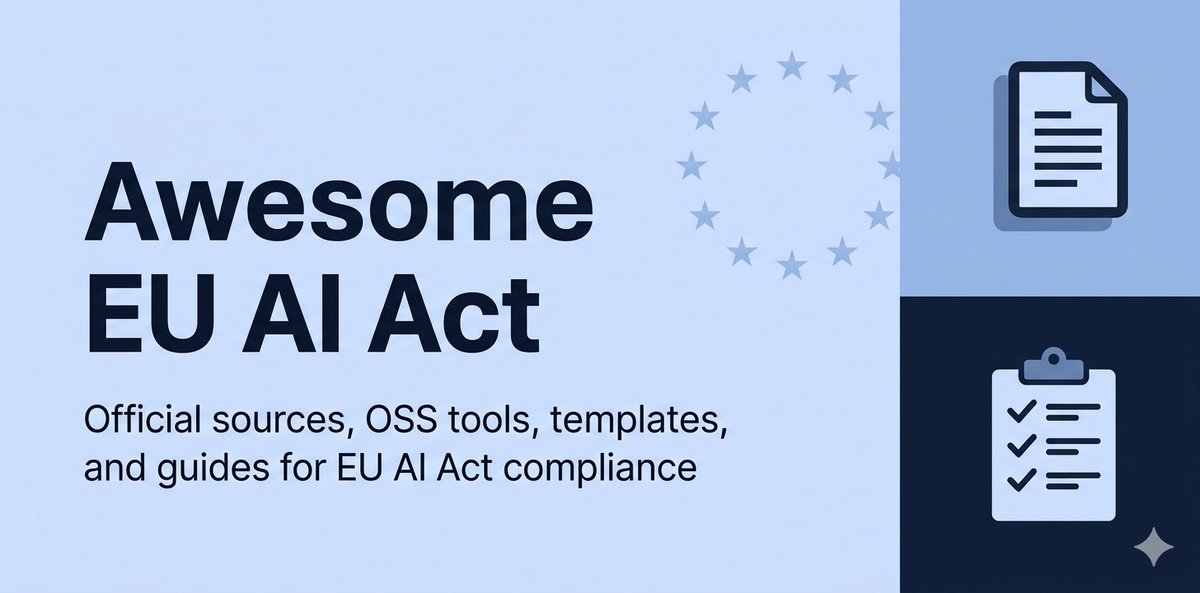
I curated a practical EU AI Act resource list for builders: official EU sources, compliance tools, open source projects, templates, legal guides, and governance references.
If useful, please star the repo on GitHub so more teams can find it.
I saw a job post the other day. 👔
It required 4+ years of experience in FastAPI. 🤦
I couldn't apply as I only have 1.5+ years of experience since I created that thing. 😅
Maybe it's time to re-evaluate that "years of experience = skill level". ♻
How does my smartphone know what am I doing? - Using Convolutional Neural Networks for Human Activity Recognition with inertial sensors and PyTorch @JovianML
https://t.co/TLpQsgreMj
My flight with @vueling was cancelled, but they don't offer refund, against the law. I try to contact them but their contact website is broken. I try to make an online claim in the @AesaSpain and their online form has bugs and cannot proceed. Anyone with ideas what else to do?
Hands on workshop met sensor om parkeerplaats te monitoren #TheThingsConference. Dat idee hebben we op kantoor ook al eens getest 😊. En zullen we herhalen bij onze eerste #braintapas op 27 maart!