Reasons for scottish independence
The UK's bluefin tuna quota has quadrupled to 230 tonnes. But Scotland has been given nothing at all, with every fishing licence going south of the Border 👇
https://t.co/7De7vjvzxf...
The world's 2nd biggest data centre is proposed for a greenfield site in a picturesque Fife village - Auchtertool.
Fife Council looks set to wave it through planning without an Environmental Impact Assessment (EIA).
The project is monstrous.
Is the so called 'Lanarkshire Labour Mafia' and ILI in cahoots with the Labour led Fife council?
Why is the SNP playing Pontius Pilate with a project that will wipe out years of Net Zero gains made in Scotland?
This is of national importance, with international interest.
We have so many questions. This proposal does not pass the 'sniff test'.
John Swinney is wilfully mis-representing what Andy Burnham was saying. We don’t have much detail but his point was that political and fiscal power has become too centralised in Edinburgh and London. He is correct. Scotland is one of the most centralised countries in Europe with very weak (non-existant in practice) *local* government. Scottish Parliament has removed many competencies that local authorities enjoyed back in 1999.
John Swinney had been actively engaged is this centralisation over the past 25 years from his threats to take away education from local authorities to his years of enforcing a council tax freeze and the creation of national police snd fire services.
It is actually John Swinney who is in no position to lecture anyone on these matters.
The children of Auchtertool made this video to tell us how they feel about the hyper scale data center planned for our village. Please take a few minutes to watch it.
But this isn't an Auchtertool problem - it's a Scottish one.
The proposed data centre would need roughly half the power currently used by every home in Scotland combined. Who is paying to build all that extra capacity?
It would also swallow huge amounts of water, and take much-needed farming land out of the food chain, which we all rely on.
And to be clear - this isn't about being "anti-Al". A data centre like this powers the everyday: your photo storage, your online shopping, and yes, Al too. The question isn't whether we need infrastructure. It's how we build it safely, and sustainably. And how the people of Scotland benefit from it.
At this scale, the only obvious winner is the developer. It's not obvious what the tangible benefits are for the people of Scotland.
If you think a project this big deserves to be properly thought through, visit our village website to find out more and object.
https://t.co/EmcawiyL0l
You have noticed it. ChatGPT feels dumber than it used to. Your prompts that worked six months ago produce worse results now. The writing sounds flatter. The ideas sound safer. The internet itself feels like it is shrinking. Every article reads the same. Every email sounds the same. Every answer sounds like it was written by the same voice.
You thought it was you. It is not you.
Researchers at Oxford and Cambridge published a paper in Nature proving what is happening. They call it Model Collapse.
Here is the mechanism in one sentence. AI trained on AI-generated data gets dumber every generation until it forgets what real human data looked like.
The internet is filling with AI-generated content. Blog posts. Articles. Reviews. Comments. Social media. AI companies scrape the internet to train the next generation of models. Which means the next generation of AI is being trained on the output of the current generation.
Each cycle loses information. Not randomly. It loses the rarest, most unusual, most creative parts first. The researchers call these the "tails of the distribution." The weird ideas. The unexpected perspectives. The things that made the internet feel human. Those disappear first.
What remains is the average. The safe. The expected. The bland.
Then the next generation trains on that. And loses more. And the next generation trains on that. And loses more. The researchers proved this is not a slow decline. Major degradation happens within just a few iterations. Even when some of the original human data is preserved.
They tested it on large language models. On image generators. On statistical models. The pattern was the same every time. The output converges toward a narrow, flattened version of reality that looks nothing like the original data.
The lead researcher put it plainly. "Large language models are like fire. A useful tool. But one that pollutes the environment."
The pollution is invisible. You cannot see which sentence on the internet was written by a human and which was written by AI. Neither can the AI that is about to train on it. And once the tails are gone, they do not come back. The damage is irreversible.
This is not a prediction anymore. It is a diagnosis.
The internet you grew up on was built by humans writing things no algorithm would have written. Strange, personal, imperfect, alive. That internet is being diluted. One generation of AI at a time. And the models trained on what remains are learning a smaller and smaller version of the world.
Model Collapse is not a technical problem. It is a cultural one. The thing that made the internet worth reading is the thing that disappears first.
The scandalous missed opportunity of Scotland’s renewables, handed on a plate to venture capital, private equity and big landowners instead of being owned and run by communities and the public sector https://t.co/WsdPc8dZsa
Mary Lou McDonald and I have spoken today with SNP leader John Swinney and Plaid Cymru leader Rhun ap Iorwerth.
The momentum for constitutional change across these islands is now greater than ever.
People in Ireland, Scotland and Wales are looking towards a future beyond the Union, where we have full control over our own affairs.
We discussed the enormous significance of this week’s election results, and the historic potential of having three nationalist, pro-independence First Ministers.
We agreed to continue working together to strengthen the friendship between our nations, and to stand up for the democratic right of our people to self-determination.
They say: "It was a union fully entered into by both sides, read the history books."
History books written by the coloniser do indeed tell us this is what happened. The reality was very different, and the primary evidence directly contradicts it - including the testimony of those who supported the Union.
Scotland was subjected to military threat and economic blockade, and forced into negotiations hobbled by a team chosen by the English monarch.
The creation of a new Kingdom of Great Britain was a condition of the Treaty and Acts themselves. Those Acts were then passed by a legislature acting under coercion - and one that lacked the competence to alienate sovereignty in the first place. It held delegated authority; it didn't own what it purported to give away. Coercion compounded the illegality. The sovereign constitutional process was then cut short by a Royal proclamation dissolving the Parliament, despite it being legally due to reconvene on the 22nd April 1707.
The English Parliament at the same time was prorogued, renamed, and continued - not a new institution, but the English Parliament, renamed, absorbing a few Scottish representatives.
No new kingdom was created, nullifying the coerced agreement on its own terms. The English Parliament, Crown, and constitution simply continued and were extended to Scotland.
That is an annexation under international law, and under the specific instruments of the period - the Claim of Right (1689), the coronation oath (1702), and salvo jure cujuslibet, operative in Scots constitutional law from at least 1594.
Its continuation into the 21st century means it is justiciable under modern law, and that is where it now is. A referendum conducted under the authority of the administering power cannot constitute free ratification - that condition has never been met.
The UK is not the adjudicator of its own annexation.
This one will require a stiff drink.
In the early 1990s, the government came up with a clever idea. Instead of borrowing money cheaply to build hospitals, schools, and roads, it would get the private sector to build them and then pay the private sector back over 25 to 30 years. The Private Finance Initiative. PFI.
The attraction was obvious. You got a shiny new hospital today. The bill didn't show up on the government's books. The cost was deferred into the future. Politicians got ribbon-cutting ceremonies without the awkward conversation about borrowing.
It was, in effect, the nation's credit card. Buy now, pay later. Except the interest rate was extraordinary.
The total capital value of everything built under PFI was around £50 billion. As of March 2024, there were 665 PFI contracts still running across the UK, with roughly £136 billion in remaining payments stretching out to the early 2050s. These are payments public bodies are contractually locked into. Hospitals, schools, councils, government departments. Paying for buildings that in many cases were constructed twenty or thirty years ago.
And the terms are extraordinary.
PFI contracts were structured so the private sector would not just build the facility but manage its services. Cleaning. Maintenance. Catering. Portering. These services are bundled into long-term contracts with built-in inflation increases that the public sector cannot renegotiate, cannot exit without paying massive penalties, and often cannot even fully scrutinise because of commercial confidentiality clauses.
In one case raised in Parliament, a hospital was charged £333 to change a lightbulb. That isn't an urban myth. It was cited in Hansard.
The NHS has been hit hardest.
According to parliamentary analysis, the capital cost of NHS PFI projects was around £13 billion. The total repayments are estimated at around £80 billion. And the peak of NHS PFI annual repayments isn't even here yet. It arrives in 2029. The bills are still going up.
In 2020-21, NHS trusts paid £457 million purely in interest charges on PFI contracts. Not services. Not maintenance. Interest. In the last five years, NHS trusts have handed over more than £1.8 billion in PFI interest alone. We Own It calculates that money would have covered the starting salaries of over 50,000 new doctors.
One NHS trust, Essex Partnership, has reportedly paid back 27 times what was originally borrowed. Some hospitals are spending more on PFI repayments than on medicines for patients. And remember, these repayments come out of the same NHS budget that's supposed to fund patient care, staff, and equipment.
Scotland got it just as badly. Audit Scotland reported that Scottish taxpayers will pay a cumulative £40 billion for PFI assets worth just £9 billion. North Ayrshire Council will have paid £440 million by 2038 for four schools that cost £83 million to build.
Now here's what makes this worse.
Many of these contracts are starting to expire. The buildings are being handed back to the public sector. And the NAO has warned of significant risks around the handback process, including cases where public bodies were dissatisfied with the condition of assets being returned to them. Decades of payments. And some of these buildings may come back needing significant further investment.
So what actually happened?
The government could have borrowed money at significantly lower rates to build these hospitals and schools itself. Sovereign borrowing has always been cheaper than private finance. Instead, it paid the private sector to borrow at a premium and passed the inflated cost on to the taxpayer. The private sector took the profit. The taxpayer took the risk. The buildings are now ageing. The debts are still being paid. And the services that were supposed to benefit are being squeezed partly because so much of their budget is locked into contractual obligations they cannot escape.
PFI wasn't investment. It was an accounting trick. A way for governments to build things without the borrowing showing up in the national debt figures. It made politicians look fiscally responsible while loading future generations with obligations they had no say in and no ability to renegotiate.
Both parties did this. The Conservatives created PFI in 1992. Labour massively expanded it after 1997. More than 700 projects were signed. The coalition eventually wound it down. The current government scrapped the latest version. But the contracts remain. The payments continue. And the damage is already done.
This is what it looks like when a country chooses to buy its infrastructure on hire purchase instead of investing properly. You lock in above-market rates for decades. You lose control of the assets. You tie the hands of future governments. And when the bill keeps coming due, you're told there's no money for doctors, teachers, or social care.
There was always money. It just went somewhere else.
It's snowing heavily all over the Highlands tonight, will someone please tell Rachel Reeves, as she said only this week it will not get cold again until the autumn. #ScottishIndependence2026
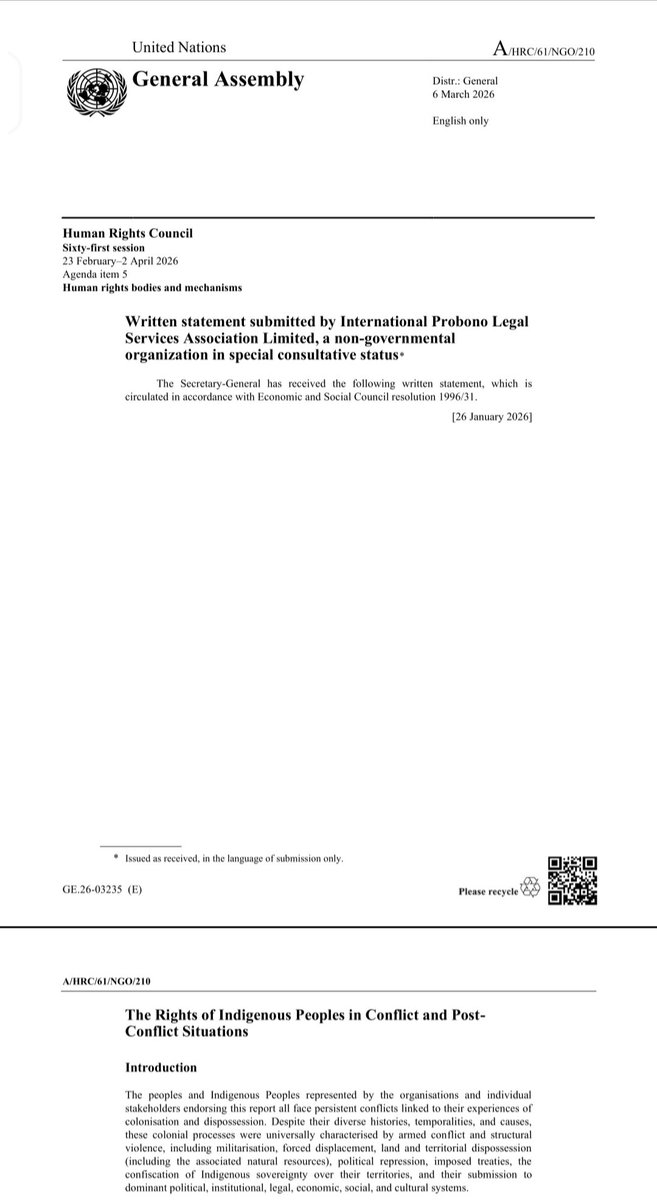
Indictment at the United Nations: A Report Submitted Directly to the UN Secretary-General Now Entered into the UN System Exposes Scotland as a Colony and Places the English Colonial State in the Dock
Read the full report by Liberation Scotland and partners on the official UN website https://t.co/A0lJ75qhza
A document has now entered the official machinery of the United Nations. Circulated at the United Nations Human Rights Council (61st session), received by the Secretary-General, and registered under UN procedures, this report constitutes far more than an NGO submission. It is an intervention within the normative space of international law itself; and an indictment of the English colonial state.
For Scotland as an English colony, it is nothing short of strategic.
A Break in the Colonial Narrative
For decades, the English colonial state has relied on a carefully constructed fiction. Scotland, the narrative insists, is part of a “voluntary union,” endowed with democratic representation, protected by devolution, fully exercising internal self-determination. It's a colonial lie.
This report dismantles that fiction with clinical precision.
It identifies Scotland not as a partner, not as a region, but as a territory under colonial sovereignty, explicitly placing it alongside cases such as New Caledonia and French Polynesia.
This classification is not rhetorical but analytical, precise, legal, and comparative. It situates Scotland within the global structure of colonial domination. It strips away the British constitutional mythology and replaces it with a framework grounded in international law.
Once that shift occurs, everything changes.
Devolution Unmasked as Legal Assimilation
At the core of the English colonial strategy lies devolution. Presented as a generous transfer of power, it has long been used to argue that Scotland already governs itself.
The report exposes this mechanism for what it is. A colonial fraud.
The Scotland Act 1998 is described as establishing administrative structures while preserving the overriding authority of the central, colonial English state, constituting a process of legal assimilation designed to negate Scotland’s status as a treaty partner.
This is a devastating reframing.
Devolution is no longer interpreted as autonomy. It is revealed as a technology of control, a system through which the English colonial centre maintains supremacy while projecting the illusion of self-government. Internal self-determination, in this light, is containment, certainly not liberation.
The implication is profound. The English colonial state does not share sovereignty. It absorbs, restructures, subordinates, plunders.
The Failure of Internal Self-Determination
The report goes further. It demonstrates that systems of internal autonomy, wherever imposed under the authority of the dominant state, remain structurally incapable of delivering genuine self-determination.
They operate within what the report identifies as a framework of hegemonic legal pluralism, where the colonised are permitted limited expression only within boundaries defined by the coloniser.
Scotland’s constitutional reality is thus aligned with a broader global pattern. From New Caledonia to Okinawa, internal arrangements function not as solutions but as instruments of stabilisation for colonial rule.
The conclusion follows with force.
External Self-Determination & Decolonisation as the Only Solution
The report states unequivocally that external self-determination is the only effective means of guaranteeing the rights of peoples subjected to such structures.
This is not a suggestion but a doctrinal position grounded in international and UN law:
-Article 1(2) of the UN Charter
-The UN General Assembly Resolution 1514 (XV)
-The UN General Assembly Resolution 1541 (XV)
The implication is unmistakable.
@UN@UNGeneva@UN_HRC@UNHumanRights@antonioguterres