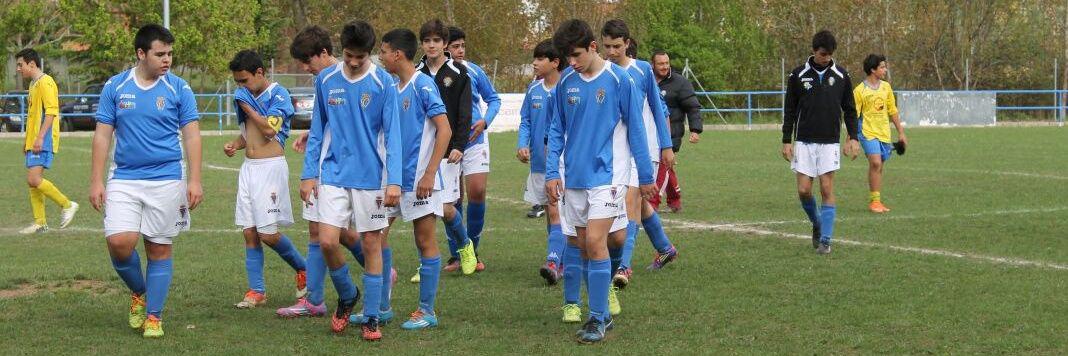
Con el gol anulado más escandaloso de la historia de los mundiales y con una segunda amarilla perdonada a paredes, los argentinos con los que he hablado piensan que España ha robado el partido.
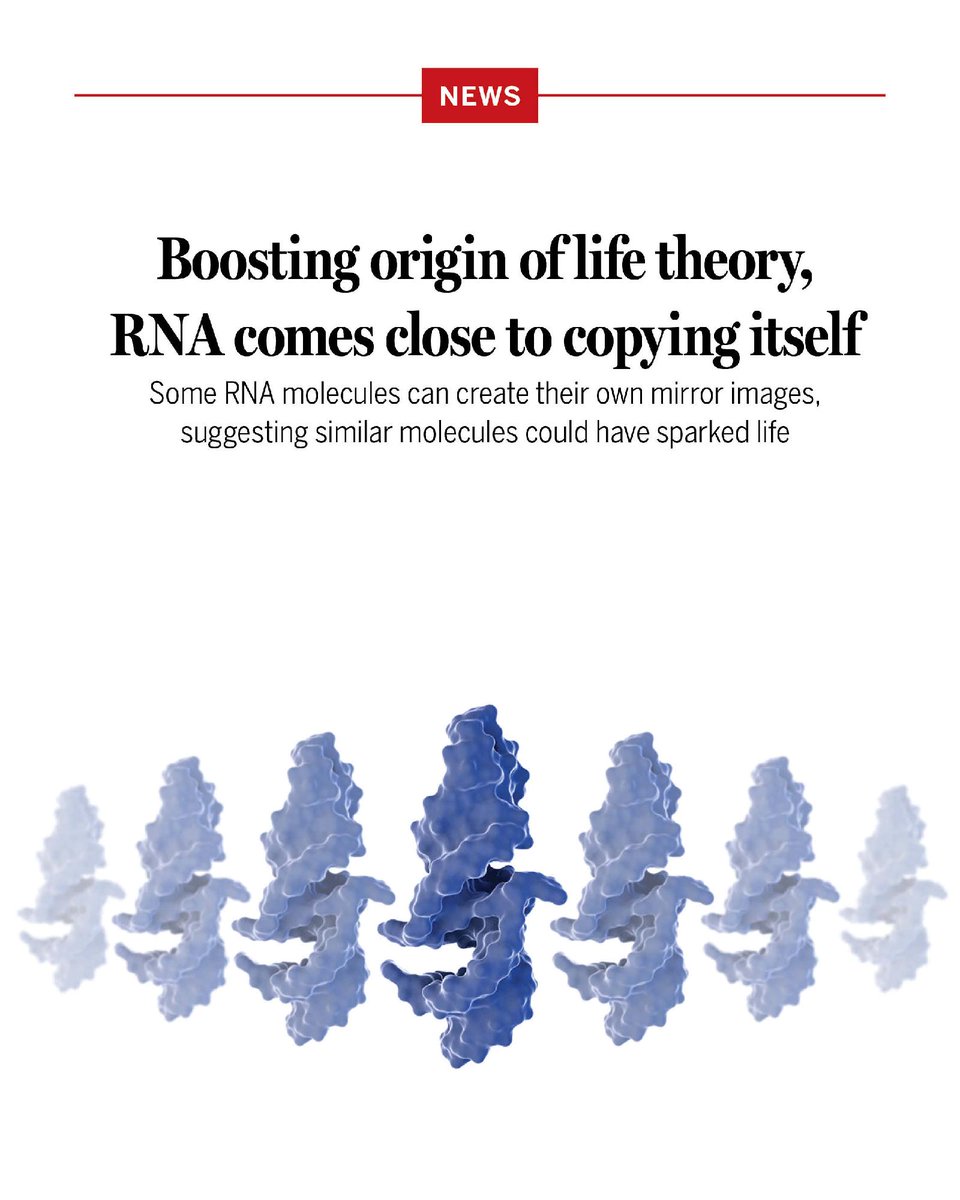
Today RNA may seem overshadowed by its glamorous cousin DNA, but many scientists think RNA molecules were the star players in the origin of life. By both storing genetic information and copying themselves, they might have touched off the march of evolution that produced increasingly complex life forms.
So far, researchers haven’t found RNAs that can replicate themselves, a key feature of living things. But they now have something close.
In a new paper, researchers report creating RNAs that can generate a sort of mirror image of themselves and use that template to generate the original. Learn more: https://t.co/lYjYdSD8X5
Como doctorando en neuro que fui en su día, uno acaba normalizando la falta de recursos en España.
Hay grupos de investigación que aún usan equipos de los 80s, ordenadores con Windows XP y donde las máquinas no están rotas pero “tienen truco”.
El mayor crimen actual es no entender el coste de oportunidad que tiene España con sus grupos de investigación.
Si con tan poco somos capaces de tanto…
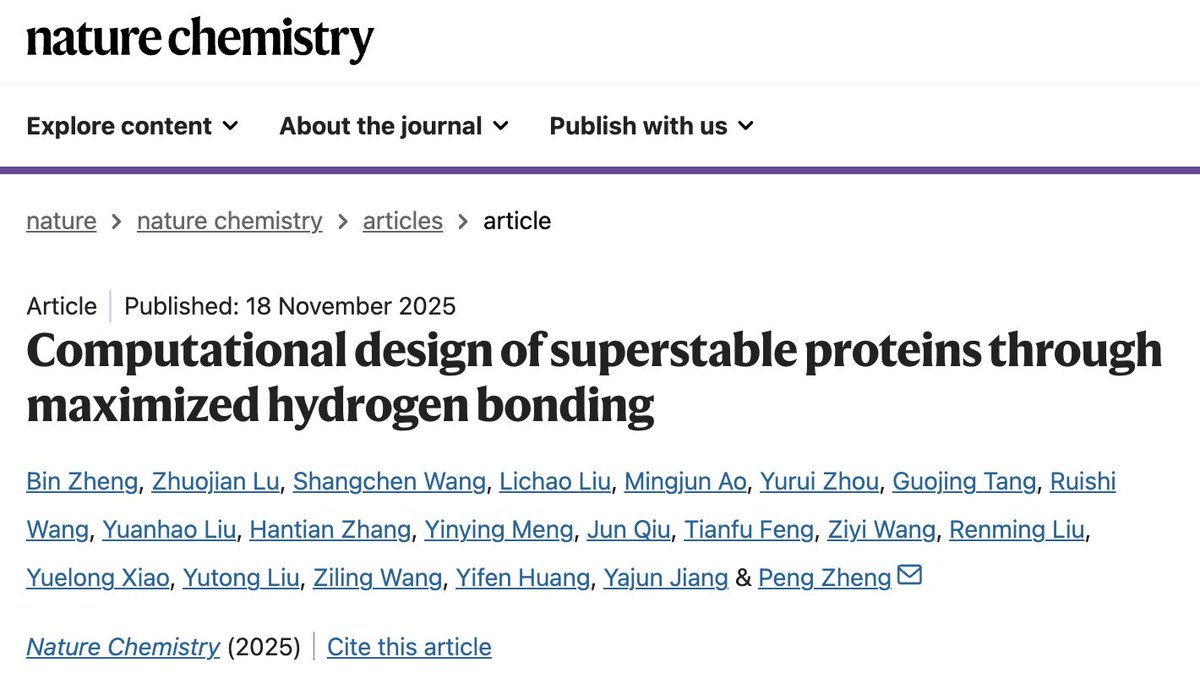
AI-designed proteins that survive 150 °C and nanonewton forces
Proteins are usually fragile machines. Heat them, pull on them, or send them through a high-temperature sterilization step (like those used in hospitals), and most will unfold and aggregate, losing their function. Yet many natural systems—like muscle titin or spider silk—hint that if you organize β-sheet hydrogen bonds in the right way, you can get remarkable mechanical strength and thermal resilience.
Bin Zheng and coauthors take that idea and push it to the extreme. Starting from the titin I27 domain, they use an AI+MD pipeline—RFdiffusion for backbone generation, ProteinMPNN for sequence design, ESMFold/AlphaFold2 for structure prediction, and steered/annealing MD for screening—to systematically elongate the force-bearing β strands and maximize backbone hydrogen bonds in a shearing geometry.
Across multiple design rounds, they grow the network from 4 to 33 backbone H-bonds, creating a “SuperMyo” series of proteins with unfolding forces above 1,000 pN—roughly 4× stronger than I27 under the same pulling conditions. Remarkably, these proteins not only refold after force, but also retain structure and function after exposure to 150 °C and repeated high-temperature sterilization cycles, and can be used as crosslinkers to make hydrogels that survive those treatments intact.
The message is powerful: by combining generative protein design with physics-based simulations, it’s now possible to turn a simple principle—pack as many shear-mode hydrogen bonds as possible into β sheets—into synthetic proteins and materials that rival or surpass nature’s own mechanostable systems, enabling protein-based hydrogels and biomaterials that remain functional under conditions that would normally destroy conventional proteins.
Paper: https://t.co/PMwfQpylqb
📲 𝟬𝟰𝟳 - NÚMERO VIVIENDA
Ponemos en marcha un teléfono gratuito de consulta e información veraz sobre vivienda. Con este número empoderamos a la ciudadanía con una nueva herramienta para defender sus derechos
To our friends in South Africa be careful You may have black magic, but we have the spirit of an old drunk man who was run over by a garbage truck, he protects us, and he will come for you
🖤 Minuto de silencio en el Cultural - Arenteiro por los mineros fallecidos en la mina de Cerredo.
De fondo, el Santa Bárbara Bendita. Gran gesto de la @CyDLeonesa.