Barry prefers stocks himself, so this isn’t a case for bonds over everything. If your plan needs a buffer against stock risk, he argues against skipping bonds just because 2022 still stings.
https://t.co/hZVhFqVL8E
The Agg fell 3.5% in Q3, its worst quarter since 2022, and bond fears returned. @gilbert3142 calls it bond derangement syndrome and argues that 2022 is the wrong year to anchor on.
🧵
https://t.co/hZVhFqVL8E
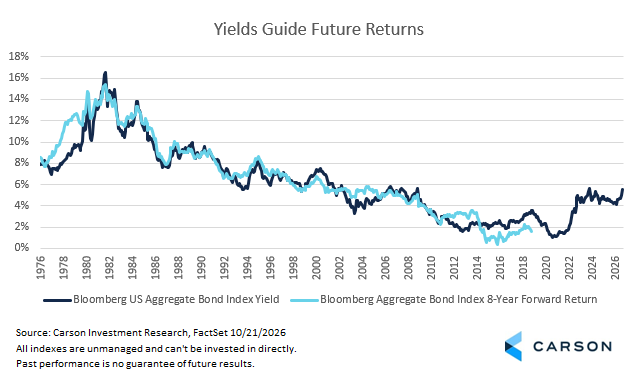
The Agg’s starting yield has been a good guide to its return over the next 8 years, landing within 1 point of it 75% of the time.
Today, the Agg yields 5.45%, and T-bills yield about 4.2%. If you hold both for 8 years, that compounds to 52% vs. 39%.
The chip shortage lasts only as long as the biggest buyers keep spending. Their stocks have barely moved since Q3 ended. Meta reports today, and Alphabet, Microsoft, and Amazon next week. Harry’s listening for 2027 spending plans and the payoff.
https://t.co/I5mR5R4dHp
Investors are acting like the chip shortage is near its peak. Since Q3 ended, Micron is down 17.5%, and the PHLX Semiconductor Index is down 11.8%, while refiners Marathon Petroleum and Valero are up 20.9% and 14.7%, respectively.
Micron beat estimates, but the stock still fell.
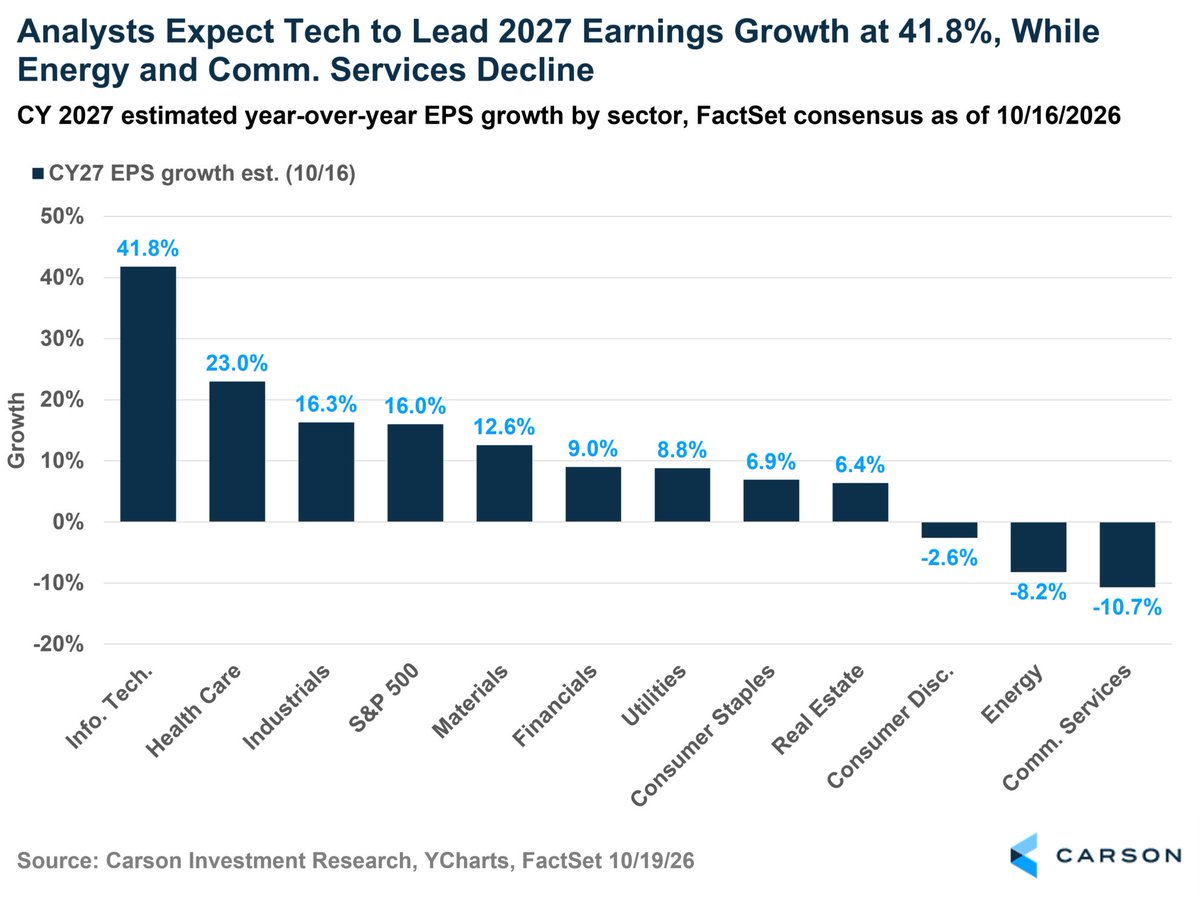
Analysts are betting the other way. They expect Tech earnings to grow 41.8% in 2027 and Energy to fall 8.2%, so the chip shortage keeps paying, and the oil windfall fades.
Harry takes that with a grain of salt. Estimates over a year out tend to start high and come down.
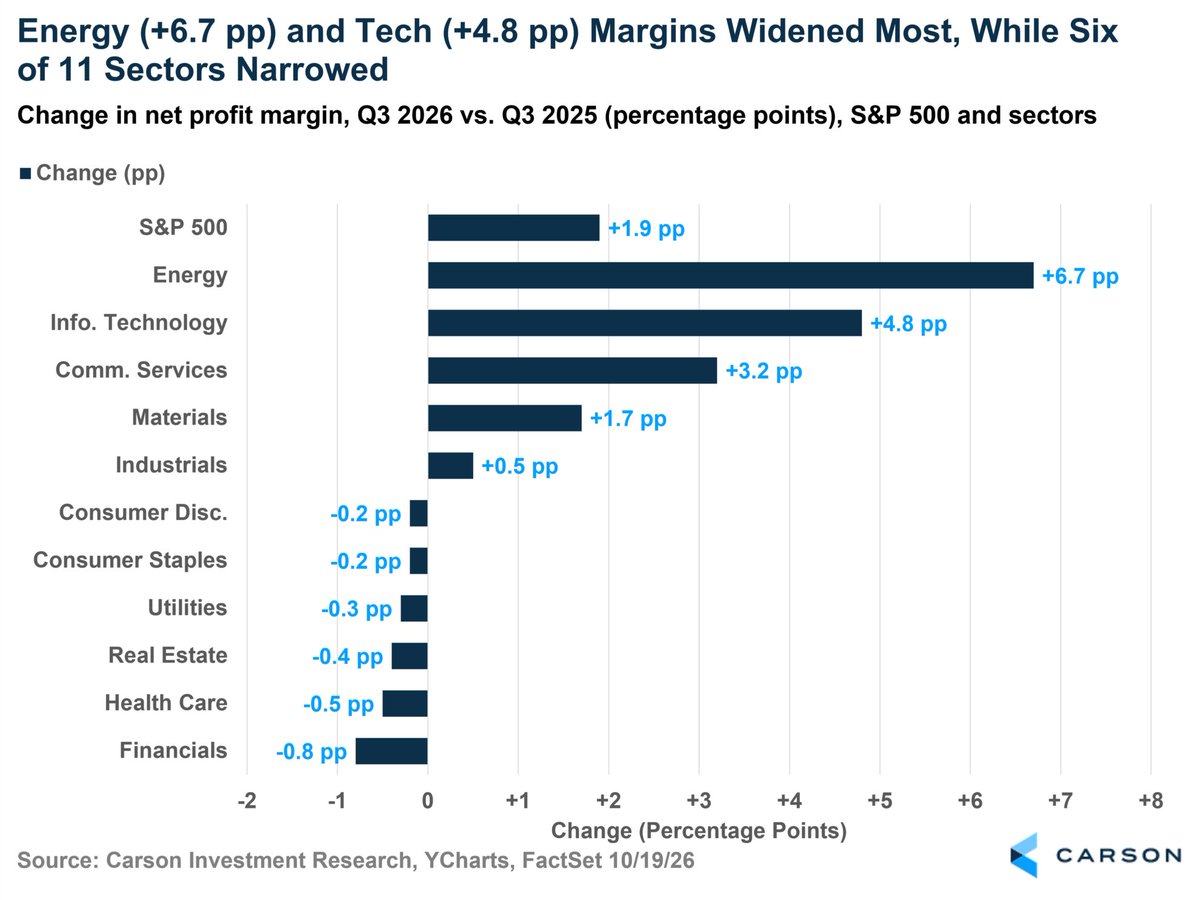
The extra profit shows up in margins. Energy’s are up 6.7 points from a year ago and Tech’s 4.8, while 6 of 11 sectors keep less of each sales dollar.
Shortage profits tend to last until supply catches up, and much of the AI boom is an effort to catch supply up.
Outside the shortages, earnings look healthy, just more normal. Tech ex-semis is growing 24.4%. Comm Services ex-Meta and EchoStar is +11.5%. Health Care only turned negative on a one-time Eli Lilly charge, and ex-drug makers are +7.4%.
Energy earnings are expected to grow 127.6% and Tech 65.1%, far ahead of the rest.
Refiners are on track for 482% growth after record diesel margins. Micron earned $33.42 a share last quarter, up from $3.03 a year ago.
S&P 500 earnings are on pace to grow 29% in Q3. Take out Micron and NVIDIA, and it’s 20%. In his first Earnings Check-In of the season, Harry McDonald follows what ties the leaders together. They all sell something the world is short on.
🧵
https://t.co/I5mR5R4LwX
About 9% of the S&P 500 have reported, mostly banks. Blended growth is 29.0%, a third straight quarter above 25% if it holds.
84% have beaten estimates vs. a 78% 5-year average, but the beats are small: 2.6% in aggregate vs. a 7.5% average, mostly on the banks.
The Dow was up more than 40% for the year by mid-August 1987, crashed in October, and still finished the year up 2%. If all you saw was the annual return, you’d think 1987 was a boring year.
Source: https://t.co/qZROQ2nGxU
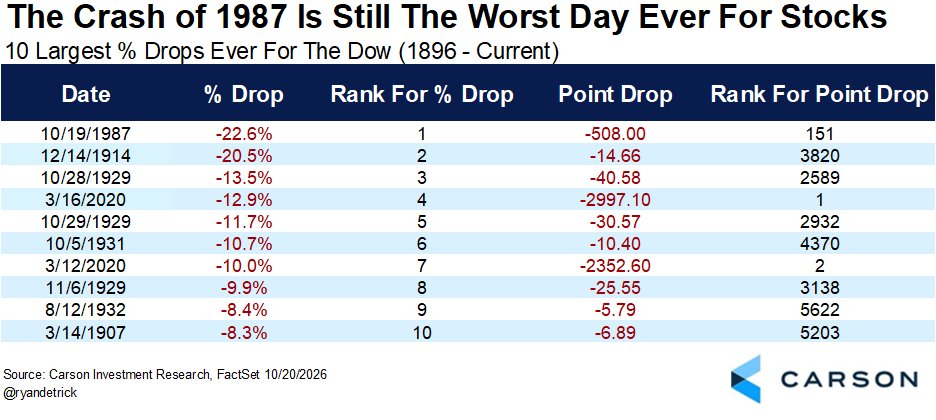
Oct 19, 1987 is still the worst day in Dow history by percentage, down 22.6%.
By points, that 508-point drop now ranks 151st. The Dow has already had 19 days this year that lost more than 508 points.
October has earned its reputation. The worst Octobers since 1900 line up with the 1907 banking panic, World War I, the 1929 crash, the 1987 crash, and the financial crisis.
1987 tops the list at -21.8% for the month.
39 years ago this week, the Dow fell 22.6% in a single day. @RyanDetrick looks back at the Crash of 1987, from Greenspan stuck on a plane to why stocks still finished the year in the green.
https://t.co/wk5MtgVWgq
Goldman CEO David Solomon cited estimates that the US data center buildout could need over $10 trillion through 2032, and said no one knows how demand for capital and compute will evolve. Blake’s take is that the unknown demands compensation.
https://t.co/hhagDphnBF