ON THE SLOW DEATH OF BIVENS:
The D.C. circuit holds that Americans cannot sue IRS agents who maliciously audit them.
Thanks to this kind of federal immunity, IRS agents now operate in a Constitution-free zone, above the law.
Congress MUST fix the problem of federal immunity.
@AFPfoundation The need to reconsider Stinson came up in another petition filed last year--Poore v. US--which has now been relisted NINE times. The excellent folks over at @NCLAlegal, including @CaseyNormando & @Kara_Mc_Rollins, filed the only #amicus brief in that docket. Worth a read!
Who decides what conduct is a crime—Congress or federal bureaucrats?
In Pheasant v. United States, a man faces criminal charges for riding a dirt bike on federal land without a taillight. The broader issue: whether agencies like BLM can make criminal law.
NCLA attorney Casey Norman (@CaseyNormando) explains why the Constitution says Congress must write criminal laws—not unelected bureaucrats.
Read more ⬇️
NCLA DOES IT AGAIN: FIRST AMENDMENT RIGHTS VINDICATED
We've settled our lawsuit for former San Antonio City Poet Laureate Nephtalí De León against the City of San Antonio. The lawsuit alleged that the City fired De León from the paid position of City Poet Laureate and defamed him over legally protected free speech.
Under the settlement, the City has paid De León more than the compensation originally agreed for his laureate services. Find out what happened. ⬇️
Can a federal agency make up crimes?
NCLA just urged the Supreme Court to hear Pheasant v. U.S. and Choice Refrigerants v. EPA and revive the Nondelegation Doctrine—Congress can't give away its power to legislate.
The Bureau of Land Management has been creating crimes. That’s legislative power the Constitution reserves for Congress—not bureaucrats.
SCOTUS should step in. Find out more ⬇️
@pjaicomo Goes to show how utterly nonsensical the “clearly established” prong of QI is. That conduct can be plainly, indisputably unconstitutional per SCOTUS and yet warrant zero consequences b/c the exact same thing didnt happen in another case defies reason. To put it lightly…
Today, SCOTUS denied certiorari in NRA v. Vullo, leaving in place qualified immunity for the NY bureaucrats who retaliated against the NRA for its pro-gun advocacy.
This violated the First Amendment—according to a unanimous SCOTUS in 2024—but QI renders the Constitution inert.
The President cannot do these things.
To the contrary, he has sworn an oath not to destroy the country.
And if he tries, every other government official has sworn an oath that creates an affirmative duty for them to stop him.
@pjaicomo Donald is encouraging us to live simply and relinquish our fixation on worldly possessions, Patrick - very Buddhist of him really. As our finances dwindle, our spiritual awakenings flourish😌
What happens when a state or local police officer violates someone’s constitutional rights—and courts say there’s no practical way to sue?
In this episode of Unwritten Law, NCLA President Mark Chenoweth and Senior Litigation Counsel John Vecchione @VecchTweets are joined by Casey Norman @CaseyNormando to discuss Mohamud v. Weyker (No. 25-760), now at the U.S. Supreme Court.
NCLA’s amicus brief explains that multiple courts have recognized Officer Heather Weyker (a St. Paul police officer) abused her authority by fabricating allegations against Hamdi A. Mohamud and at least 30 other people—conduct the brief describes as “framing” that led to Mohamud’s incarceration for over two years. Yet the Eighth Circuit held Mohamud cannot sue Weyker under 42 U.S.C. § 1983 because Weyker was also cross-deputized for a federal task force—treating the conduct as federal in nature and shutting the courthouse door.
The episode also explains why this accountability gap is especially dangerous after Egbert v. Boule, which largely eliminated Bivens remedies for most plaintiffs—making § 1983 often the only viable path for damages when cross-deputized officers violate constitutional rights.
A police officer fabricated a sex-trafficking conspiracy.
30 innocent people were implicated.
Hamdi Mohamud spent over two years behind bars — with no pathway to relief.
This is why NCLA is urging the Supreme Court to take the case.
🎙: Unwritten Law podcast
@NCLAlegal Mark Chenoweth, @CaseyNormando , and @VecchTweets
Per some courts, a cop who fabricates a sex trafficking conspiracy and gets innocent teen refugees thrown behind bars for 2+ years to boost her own career should face zero consequences—so long as the cop’s “cross-deputized.” Glad to continue supporting @pjaicomo@IJ on this one
A police officer fabricated a sex-trafficking conspiracy.
30 innocent people were implicated.
Hamdi Mohamud spent over two years behind bars — with no pathway to relief.
This is why NCLA is urging the Supreme Court to take the case.
🎙: Unwritten Law podcast
@NCLAlegal Mark Chenoweth, @CaseyNormando , and @VecchTweets
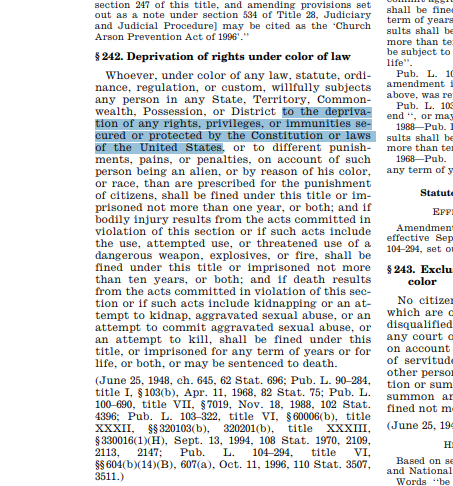
REMINDER: If a federal agent uses or threatens to use force on someone while violating her constitutional rights it is a federal crime and felony.
But I fear that @TheJusticeDept and @CivilRights may sweep these crimes under the rug.
This is why Congress must amend § 1983.
Take a gander at m’latest blog @NCLAlegal for more on BASE jumping, criminal laws without Congress, and the weird shite that might land you in prison if you do it in a national park (spoiler: flip off a horse at your own risk…)
Can an executive agency decide—on its own—what counts as a crime?
In new @NCLAlegal blog, NCLA's Litigation Counsel Casey Norman (@CaseyNormando) explains how the National Park Service criminalized BASE jumping across 85 million acres of public land—without clear direction from Congress—and why the so-called “intelligible-principle” test has failed to stop it.
Read more ⬇️