UNBELIEVABLE: Kaspa Will EXPLODE Soon 🤯 Because Of This
Vertical version of my Longform vid on YT
#kaspa#vprogs
0:00 Real apps on the base layer
0:40 Not an L2
1:23 How a vProg works
2:00 Sovereignty and composability
2:19 Where it stands
3:07 Proof of work money with apps
The lineage is the interesting part, Bitcoin's UTXO and script structure kept as the accounting foundation, consensus rebuilt as a BlockDAG, implementation rewritten in Rust.
Toccata then made covenants and ZK first class inside that same script model. For a magazine on Bitcoin derived designs, Kaspa is the case where the inherited model became a programmability platform.
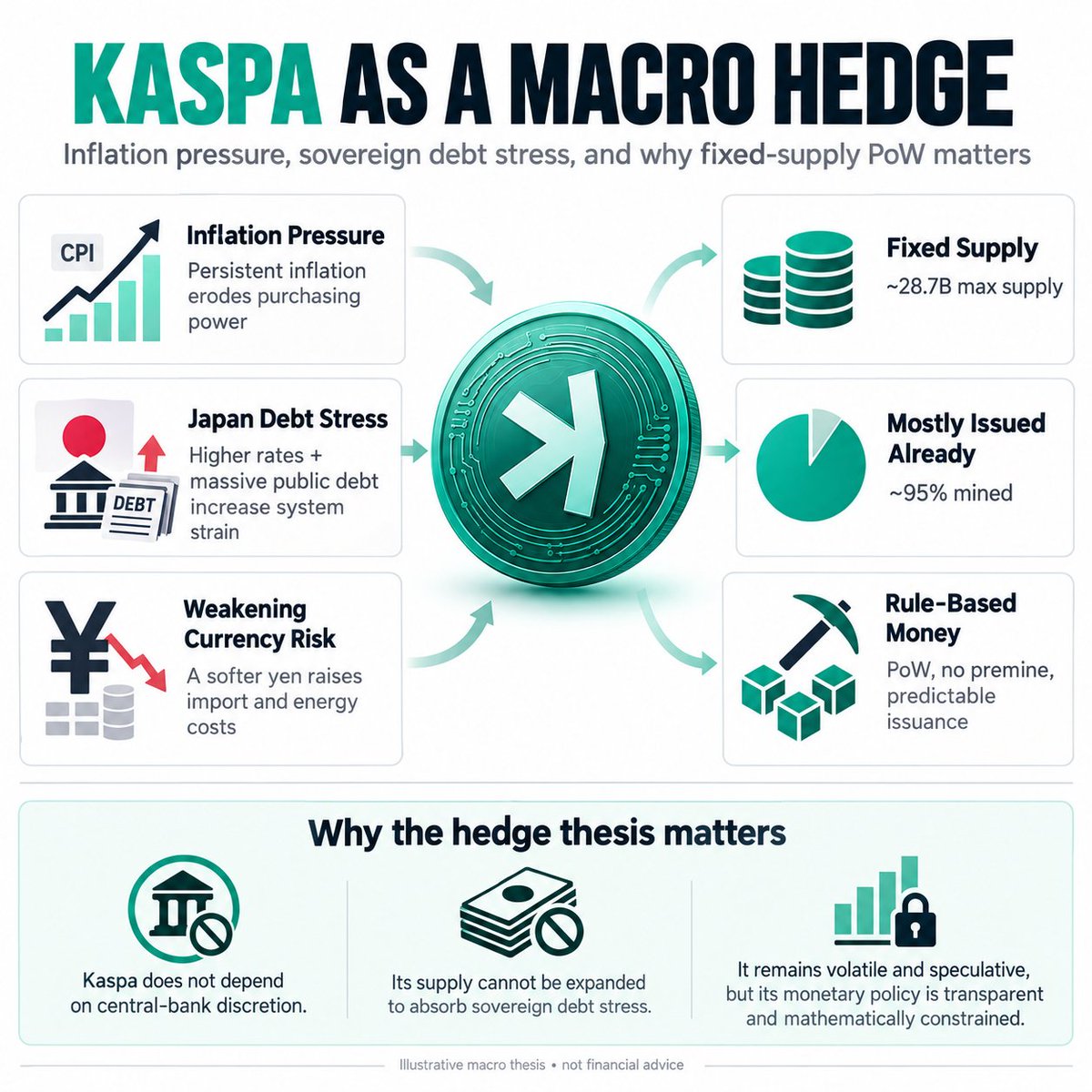
Kaspa is becoming increasingly interesting as a monetary hedge because the macro problem is no longer simply “inflation is high.” It is that the mechanisms governments and central banks use to control inflation are beginning to collide with enormous debt loads. U.S. CPI is running at 3.4% year over year, producer prices are rising faster, Treasury yields have pushed above 5%, and higher energy costs are feeding another wave of inflationary pressure. Japan may be the clearest warning of what this transition looks like. After decades of near-zero rates, the Bank of Japan has pushed its policy rate to 1.25%, while Japan’s 10-year government bond yield has climbed above 3%, around its highest level in three decades. The problem is that Japan also carries gross public debt above 200% of GDP, meaning normalization eventually translates into substantially higher debt-service costs. A weakening yen adds another feedback loop by making imported energy and commodities more expensive. This creates an uncomfortable monetary equation: tolerate inflation and currency depreciation, or tighten aggressively and increase pressure on debt, credit, and economic growth. Kaspa exists outside that equation. Roughly 95% of its eventual supply has already been mined, its issuance declines predictably, its approximate 28.7 billion KAS supply cannot be expanded because policymakers need cheaper financing, and there was no premine or allocation that can be quietly diluted into the market. Its proof-of-work monetary policy is enforced by protocol rather than discretion. That does not make Kaspa a low-volatility safe haven; it remains a speculative asset capable of severe drawdowns. The hedge thesis is different: Kaspa is a scarce, globally transferable monetary asset whose supply schedule does not change when sovereign debt markets become stressed. If the coming decade becomes a struggle between inflation, currency debasement, and unsustainable borrowing costs, mathematically constrained proof-of-work assets become increasingly difficult to ignore.
toccata added a native ZK proof verifier to kaspa’s L1.
an app can do expensive calculations off-chain, then submit a proof that it followed the programmed rules.
a covenant checks the proof and makes sure the transaction applies the proven result.
kaspa calls this inline ZK.
BlackRock just published “The Machine-Native Economy.”
They didn’t say banks are dead. They said something more important:
AI agents can’t open checking accounts.
Card fees destroy a $0.001 API call.
ACH doesn’t run at 3am on Sunday.
So they want machine-native money and machine-native rails. Stablecoins for spend. Programmable settlement. Protocols like x402 so an agent can hit HTTP 402, pay, and get the data — no human click.
That’s not a bank product. That’s a high-frequency, always-on, sub-cent settlement problem.
Kaspa was built for that traffic.
BlockDAG + parallel blocks = throughput humans don’t generate and machines will. Fees stay tiny when volume is millions of tiny payments, not a few wires. Fast confirmation is what an agent needs before it releases compute or an API response. Toccata covenants give L1 programmability without turning the base layer into a congested app chain — exactly the kind of constrained, verifiable logic agents can trust.
x402 is chain-agnostic. The rail that wins is the one that is cheap, fast, and boringly reliable when ten million agents are paying each other for tokens, inference, and data.
BlackRock described the demand.
Kaspa is the plumbing that already looks like that demand.
Machine-native intelligence needs machine-native money.
Choose the chain that was designed for machines first.
#Kaspa #KAS #x402 #AIAgents
SilverScript Studio is live on Kaspa mainnet.
Write, compile, and deploy covenants directly from your browser.
Three ways to build:
-> Write SilverScript manually
-> Describe what you want in plain English AI generates the code
-> Use guided wizards for vaults, escrow, recurring payments
No local setup. No node required.
One click deploy to mainnet.
The barrier to building on Kaspa L1 just dropped significantly.
https://t.co/PtlPW4fUH5 | #Kaspa #NFA
Example of a real-life use case for SilverScript:
A freelancer contract that releases payment on a schedule or when a milestone is delivered, with the delivery notarized on chain (the files themselves if it's digital work, or a photo of the finished job if it's physical, to prove when it was done).
What I like about Kaspa is that it makes cheating harder. The contract is enforced by the chain itself.
bitcoin dev's were discussing covenants back in 2013.
bip-119 later proposed one approach to covenants, restricting spending to a predefined transaction template. it was never activated on btc tho.
kaspa’s covenants go further (covenants++ if you like). scripts can enforce spending rules, carry application state forward and let that state split into branches that progress independently. multiple contracts can also update together in one transaction, with all changes accepted or none of them.
dev's write that logic in silverscript, which compiles it into scripts kaspa enforces on L1.
Kascov has opened up the code behind the covenant labels in its Kaspa explorer.
That’s more useful than it sounds.
On Kaspa L1, covenant outputs can commit to a program. When one of those outputs is spent, the program is revealed.
Kascov’s decoder can take that revealed program, check that it really matches the commitment in the original output, and then identify known SilverScript or Argent builds and read their fields.
The important part: once you have the transaction data, the check runs locally.
You don’t have to trust the label shown by the explorer. Developers can reproduce the result themselves from Kaspa L1 data.
There’s also a command-line tool and a WebAssembly build for browsers and Node.
One distinction matters:
The covenant itself is on Kaspa L1.
Kascov Decode is off-chain tooling that reads and verifies that L1 data.
And identifying a program is not the same as proving it is secure. Contract security still needs its own review.
The decoder code landed publicly on September 24–25.
Explorer: https://t.co/Utc1VsaRts
Code: https://t.co/NFHLC9zbyw
Initial decoder commit — Sep 24:
https://t.co/iog5QQqZCd
CLI + WebAssembly + fixture provenance — Sep 25:
https://t.co/UHFJfk6y5P
KIP-20:
https://t.co/EwkxO355Jf
@kascovio #Kaspa #KAS
The Kaspa community showed us some serious love. 💙
So if you're diving deeper into $KAS, we’ve put together a full Chainquiry Insights research piece covering Kaspa, GHOSTDAG, BlockDAG architecture, kHeavyHash mining and more.
🔎 https://t.co/eQq27vnVtY
@kaspacurrency#Kaspa
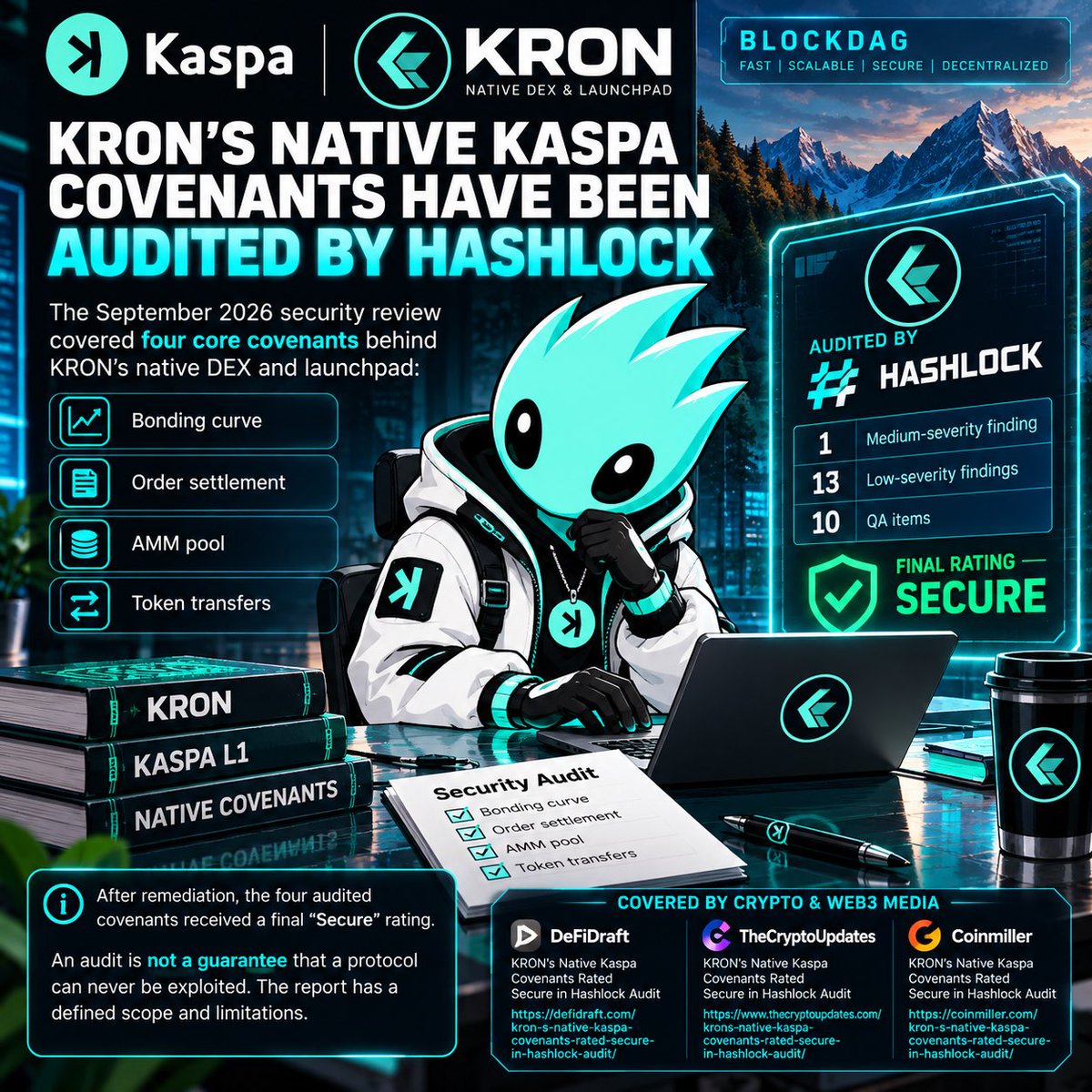
KRON’s native Kaspa covenants have been audited by Hashlock.
The September 2026 security review covered four core covenants behind KRON’s:
• Bonding curve
• Order settlement
• AMM pool
• Token transfers
Hashlock identified 1 medium-severity finding, 13 low-severity findings and 10 QA items.
After remediation, the four audited covenants received a final “Secure” rating.
Important context: an audit is not a guarantee that a protocol can never be exploited. The report has a defined scope and limitations.
What makes KRON interesting is its architecture: it runs directly on Kaspa L1 through native covenants, rather than relying on a separate chain or bridge.
Audit ≠ invulnerability.
But independent code review matters.
https://t.co/bT4Rbj9oCR
https://t.co/Ht9koTn08Z
#Kaspa kaspa:native #KRON #Dex
hello again. the devs made things this week and i made a list.
1 / Rusty Kaspa v2.1.0
nodes now download sync data in smaller chunks to avoid bottlenecks and timeouts while catching up with the network. v2.1.0 also includes Stratum bridge fixes and moves the existing zero-knowledge proof tools into their own package.
https://t.co/WzHdJGh4qo
2 / vProgs
@Max143672 announced the first vProg running on testnet. it’s a playable tic-tac-toe game with real execution and settlement. still a working proof of concept, with public code for devs to build from.
https://t.co/P9wYRkkcMx
3 / Python SDK
@smartgoo_ released Python SDK v2.1.0. devs can now compile SilverScript contracts in Python and debug them without running a node. it also adds tools for using zero-knowledge proofs, examples and bug fixes. SilverScript support is still experimental.
https://t.co/yYkw11hhop
4 / SilverScript Studio
@KasperoLabs announced SilverScript Studio is live on mainnet. build, compile and deploy covenants from your browser. write them yourself, describe what you want to its AI, or use the wizards for things like vaults, escrow, recurring payments and payroll.
https://t.co/pXKUP3Ob4l
5 / KCC23
@manyfest_ explained a proposal for linking details like token names, symbols and images to a covenant, without copying them into every holder’s coins. KCC23 is still a draft and open for review.
https://t.co/Tk4rGZxJjN
6 / KCC standards
@asaefstroem’s proposal to finalize KCC0 was merged. it sets out how shared ecosystem conventions are proposed and reviewed. he also proposed moving KCC20 into last call review. that hasn’t merged, so KCC20 is still a draft.
https://t.co/48shGa9eNJ https://t.co/u1SKQvgPOk
7 / DNS seeder
@supertypo_kas released DNS seeder v0.9.6, fixing a bug that counted some offline nodes as online.
https://t.co/2MvdLFDHF9
thanks to everyone building. see you next week.
Now imagine a bank that has to prove every balance adds up before any money moves.
Now imagine a game economy where the developer can't print extra items and sell them to you.
Now imagine a stock exchange where nobody can jump the queue, not even the exchange.
Now imagine a tournament where the organiser can't walk away with the prize pool.
Now imagine a gig app that can't change your pay after the job is done.
Now imagine sending money home through a service that can't take a cut it never told you about.
Now imagine loyalty points no company can quietly devalue.
Now imagine song royalties split between every artist exactly as the contract says.
Now imagine a subscription that can't charge you more than you agreed to.
Now imagine an airdrop where insiders can't grab more than the rules allow.
Now imagine a village savings circle with no bank, where the rules hold the money, not a person.
Now imagine disaster aid that can only be paid out the way donors were promised.
Now imagine a public budget where every payment has to match what was approved.
Now imagine a vote count that nobody can change, not even the organiser.
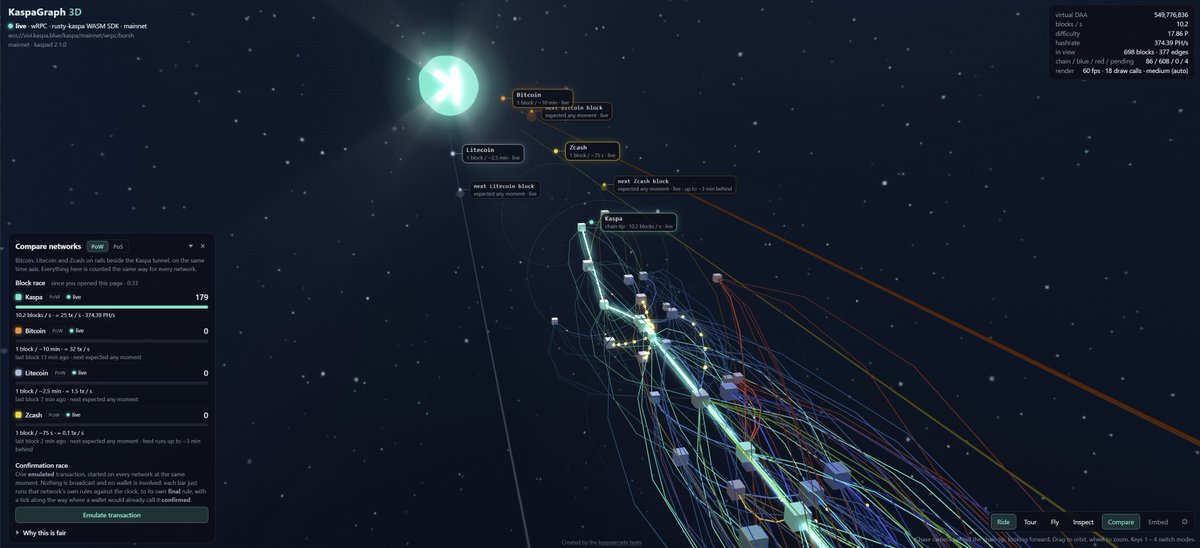
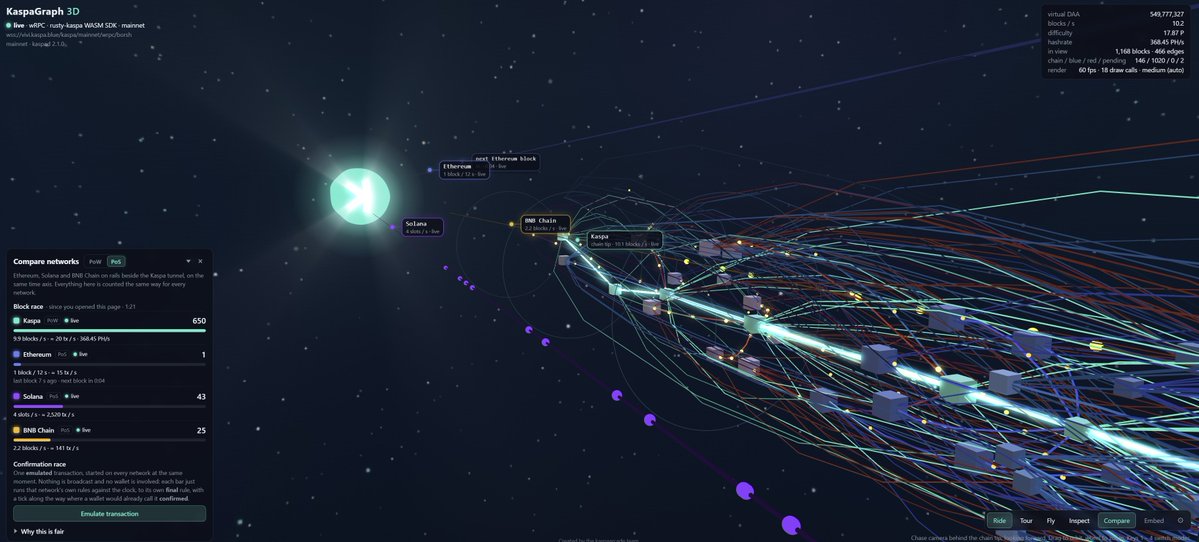
https://t.co/42ItIeWZKo has added the ability to compare kaspa:native to other crypto assets' chains. compare the #kaspa to live bitcoin:native, zcash:native, litecoin:native, and 3 PoS coins ($eth, $bnb and $SOl).
It does give you perspective of how amazing Kaspa is.
Just click "Compare"
1/2
Kaspa's consensus makes one hardcoded guess about network delay, and lives with that tradeoff either way.
New article covers DAGKnight, the upgrade removing that guess entirely, what it unlocks, and when it's expected. 🧭
#Kaspa#Crypto#Bitcoin#DAGKnight https://t.co/UfaC9FpWde
SilverScript Studio is now live on mainnet.
Write Kaspa covenants by hand, with a wizard, or by describing them to an AI that speaks only SilverScript.
Deposit and withdraw with your own wallet: Kasware, Kasla, Kastle (Kastle to deposit; signing support is coming).
Multi-signer covenants get a link the other parties sign from.
https://t.co/ptHHHf0k1K
After further working on Kaspire we also made use of the security audit tool by Cloudflare which is a coding-agent skill that turns your agent into a security auditor. It orchestrates isolated agents through reconnaissance, coverage-led hunting, candidate validation, structured output, independent record verification, and target-neutral reporting. This is the skill that seeded Cloudflare's vulnerability discovery harness.
As AI is getting more and more advanced and finds vulnerabilities in code even humans oversee this is a very important step to do, especially after recent incidents with Coldcard, the Lightning network or Kasplex.
The good news: after an over 4 hour check via Cloudflare Security Audit, the audit result came back mostly with only minor issues with the integration of KCC20 tokens, L2 tokens, and WalletConnect v2. This issues could potentially only lead to errors but no funds were ever at risk.
For full transparency there was however an actual security vulnerability. This is what the report says:
"Website build may accept an APK not authorized by the update-manifest signing key
The website post-build gate decodes the staged Android update envelope and treats the payload's SHA-256 as authority for the staged public APK without verifying the envelope's RSA signature. If an artifact-staging or deployment identity can replace both tracked public files while lacking the Android/update signing keys and while trusted build code remains protected, it could cause the website to publish a matching unauthorized APK for fresh installers. Existing supported installations have an additional Android package-signing-lineage control, and repository source does not establish whether the required lower-trust staging identity or deployment path exists."
This is a potential security issue when an attacker does not possess an Android signing key or an update signing key, but can somehow replace the two files during staging or deployment. This issue is being fixed right now.
The tool we used: https://t.co/63Dt3UGYw3
We encourage other builders to also make use of Security Audit Skill and find potential flaws to fix, before AI grants more attackers with flaws in the code to abuse.
If you build in Python, there’s something new to play with in Kaspa SDK 2.1.0.
You can now compile SilverScript contracts and debug calls locally, including a step-by-step trace when something fails. The release also includes a Counter covenant example on TN10.
On the ZK side, Python can now build the scripts used to verify a RISC Zero proof on Kaspa. You bring the proof; the SDK handles the script-building part.
Nice work by @smartgoo_ and everyone involved. The SilverScript bindings are still experimental, but it’s good to see these tools reaching Python developers.
https://t.co/okKsuwc7pu
#Kaspa #Python