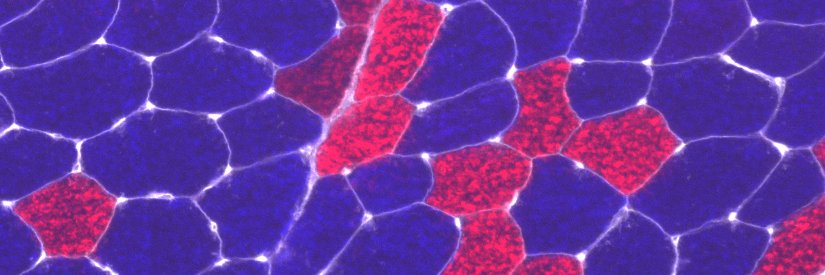
Does one biopsy cut it? Short answer: no. Find out the longer answer below 🧵👇
This thread is based on our new @japplphysiol paper, where we investigated human muscle fiber type composition variability by analyzing repeated biopsies. Lots of them.
https://t.co/6yAHbrurqc
Proud to have our paper featured on the cover of the April issue of @Cell_Metabolism. It shows an exercise-induced degranulating mast cell releasing histamine. Thanks a lot for the design Emma @DrawImpacts.
Read the full story here: https://t.co/ptk17Iy72p
@TeamDerave
From @ugent@karolinskainst@uni_copenhagen@CasteeleFreek et al.: Does one biopsy cut it? Revisiting human muscle fiber type composition variability using repeated biopsies in the vastus lateralis and gastrocnemius medialis 💪
🔗https://t.co/L2z0zDGCLj
Inter‐Individual Variability in Muscle Fiber–Type Distribution Affects Running Economy but Not Running Gait at Submaximal Running Speeds | https://t.co/zFn2Iio2hI
-Does one biopsy cut it? Revisiting human muscle fiber type composition variability using repeated biopsies in the vastus lateralis and gastrocnemius medialis-
New in @japplphysiol by @TeamDerave - nice work!
https://t.co/1KBESAWuJU
@DebevecTadej@japplphysiol Most interventional applied studies (e.g. training study) are short-term and likely have no or a small effect on MFTC. To investigate the intervention effect properly we need to reduce the variability of the MFTC measurement, or increase sample size, and ideally both. (2/2)
Does one biopsy cut it? Short answer: no. Find out the longer answer below 🧵👇
This thread is based on our new @japplphysiol paper, where we investigated human muscle fiber type composition variability by analyzing repeated biopsies. Lots of them.
https://t.co/6yAHbrurqc
@DebevecTadej@japplphysiol Thanks, Tadej! I would propose collecting 4 samples from 2 biopsy needles inserted in opposite directions through 1 incision. I get that this is still a burden on the participant and researchers, and maybe not feasible for everyone, but necessary. (1/2)
Glad this stuff keeps coming out.
The variability in 'fiber type' from each biopsy is quite large, so results should be interpreted with caution - probably explains much of the 'mixed results' that plagued the field for decades.
https://t.co/QdZ2DusSns
👏@WiApro et al.
Sidenote: although type I % is not considered a direct determinant of V02peak, a significant positive relationship is expected as type I fibers generally have a higher capillary density and greater oxidative capacity than type II fibers