The Renaissance of Onchain Options
Mapping the expansion of options as a trading instrument and the volatility that prices them
Co-authored with @BlockScholes
Read the free report here: https://t.co/gcfrb2LF2A
Just a week after launch, @RobinhoodApp is already the 5th-largest chain by 24h DEX volume, with over $370m in daily volume and $1.35b in cumulative volume, mostly driven by $CASHCAT
Just a week after launch, @RobinhoodApp is already the 5th-largest chain by 24h DEX volume, with over $370m in daily volume and $1.35b in cumulative volume, mostly driven by $CASHCAT
Onchain options have often been an overlooked niche.
But teams are simplifying complexity with option-like products that deliver clear value to users (e.g. prediction markets).
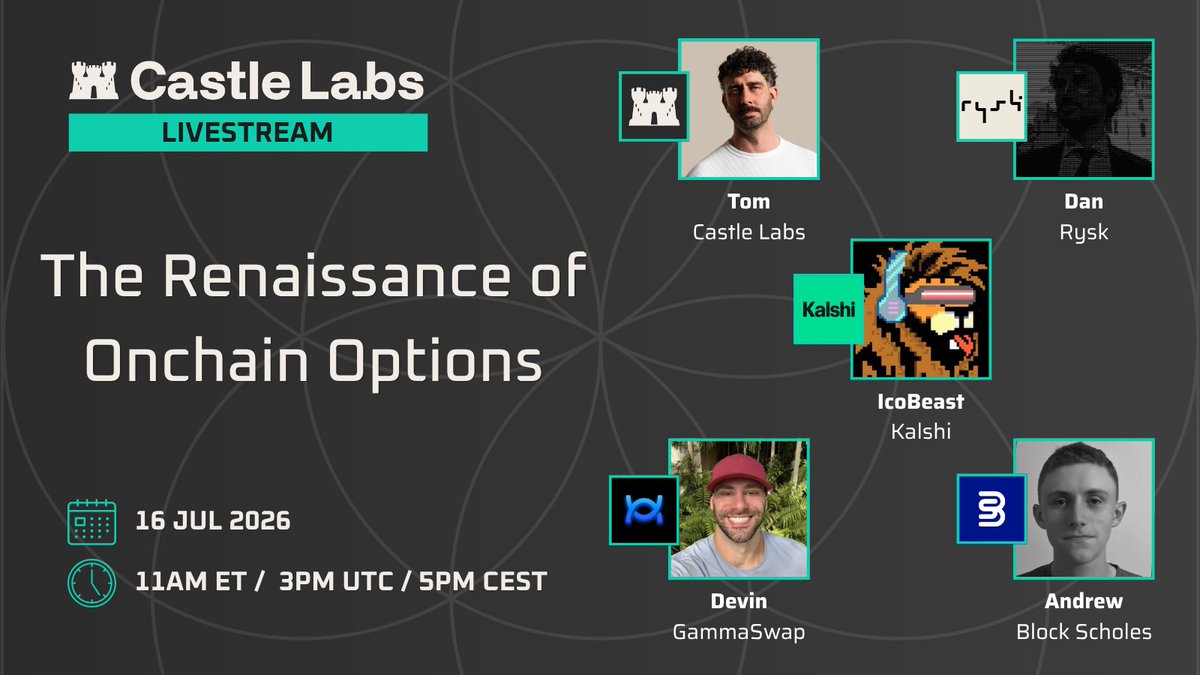
Join the discussion w/ @kalshi@ryskfinance@GammaSwapLabs & @BlockScholes
📆 Thur 16th Jul 3pm UTC
We often do not reflect much on the consistency of revenue in crypto.
Below, we compare the revenue of several top protocols across H1 2025 and H1 2026 and highlight the change between them.
Protocols like Hyperliquid, Aave, and Sky had the most consistent revenue, while Pump, Aerodrome, and Jupiter saw a sharper decline and struggled to match their performance from the past year.
(Source: Defillama)
Securitize (SECZ) became the largest tokenised stock on the same day they listed on the NYSE.
For @Securitize, this is a great marketing campaign.
This is the company’s entire business. By tokenising its own public stock at listing, it's using itself as the case study👇
Securitize is a regulated tokenisation platform, transfer agent and infrastructure provider for tokenised securities. Its wider platform already supports roughly $3.5B+ in onchain market cap across a range of products.
$SECZ has quickly become the largest tokenised stock by onchain market cap, at roughly $239M. Although access remains permissioned, only for eligible US investors, and subject to onboarding, KYC/AML checks, jurisdictional eligibility, etc.
Securitize now needs to go one step further.
It has shown that a public stock can be tokenised in a way that stays closely aligned with the offchain share.
The harder step is proving that the tokenised asset exists for a reason. SECZ needs to become more than Securitize’s flagship stock issuance. It needs to become a working example of what tokenised equities can do differently:
✦ Be useful beyond holding
✦ Be accepted as collateral
✦ Support faster settlement or transfer workflows
✦ Expand access across jurisdictions where compliant
✦ Develop secondary liquidity or credit markets
That is what would turn SECZ from a strong marketing case study into a real shining example for RWAs, and Securitize is perfectly positioned to do it.
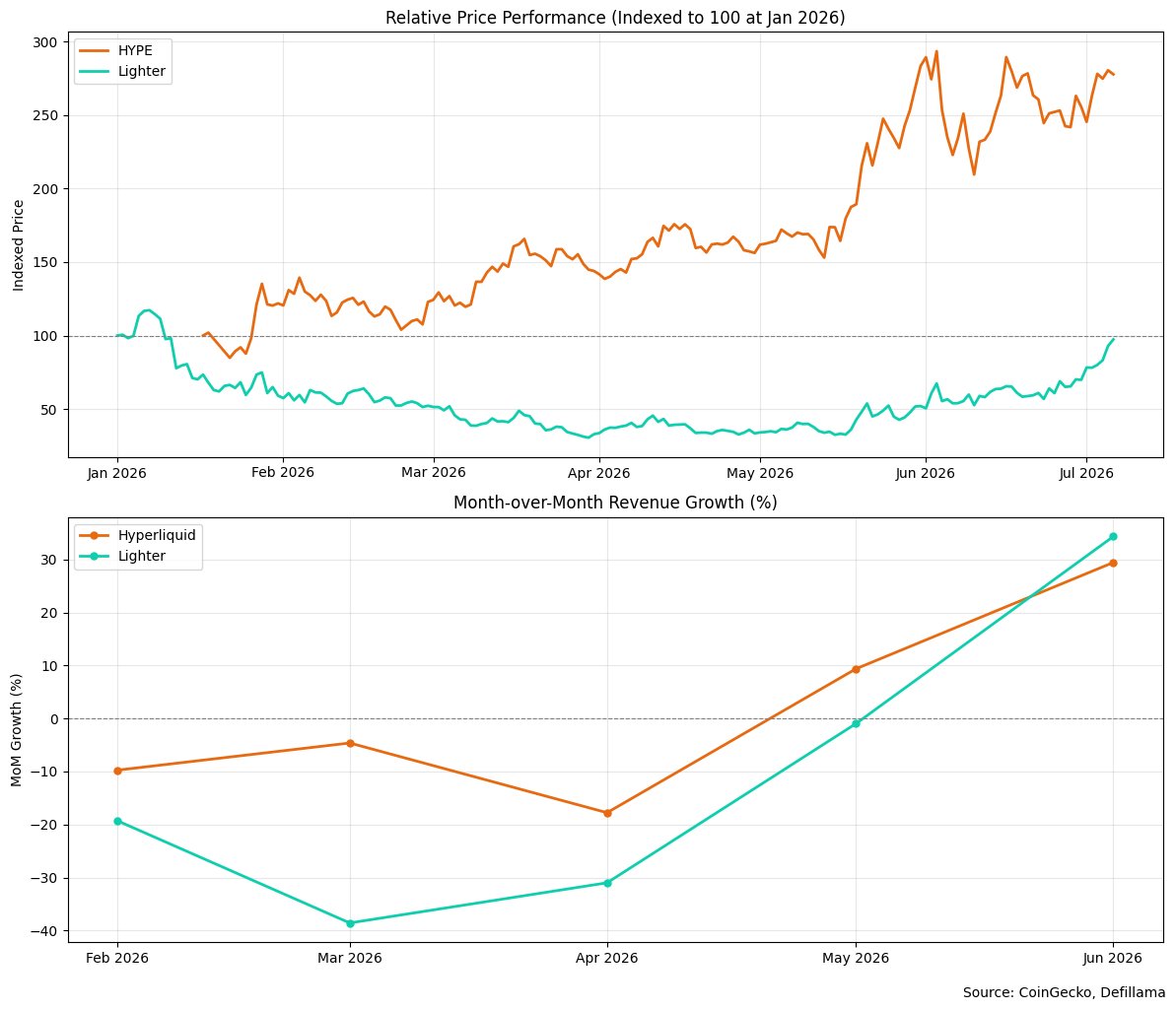
$LIT has risen over 80% in the last 30 days.
Their recent uptick is due to two major announcements:
✦ Tokenomics Update: On June 30th, @Lighter_xyz announced an update to their tokenomics, which would now burn all the repurchased LIT from the revenue, which would be 15.5 million LIT tokens (6.3% of the supply). With this, the protocol is also targeting a staking yield of 6%, which, at the current staking level of 125 million tokens, would distribute 7.5 million LIT.
✦ @RobinhoodApp Partnership: Robinhood Wallet will now offer perpetual trading with USDG as the quote asset through a Lighter instance deployed on the Robinhood Chain.
Lighter is pursuing a horizontal expansion strategy, aiming to build separate liquidity, unlike its main competitor, Hyperliquid, which focuses more on vertical expansion and uses a single execution engine, HyperCore.
As of today, $LIT market cap is ~$650m, with annualised revenue of $72m, giving it a P/S ratio of 9.02, which is about half of Hyperliquid's P/S ratio of 18.84, with a $15.62b market cap and annualised revenue of $830m.
Additionally, Lighter posted 34% MoM revenue growth last month, following consistent negative MoM growth since the start of the year.
Options have momentum, validating a thesis we have held for a long time.
But it was never really about options.
Options work better in DeFi as infrastructure. Income is the product.
@castle_labs went deep, understood the Rysk thesis and the model behind it, and placed it within the broader evolution of DeFi.
I also wrote about rysk thesis a while back:
https://t.co/YtnihHVjYB
The Renaissance of Onchain Options
Mapping the expansion of options as a trading instrument and the volatility that prices them
Co-authored with @BlockScholes
Read the free report here: https://t.co/gcfrb2LF2A
Prediction markets have been capturing the world's attention
Monthly volume across Polymarket and Kalshi has risen from $5b to $24b in the last year, with each raising at multi-billion valuations from institutions.
Their success is now spilling back into traditional markets 👇
Cboe is reviving its S&P 500 binary options in response to the demand popularised on these prediction-market platforms, with Kalshi’s crypto prediction markets’ monthly volume growing from $120M in November to $2B in May.
This is something we have been looking at closely, and this week we published a flagship report, in partnership with @BlockScholes, on The Renaissance of Onchain Options: mapping the expansion of options as a trading instrument (incl. prediction markets) and the volatility that prices them
This overlap might seem out of place at first glance, but prediction markets closely resemble traditional binary options. These markets have a fixed expiration time and a binary payout structure that settles at either $0 or $1.
What Polymarket and Kalshi have done is make the conditional payoffs feel retail-native by simplifying the interface and allowing users to express their views on an outcome without needing to understand greeks (traditional options) or manage margin and liquidations (perps).
In the report, we look at the evolution of options, both off-chain, where they are widely utilised and heavily integrated into the economy, and onchain, where they have had a mixed past but are experiencing a new revival alongside the growth of prediction markets, which in themselves are a volatility-driven outcome product.