@oliviajune82 I loved having UFLI type slides for phonics and concept review, but I also loved my document camera and white board too. It depends on the lesson.
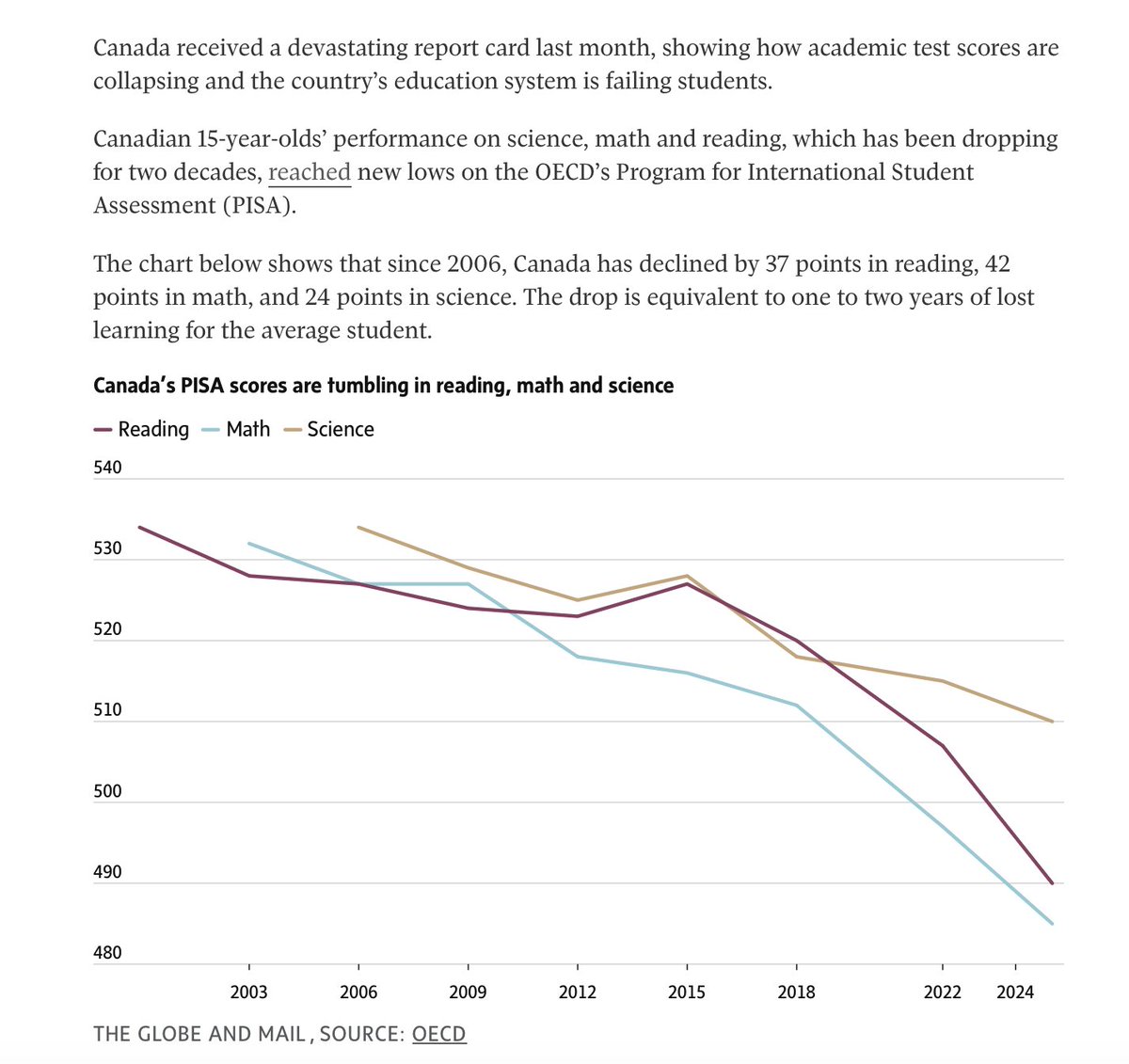
👏 The Globe & Mail editorial team absolutely nailed it with this. People are paying attention. No more excuses. Canada has an education problem and we have to fix it.
Summary:
🔸 Canada's education scores are declining on both PISA and TIMSS
🔸 We have way more low performers and fewer high performers
🔸 Canada spends significantly on education and needs to better allocate those resources
🔸 Downward trend started before COVID
🔸 Movement away from methods that work, like explicit instruction, has likely had a negative impact
🔸 Rampant grade inflation, with a mention of U of Waterloo instructor, Dan Wolczuk
🔸 Open door to tech in the classroom has not helped
🔸 Teachers unions have pushed back against things that could help like early screening for reading
🔸 Faculties of education have not always been on board with equipping teachers with the tools that will help teachers teach effectively
🔸 Look towards England, which has managed to buck the trend. Regular phonics screening, a times table check, calculator ban on standardized tests, etc.
🔸 Provincial governments must take action.
Last paragraph is amazing:
"PISA might seem like a test for Canadian school children, but it’s really a test for policymakers and educators on how they are running the schools. Right now, they are failing. In order to turn around test scores, and put children back on the path of achievement, they need to fundamentally change how students are being taught."
https://t.co/H3LZxT5dJc
@AlexKontorovich@ehanford@rastokke I totally agree with you, Alex. @rastokke has been doing a fabulous job of educating us about math, but adding another voice, @ehanford, will be even more powerful!
I can't wait to hear Sold a Story 2!
We're hearing the same story from universities in both Canada and the US. Students are arriving unable to do basic math.
But the problem doesn't begin in university.
People tend to underestimate just how hierarchical math is. Learning new math concepts depends on what came before. When students don't develop a strong foundation early on, the gaps don't repair themselves. The gaps just get worse.
Then students are moved ahead when they didn't master the foundational material and later math is inaccessible. It's nearly impossible to learn more math when your foundation is made of sand.
University is not the best place to try to fix these issues. We need to look further back and address the core issue. And I believe in many cases kids are being done a disservice in especially K-8 math.
I think this is one of the most serious issues facing our society right now.
What's going on in public education should be one of the biggest scandals out there.
Yet the Lucy Calkinses of the education world keep getting away with it.
I hope everyone listens to my recent anonymous episode with two teachers.
People need to understand that there are teachers on the ground who KNOW much of this stuff doesn't work. They want better MATH outcomes for their students.
These teachers went against the prevailing ideology. Their students learned more math when they did! And they presented research supporting explicit instruction.
They were gaslighted and got pushback at every turn.
It's tragic. Families are trusting schools to do a good job. In some cases, that trust is being violated.
The public needs to stop being complacent and start demanding better education for kids.
❓Has your district adopted Illustrative Math? Today's Chalk & Talk features teachers who were required to use it. The say it didn't work. They found ways to work around it & within a year their students' scores rose. It's a story I want everyone to hear. Please share. Link below👇
@rastokke This was such a good segment! I appreciate your vulnerability at the end, I have felt the frustration too. It’s got to be about what is best for kids. 💙