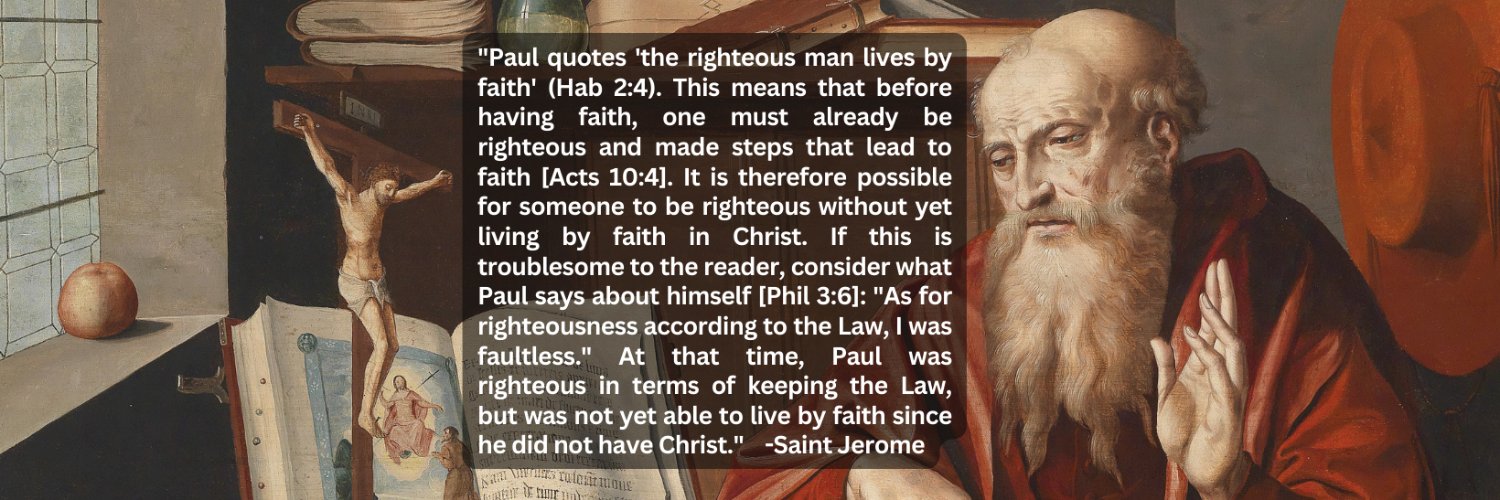
Because Sola Scriptura is really about who has the better interpretation of Romans 4. If Catholicism has botched the plain teaching of Romans 4, then Rome loses all exegetical credibility and thus is unreliable as a teacher. Same goes for Protestants, except Protestants are tragically never challenged on Romans 4 by Catholics, giving Protestants the false impression of exegetical superiority. The record easily shows Protestantism folds instantly when challenged on Romans 4, since it fails as the Locus Classicus for Imputation of Christ's Righteousness
Funny that when I say PSA must begin with examining the Scriptures and how the Bible understands Atonement, the room suddenly goes quiet. PSA is a doctrine Protestants want to be true and then have to dig in their heels once they realize it might not have the Biblical backing they thought it did. Same for Justification, Imputation, etc, it's all one big house of cards when real exegesis is requested.
@PensiveJustin@DodgersAndrew Note, I was just blocked by the OrthoEnsign guy for discussing Psub, so I can't respond on that thread but can elsewhere like on this same topic here:
https://t.co/PvT0nrCduw
The phrase "hand-written ordinances" is a very reasonable way of saying the Mosaic Law itself. This isn't a controversial claim, it's a straightforward interpretation, and fits a common theme (Judaizing). I previously noted how Paul often speaks against the Mosaic Law itself (e.g. calling it the "written code"; saying work by "human hands" is inferior to that done by the Spirit; the clear "Scripture interprets Scripture" parallel to Ephesians 2:15). What "ordinances" would Paul have in mind if not the Mosaic Law? Hence why the context says kosher and Sabbath obligations no longer apply (2:16ff).
To downplay the above evidence is basically to violate every principle of sound exegesis.
Some obvious weaknesses with the "Certificate of Debt" reading are: (a) who 'hand wrote' or issued this certificate; (b) the common meaning of "bond note" or "depository note" per typical financial usage is not synonymous with debt accrued, much less sin debt; (c) to cancel the debt would not go far enough, as paying off a balance would leave the Mosaic Law still in force; and (d) violations of the Mosaic Law would only be held against the Israelites/Jews, so Gentile sins wouldn't be in view. Thus, the "Certificate of Debt" reading doesn't even readily fit. Verse 13 mentioning "forgiveness of sins" doesn't really prove one way or the other, and would be redundant if repeated in v14.
Lastly, the term λογίζομαι (reckon) is a term that refers to mental evaluation of something. It does not mean to transfer, or deposit, or credit to an account. It is a statement of fact that something truly holds certain qualities or truly holds similar force. So "faith reckoned as righteousness" means God saw truly righteous qualities displayed by Abraham, such as having a pure heart. Regeneration would produce a pure heart in Abraham, which he can exercise in an act of faith.
The phrase "hand-written ordinances" is a very reasonable way of saying the Mosaic Law itself. This isn't a controversial claim, it's a straightforward interpretation, and fits a common theme (Judaizing). I previously noted how Paul often speaks against the Mosaic Law itself (e.g. calling it the "written code"; saying work by "human hands" is inferior to that done by the Spirit; the clear "Scripture interprets Scripture" parallel to Ephesians 2:15). What "ordinances" would Paul have in mind if not the Mosaic Law? Hence why the context says kosher and Sabbath obligations no longer apply (2:16ff).
To downplay the above evidence is basically to violate every principle of sound exegesis.
Some obvious weaknesses with the "Certificate of Debt" reading are: (a) who 'hand wrote' or issued this certificate; (b) the common meaning of "bond note" or "depository note" per typical financial usage is not synonymous with debt accrued, much less sin debt; (c) to cancel the debt would not go far enough, as paying off a balance would leave the Mosaic Law still in force; and (d) violations of the Mosaic Law would only be held against the Israelites/Jews, so Gentile sins wouldn't be in view. Thus, the "Certificate of Debt" reading doesn't even readily fit. Verse 13 mentioning "forgiveness of sins" doesn't really prove one way or the other, and would be redundant if repeated in v14.
Lastly, the term λογίζομαι (reckon) is a term that refers to mental evaluation of something. It does not mean to transfer, or deposit, or credit to an account. It is a statement of fact that something truly holds certain qualities or truly holds similar force. So "faith reckoned as righteousness" means God saw truly righteous qualities displayed by Abraham, such as having a pure heart. Regeneration would produce a pure heart in Abraham, which he can exercise in an act of faith.
You still aren't doing any exegesis. You're doing some weird mind reading eisegesis on what a Christian might object if they heard some undefined Protestant interpreting the prior 5 chapters and somehow the Catholic view doesn't raise this objection. A Christian thinking their sin might bring about blessings can be derived from just Rom 5:20-21 and isn't unique to Sola Fide or prior chapters.
The response in Romans 6:15-16 is basically the same as 6v1 yet it clearly doesn't fit the Protestant view at all, since Paul says they will gain righteousness or will die based on their behavior. So the answer of Paul is that a Christian can certainly still sin and cause grace to abound, but their own salvation will be harmed. The unsaved Opponents in Rom 3:3-5 raised this same objection about their comfortable status in the Old Covenant and they had not yet even read ch3-5 yet, so your claim 6v1 naturally comes only on ch3-5 is even more bizarre, since it's really just a general treatment on "theodicy". Paul is basically now just reiterating it for Christians who might think their own situation is different, but 6v15-16 shows it's not.
What doesn't work? The Christian is now spiritually alive and will die if they turn back to sin. Just because God can bring about good from sin doesn't mean there are no consequences to the sinner. Romans 6v15 is the same line of thinking as 6v1,
"15 What then? Are we to sin because we are not under law but under grace? By no means! 16 Do you not know that if you present yourselves to anyone as obedient slaves, you are slaves of the one whom you obey, either of sin, which leads to death, or of obedience, which leads to righteousness?"
Rom 6v2 says: "By no means! How can we who died to sin still live in it?" This means Paul grounds 6v1 in being dead to sin, which is not a forensic category, and thus not Protestant Justification in mind. This dying to sin must have already happened, at the time of Justification. So Paul is not speaking of forensic or imputation going on during Rom 3-5.
I'm not sure why you keep bringing this 6v1 up as almost a dodge of addressing the bad exegesus on Rom 4v5. I have no problem addressing Rom 6v1 on a separate post if you make one, stating how you read it and why Catholicism cannot answer it. It can even be in DM if that's easier.
This isn't the NPP, so that's a bad excuse to use. This is the lexical range of meaning and exegesis. If you look at that Rom 4v5 post I made it will show this more clearly. There's a mental block of sorts that refuses to question the bad exegesis and be open to humble submission to God's Word, including having to admit the Protestant scholars were wrong.
https://t.co/fQX4ouxZez
The irony here is that, while there is truth to this, Protestants have not kept up with the refinement of knowledge, hence why they will not critically examine their own doctrines like Imputation and Romans 4v5. The refinement of knowledge should have these things internally critiqued every now and then, but we don't see that with their key proofs like Rom 4, Eph 2, 2 Cor 5, etc., because those Protestants who know better cannot afford to discuss it too openly.
Life, as in Adam would continue staying alive in the Garden. That is an earthly promise and not about going to Heaven. Now you say the "covenantS of promise" were actually covenants of works, which is now conflating grace and works. This is really all just making up theology according to what sounds good to human ears. Covenants in the Bible are explicit and the terms, consequences, duration, etc, are varied, so they cannot be categorized as Works or Grace. For critical doctrines the principle of Sola Scriptura would have them be very clearly stated in Scripture, not assumed. Sola Scriptura is false because topics like CoW come up and will not have the humility to admit the exegesis is severely lacking. Paul is constantly comparing the Mosaic Covenant with the New Covenant, which hardly makes sense if there's a CoW that is the real overarching covenant. The very language of Covenant of "Works" comes from reading Paul and thinking works are the problem. So the irony is they borrow "works" from Paul but not "covenant" from Paul. This should be a red flag that there is a problem with the theology or exegesis.
What are the promises of blessings given to Adam for the CoW? The text doesn't mention any. And if each Covenant with Noah, Abraham, David, etc, was "a" Covenant of Works, then you can't speak of "the" Covenant of Works. The promised seed is not a covenant, for it would have been made with Adam (or even the snake) after Adam's disobedience.
You are inserting "covenant," as well as the rules, in places where the inspired text doesn't use the term nor rules. That is not exegesis, that is not deduction, that is not "clear texts". To turn "eat from all trees except one" into a permanent Covenant of Works for all mankind that requires keeping all commands to get into heaven is an abuse of Scripture, especially when Scripture speaks of all sorts of covenants with all sorts of rules and blessings. You are turning "the Bible doesn't have to say it" into making up theological ideas not actually in Scripture and yet claiming to submit to Scripture above all else.
Explain how Rome teaches a Gospel of works. The Imputation of Christ's Righteousness says that Jesus kept the law perfectly in our place, doing all the works required of us, and imputed that perfect obedience to us by faith so that God will look at the believer and consider them to have kept the works themselves. That sounds like works based salvation to me.
Not merely that Gen 2 constitutes a covenant, but more specifically that it constitutes a "covenant of works". Even if "don't eat from this tree" was a covenant, that does not equate to "keep all of the ten commandments throughout your life and love God perfectly to be awarded heaven". That is a very different thing.
Genesis 2v16-17 is a command to not eat of one tree. That doesn't equate to a covenant of works of perfect obedience to all the ten commandments and beyond. God tells people to do things in the Bible but that doesn't make it a covenant. Not a deduction and not clear. How about the many texts of Scripture that say clearly "on that day God made a covenant with them". God made a covenant with Phinehas and did not require anything of it, so it must be a Covenant of Grace?
You mentioned "righteousness isn't merited" but I would say the term "merit" isn't used by Paul and isn't a bad thing in Paul's mind. Rather, Paul is saying earning a wage is fine, but getting a gift or some special treatment is better. The background here is that while keeping the Mosaic Law is worthy of a reward, believing in the Gospel will graciously reward you with more than the Law can offer even though the Mosaic Law is this elaborate covenant. Believing has intrinsic value and very pleasing to God, so it is not an empty hand nor is it that Abraham was wicked and needed to hide behind something else. Further, the Greek term Logizomai does not entail a transfer, so by definition it cannot be speaking of wages or righteousness moving from one place to another.