Statelessness is often called "the lost human right". It was made a human right after WW2 when Nazis took citizenship away from over 40,000 people.
Now experts say denaturalization is making a comeback, and the Iran war is making that comeback worse. https://t.co/tH8uhuRf1V
In 4 hours and 23 minutes, Yemen Podcast released what I expect will become one of the most debated political interviews on Yemen in months.
In an exclusive conversation with @osamaalqutaibi, former National Security Bureau (NSB) - Yemen's Former Spy Agency - chief, Ambassador Ali Al Ahmadi (Phd) speaks with unusual candor about the Houthis, AQAP, Iran, Hezbollah, Saudi Arabia, Oman, the fall of Sana'a, Ali Abdullah Saleh, President Hadi, and the long cycle of conflict that has shaped modern Yemen.
This is not an interview with someone commenting from the outside. Al Ahmadi spent decades inside Yemen's political, diplomatic, and intelligence establishment. He witnessed the conflicts of North and South Yemen, the 1994 civil war, the rise of AQAP, the emergence of the Houthis, and ultimately the collapse of the Yemeni state.
One of the most fascinating sections concerns intelligence cooperation across the region.
When asked whether he met Iran's deputy intelligence chief in Muscat, Oman, Al Ahmadi confirms the meeting but refuses to discuss what was said.
"These are state secrets. Especially intelligence work. It is not permissible to talk about them."
He is equally direct when discussing Saudi Arabia. Asked whether he met Saudi intelligence officials, he replies simply, "I met them daily."
Those two answers alone reveal how closely Yemen's intelligence services interacted with regional actors during one of the country's most turbulent periods.
The most politically explosive part of the interview, however, is Al Ahmadi's account of what Yemen's NSB says it observed before the Houthis captured Sana'a in 2014.
According to Al Ahmadi, the warning signs appeared years earlier.
He says Yemeni intelligence identified the presence of Iranian operatives in Saada, including an Iranian commander he identifies as "Shahlai," along with Iranian experts and Lebanese Hezbollah trainers working with the Houthis. He says Yemeni authorities detained two Hezbollah operatives. "One had already completed his mission, and another was intercepted on his way."
He goes further, alleging that some Iranian and Hezbollah personnel entered Yemen without passing through normal immigration channels. According to his account, they arrived by sea, possibly through Fatima island off the Eritrean coast before entering Yemen, and were later provided with fake Yemeni identity cards and passports issued in Saada. He also claims that Houthi members used these forged documents to travel to Lebanon and Iran without revealing their true identities.
Al Ahmadi also describes what he says was a sophisticated financial and logistical network supporting the movement.
According to him, weapons were transported by boat to Yemen's eastern coast near Al Shihr before being moved through mountain routes into Saada. He says money reached the Houthis through financial transfers routed via Jordan and, at times, Beirut. Beyond direct funding, he alleges that commercial goods were imported into Yemen through individuals connected to the movement, sold on the local market, and the profits redirected to finance Houthi activities. He notes that these transactions often appeared to be ordinary commercial business, making them difficult to prosecute despite being monitored by the intelligence services.
Another striking part of the interview concerns what Al Ahmadi describes as the origins of the Houthi military industry.
He argues that the movement's domestic military production began taking shape around 2012 and 2013, years before the fall of Sana'a. According to him, NSB intercepted shipments of industrial machinery, including lathes, metalworking equipment, and manufacturing tools destined for Saada. He says the equipment was intended to establish arms workshops capable of producing mines, improvised explosive devices, rocket components, and other military hardware inside Yemen.
In his account, the Houthis were not simply importing weapons. They were building an indigenous military production capability while simultaneously expanding smuggling routes, financial networks, and technical cooperation with Iranian and Hezbollah advisers.
His discussion of AQAP is equally compelling because it comes from personal experience.
Al Ahmadi recalls surviving assassination attempts while serving as governor of Shabwa and later directing operations against AQAP strongholds. He describes battles to retake Azzan after it became what he calls an AQAP emirate.
Even after Aden was liberated from the Houthis, he says the threat remained.
"The fear was not only from the Houthis. AQAP was also there."
The interview also offers remarkable behind the scenes accounts from inside the Yemeni state.
Al Ahmadi says he first learned he had been appointed head of the National Security Service by watching television.
"I heard it on television."
He says he immediately told President Ali Abdullah Saleh, "I do not want to fail before you in a mission I cannot succeed in."
According to Al Ahmadi, Saleh replied, "I do not want anything from you except to stop the evil of this agency."
For me, though, the biggest takeaway is not a single intelligence revelation about Iran, Hezbollah, AQAP, Oman, Saudi Arabia, or the Houthis.
It is the historical pattern that emerges throughout the conversation.
Al Ahmadi's life spans nearly every major chapter of modern Yemeni history, from the conflicts of the 1960s to the civil wars in North and South Yemen, unification, the 1994 war, the rise of AQAP, the emergence of the Houthis, and the collapse of the republic.
Listening to him, it is difficult not to notice that Yemen has remained trapped in recurring cycles of political rivalry, tribal conflict, ideological struggles, outside intervention, state weakness, and war. The personalities change. The alliances change. The slogans change. Yet the same patterns seem to repeat across generations.
Many will strongly disagree with Al Ahmadi's account. Others will see it as one of the most important firsthand testimonies from someone who spent decades inside Yemen's intelligence establishment.
Either way, this interview is unlikely to pass quietly. It revisits some of the most sensitive files in modern Yemeni history and will almost certainly spark intense political debate across Yemen and beyond.
https://t.co/ZqMV9YXrLe
I can't stress enough how much this tweet gets wrong.
First, Prime Minister al-Zaidi is hardly the person who initiated this campaign. At most, he is overseeing its implementation in his capacity as Commander-in-Chief. The more likely driving force lies within Iraq's judicial establishment. Anyone familiar with how the Iraqi judiciary operates knows that arrest warrants targeting figures of this political stature are highly unlikely to be issued without approval from the highest judicial authority.
Second, this is hardly a "coup." Most of those arrested occupy second- or third-tier positions in Iraq's political hierarchy. Even the most prominent among them, Muthana al-Samarrai, is far from politically indispensable. He heads a relatively small parliamentary bloc and has generally functioned more as a political broker than as a top-level decision-maker.
Third, the Iran angle is probably the weakest claim in the tweet. Most of those arrested are Sunni politicians or state officials and functionaries. The Shi'a figures involved are hardly hardline pro-Iran actors, let alone individuals closely associated with the IRGC.
What we are most likely witnessing is another episode of elite power struggles and factional politics. Among the major political players, the biggest apparent loser seems to be former Prime Minister Mohammed Shia al-Sudani, although it is still too early to draw firm conclusions.
It is not unusual for new Iraqi governments to launch anti-corruption campaigns at the beginning of their tenure, only for these efforts to lose momentum over time. What makes this episode different, however, is that it appears to have strong backing from the upper echelons of the judiciary and is unfolding in the context of mounting external pressure and growing economic challenges.
Given the enduring popularity of anti-corruption rhetoric in Iraq and the public's deep frustration with impunity for the "big fish," this could prove to be a politically astute strategy for enhancing the legitimacy of the new government—and, more broadly, the political settlement on which it rests.
“I’ve spent the last year and a half watching evidence of the worst things human beings can do to one another. And that… is a life-changing thing.” In his powerful new book, “One Day, Everyone Will Have Always Been Against This,” @omarelakkad writes about what he sees as western hypocrisy on human rights.
Thank you @IraqNT_EN 🙏 Plenty to build on for the upcoming 2027 Asian Cup and 2030 World Cup qualifiers, meanwhile we get to keep our 2026 World Cup memories for life.
🗞️ [#InTheNews] Is a diplomatic framework enough to bring stability to Lebanon?
@faysalitani tells @dwnews that while the Egypt-backed proposal is sound in theory, the chances of Iran standing down Hezbollah are "almost non-existent."
Read @CathrinSchaer's article here ⤵️
https://t.co/zEgssQntNx
As the U.S. and Iran prepare to negotiate in Geneva, there is an opening for Lebanon to put on the table a plan being prepared by a coalition of five regional countries to stabilize Lebanon and disarm Hezbollah. But first we need diplomatic coherence in Beirut. Mine for Diwan: https://t.co/eaQDUXssNh
“The whole situation is completely unacceptable,” Jo Floto, the BBC’s Middle East bureau chief, told me. “We all know why we’re not allowed into Gaza: it’s because the impact of our reporting would be so much greater.”
via the great @gerryshih: https://t.co/K2QlFYK2Lq
A.G. Sulzberger warns in a speech today that tech giants that make A.I. products are violating settled law, causing unnecessary harm and threatening to undermine the future of journalism and creative work in all its forms. https://t.co/jqyMCsRZEa
AFP update on the push different MENA countries to join Trump's Abraham Accords: includes my thoughts (full comment to AFP below).
"The Arab Peace Initiative has been on the table since 2002 — full normalisation from every Arab state and OIC member, in exchange for Israeli withdrawal and a Palestinian state. Israel has declined every time. That is the baseline from which any serious analysis has to start, and it is the baseline Washington consistently avoids."
"For most of the states named, the political cost of signing up under current conditions would be prohibitive. Gaza is ongoing, annexation of the West Bank is accelerating, Israeli forces remain in southern Lebanon, the Golan is occupied. These are not complications to be negotiated around — they are the substance of the conflict. Whether any individual state might calculate differently is possible, but for the overwhelming majority, the domestic and regional costs make compliance extremely difficult to envisage."
"As for the motivation behind the demand — that remains unclear. One possibility is that someone suggested to Trump this condition precisely in order to scuttle the Iran deal. Another is that he wishes to scuttle it himself. What is striking is that it has any traction in Washington at all. That tells you a great deal about how disconnected the DC policy conversation remains from regional political calculus."
— Dr. H.A. Hellyer, Senior Fellow, Royal United Services Institute (RUSI) and Center for American Progress (CAP)
https://t.co/MvPYHfNvxA
"The UAE must abandon the illusion of strategic exceptionalism, and rebuild its autonomy through a collective Gulf security order"
My new piece for @MiddleEastEye unpacking the friction between middle power narrative and small state reality
"The performance of invulnerability has collided with the material facts of proximity, demography and dependence on external security guarantees"
https://t.co/Pth4SoHbkB
Never forget the three Cs that define Iraq’s political system: corruption, collusion, co-optation. But even by those standards, this is a new low. The SCF’s nomination of Ali al-Zaidi shows the Shiite ruling elite is willing to hollow out the premiership.🧵https://t.co/JHk86F4DVD
Prime Minister Ali al-Zaidi's cabinet doesn't quite reflect "fresh leadership", but the Shiite Coordination Framework has heeded US demands to exclude parties of designated groups such as Qais al-Khazali's Sadiqoon.
i love my editors at NYT dearly, but you would not believe the dozens of hoops i had to jump through to publish an opinion piece about gay guys going to *Hooters*
for Kristof’s piece to be greenlit… i can’t fathom how rigorously vetted his reporting was.
"This is the first call between MBZ and Netanyahu that WAM’s announced since early 2023"
"During a private discussion last month with European officials, MBZ said the GCC was dysfunctional and that the UAE would reinforce ties with Israel and the US"
https://t.co/xp3BpFJUmB
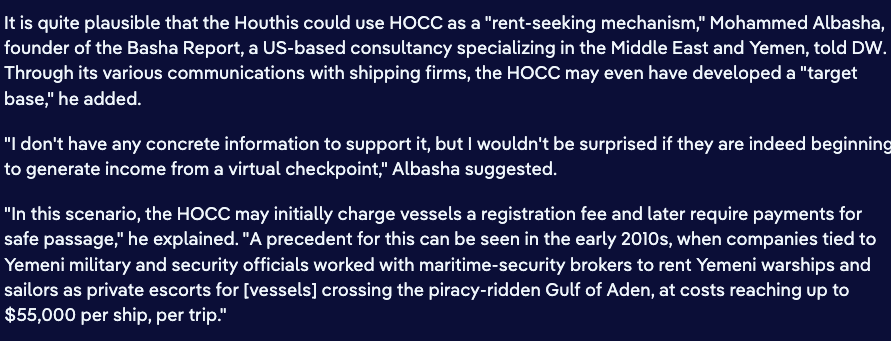
Reporting that the Houthis are discussing a “toll mechanism” in the Red Sea and Gulf of Aden corridor via Bab el-Mandab from @LloydsList’s Matthew Rajendra, quoting Obsidian International’s Joe Sheffer, is nothing new. @BashaReport has been reporting on this since 2024, including published commentary by @dwnews and @CathrinSchaer. Anyhow, with high confidence, the Houthis are not moving at this stage of the conflict to implement transit fees in the Red Sea. https://t.co/KZhBJrC8lC
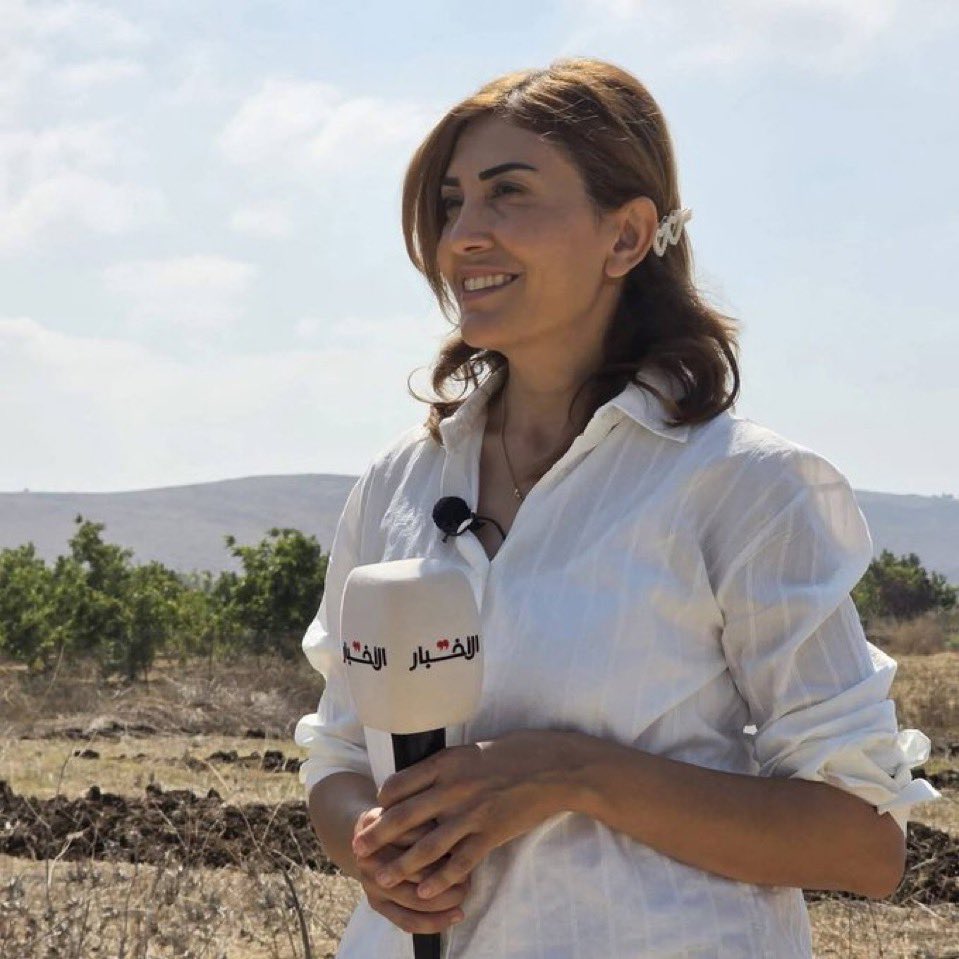
Lebanese journalist Amal Khalil was found dead after hours of searching under rubble. She was killed in an Israeli strike, after the Israeli army fired at ambulances trying to reach her, delaying her rescue.
She is the fourth journalist killed by Israel while in the field since 2 March.
She was a professional, kind and dedicated journalist, and always a pleasure to run into in the field.