I keep a positive outlook and continue to talk to God. He always reveals himself to me. Sometimes you feel like he’s not hearing you, it’s just him responding in his perfect time. His time is always perfect. Not ours, hang in there.
Hi $kas, time for a blockchain security 101, a.k.a. "ah yeah, the two types of security". A subtlety that a lot of people don't understand and often leads to misinformed takes like the one below.
But before diving into that, let me just list some other benefits of high BPS besides revert security:
0. Throughput
1. Mining decentralization
2. Smoother fee markets that actually kick in long before the network becomes saturated
3. MEV resistance
That being said, let us dive into the significance of high BPS (or more accurately, rapidly accumulating confirmations, which is not an immediate consequence of high BPS and is actually very hard to obtain) to the security of the network.
The crux of things is that there are actually two types of security against double-spend/liveness attacks: 49% security (better known as honest majority security) and 51% security (also known as economic security).
Interestingly, these two types of security are very different from each other, and rely on almost orthogonal things: 49% security increases with the number of obtained confirmations and has nothing to do with the mining market or values of transactions, whereas 51% security is completely determined by the mining market and the value of the transaction and has nothing to do with how the underlying protocol actually works (though at the end of the post I explain why even though higher BPS does not increase 51% security, it does allow leveraging it better).
Instead of talking about 49% security I will talk about p-security where 0<p<1/2.
The nicest way to illustrate p-security is as the following game between the honest network H and the adversary A: imagine a coin which has A and H written on its sides. The coin is biased against A: flipping it returns A with probability p.
We play a game where we flip the coin many times, if the result is A (resp. H) then A (resp. H) wins a point.
A wins the game if there is some point in time satisfying the following:
1. A has more points than H.
2. H has at least k points.
This game actually emulates a double-spend attack. The number of points each side has is the number of blocks they created. The bias of the coin represents A's computational inferiority. A point in time where A has more points than H represents a point in time where A has a longer chain than the honest chain so he can revert it. The condition "H has at least k points" means that users wait for k confirmations before submitting a transaction. So the probability of A winning the game is the same as the probability a p-attacker can revert a transaction that has k confirmations. For example, in Bitcoin this game is usually played with k=6.
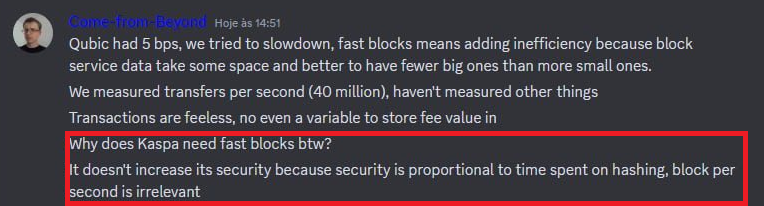
It turns out that the probability for A winning the game grows with k as (p/(1-p))^k. That is, the probability of an p-attacker to succeed decays exponentially with the number of confirmations.
So if a Kaspa txn has 6 confirmations, it has exactly the same p-security as a Bitcoin transaction with 6 confirmations. Does Kaspa having 1BPS implies that this should only take 6 seconds? Not really: due to parallelism, some of the blocks created after the one containing the txn will be parallel to it, and will provide a confirmation. This is essentially the reason why after some point (the point where the block delay is shorter than the network delay), increasing block rates does not decrease confirmation time, and the confirmation time becomes dominated by network latency, which is the best possible (actually it doesn't rely on the actual network latency, but on an apriori bound on the network latency. DagKnight solves this, and this is why it is called parameterless).
Note that everything I said above is true even if Kaspa was mined by a single CPU. As long as there is an honest majority, this holds up.
The notion of "51% security" investigates the other side of this coin: how hard would it be to violate the honest majority assumption?
Quantifying 51% security is very hard since 51% security is not, strictly speaking, a security notion. A security notion says that an adversary can't do something. However, we can't assume that an adversary can't obtain a majority, neither can we try to argue that an adversary with a majority can be prevented from double-spending. The best we can do is to observe the mining market and try to estimate how hard it would be to carry a 51% attack.
The most naive interpretation of "how hard" is "how much electricity would it cost". This is the analysis sites such as https://t.co/1ax1xLIzFc do.
There are many problems with this approach, I'll list the two major ones:
1. It does not take into account capital expanse (or operational expanse outside energy costs). This does not make a lot of sense for ASIC dominated coins. Consider a hypothetical coin X which has ASICs that produce the same hash rate a GPU but require 0.1% of the energy. By moving from GPUs to ASICs, has the network became 1000 times less secure? How does you answer change if I tell you that each ASIC costs 5000 times more than a GPU? Suddenly an attack isn't that cheap, even if it requires much less energy.
2. It ignores scarcity: GPUs are general purpose and so many of them can be rented for short periods. ASICs are designed for a specific task and are manufactured by demand. A 51% attacker would have to somehow obtain control of a majority of the ASICs for long enough to carry out the attack. ASICs owners have no incentive to go along with this, since whatever bribe the attacker might pay them will not cover the devaluation of the coins (remember, they make a living off mining Kaspa) that will follow a successful attack. Let us be highly optimistic, and assume that a successful 10 minute double-spend attack will only devalue Kaspa by 10% for a month. Even then, compensating 51% of the miners for their loss would cost more than 20 million dollars, which is a bit more costly than the 9500$ of the electricity cost of running such an attack.
The attacker can of course take a different route and try to obtain sufficiently many ASICs for themselves, effectively pouring high amounts of money into equipment that is useless for everything except mining the coin they are about to completely devalue. Not to mention their massive buying will drive the hardware price through the roof, making the attack even more ridiculously expansive.
So while there's definitely a strong connection between 51% security and the mining market, it is a very complicated connection. It has much more factors than just the energy cost of the hashing rate (and in the context of ASIC dominated coins the energy cost actually becomes a negligible component, comparable even to the rent, network and maintenance costs required for keeping the ASICs online), and is highly affected by the cost and scarcity of the ASICs themselves, the fragmentation of the hash rate (and no, pools are not detrimental to this. Pools can't just participate in a 51% attack without anyone noticing since, as long as they do, the users of the pool do net get paid), ASIC scarcity, and human factors such as conviction, cultural barriers, or the sheer difficulty of rallying together thousands of entities without anybody noticing. The high BPS arguably makes such an attack even less feasible by furnishing a much more fragmented mining market.
To conclude, I just want to point out that high BPS do help getting 51% security faster.
Say that you were paid 1000$ worth of Bitcoin. Also say that 51% attacking Bitcoin costs 1000$/second (it doesn't, just an illustration). Does that mean that you can consider your transaction "secure" after one second? Of course not.
First, the 51% timer doesn't even start to tick before your first inclusion. So that's already 10 minutes. But that's not enough because you still want to be secure against 49% attacks or organic reorgs. So you wait for six confirmations to make sure that the probability that a 49% attacker is lucky enough to revert the transaction is about the same as a woman giving birth to a duck.
Only then, after a full hour, does 51% security even start becoming relevant.
Now say you were paid 1000$ worth of Kaspa, but you estimate that 51% attacking Kaspa costs 50$/second (again, just an illustration). After 10 seconds you already accumulate enough confirmation to feel secure against 49% attackers, and then you wait 10 seconds more to feel sufficiently secure against 51% attackers.
So while in this thought experiment Bitcoin is 20 times more costly to attack, the Kaspa user still enjoys 51% security much faster, simply because for all but very large transactions, 51% security times become smaller than 49% security times, and those are terrible for low BPS.
10 bps running on TN11 🔥⚡️🐇
This is Visa level speed and faster than $SOL
And yet $KAS is a decentralized proof of work network like #BTC
Are you beginning to understand what scalable stateless money means yet? 🧐
Wait until it has smart contracts… 🤯
Jimmy Kimmel is a hypocritical POS!
He enjoys objectifying women and wearing blackface.
But sure, I'll believe him when he says he's never met Jeffery Epstein or been to Epstein's island....
WATCH: CNN hack reporter just tried to bait Vivek into turning on Trump
Instead, Vivek instantly flipped the script on her leaving her in shocked bewilderment on LIVE TV— PURE FIRE. 🔥
"You know what's vermin? What's running around San Francisco on any given day before Gavin Newsom cleaned it up on a dime to roll out the red carpet for Xi Jinping."
Does @elonmusk know that $KAS will soon implement DAGKnight, which scales with the speed of the internet?
It’s already running at 1 block/second, and soon will 10x to 10 blocks/second.
Next, DAGKnight assumes no bounds and adjusts to the internet speed in real time.
I know we all want pauses/lower entries, but
What if the inflection point has been reached?
What if the market finally woke up?
What if quadrillions has sunk in?
What if it doesn’t stop?
What if ATHs get taken out this year?
You’ve had years $LINK
These are the 3 innocent children who were murdered at school for being white by a trans, racist ter*0ri*t. Remember their names:
William Kinney, 9
Evelyn Dieckhaus, 9
Hallie Scruggs, 9
$Link 1 day in the not so distant future link will have an 4 Trillion+ Market Cap($10,000+ per link). Link really is on its way to becoming one of the most important pieces of technology in our generation, arguably the biggest since the internet itself...personally I'm all in
#Crypto
#Web3
I have never seen an opportunity like $LINK
Chainlink is building the infrastructure for verifiable truth on the internet in a world where trust is being lost
How many people truly understand what’s being built here?
The world doesn’t know what’s coming
I welcome every pullback so I can accumulate more
Tokenized real-world asset adoption continues to accelerate.
@HSBC has launched a blockchain-based platform for institutional clients that tokenizes 400 troy-ounce gold bars held in the bank’s London vault. A prime example of fractionalization, each token is equivalent to just 0.001 troy ounce—which could make gold more accessible to retail clients.
The future is on.
https://t.co/au4QQ2FWA4
You know whats absolutely criminal and catastrophic?!
SBF had hundreds of meetings with the SEC
He worked closely with Gary Gensler
This went on for MONTHS
FTX was about to establish a regulatory monopoly on crypto in the United States
AND YOU'RE TELLING ME THEY HAD NO IDEA HE WAS DEFRAUDING INVESTORS?
I call BS.
Someone needs to investigate the SEC right now.
While all oracles may appear like just oracles, we know from experience and onchain data that they are not.
Chainlink is being built to resist manipulation, while other oracles for data, decentralized automation and cross-chain services actually seem to be built with value extraction from unsuspecting users as a planned strategy. If we're trying to build a better global financial system that consumers and institutions can put their faith in, it might be a good idea to build high integrity markets and avoid building systems that are expressly made to rebuild the rigged casinos of the past.