@countrydancer99@FoodProfessor Dedication and focus on restaurant cleanliness and hygiene needs to be driven from the top and the franchisee. This is not an ethnicity thing, it’s a corporate culture thing.
Why do you do what you do? Our true north is impacting an industry that touches everyone everyday. Helping farmers feed the world, especially the young among us, contributes to the best societal return on investment in health outcomes, learning potential and future productivity. #cdnag
Under CUSMA the United States already enjoys duty-free entry to 14 Canadian dairy TRQs—over 50 million kg of milk, cheese, butterfat and powders each year—yet roughly 70 percent of that quota sat unused last year. A consistent pattern: louder demands for “more access” haven’t translated into real trade.
Meanwhile Washington spends about US $40 billion a year on farm supports. Those subsidies are WTO-compliant, just as Canada’s supply-management system is; each country simply chooses a different, legal way to keep its farmers viable. The takeaway is clear: the access exists and isn’t being used, so casting Canada’s tariffs as the last barrier to “fair and open trade” is more rhetoric than economic reality.
Spotted a bold “$0.99 Nova Scotia Cucumbers” tower at Sobeys today, draped in familiar Den Haan colours and branding. I reached in, every wrapper read Product of Quebec.
That small mismatch raises a bigger question: What is “local” in 2025?
For those of us in the Valley, local instinctively means the farm up the road. Yet with inter-provincial collaboration deepening, and U.S. trade uncertainty nudging us closer together, local increasingly means Canadian: food grown under the same standards, stewarded by fellow citizens, and moving through a supply chain we can see and trust.
Still, clarity matters. When the label and the display don’t match, genuine Nova Scotia growers lose the premium that fuels jobs, equipment dealers, mechanics, etc. A single cucumber purchase might feel trivial, but multiplied across thousands of carts it becomes real money circulating through our neighbourhoods: sponsoring youth sports, funding community halls, and keeping rural main streets vibrant.
So perhaps the first question isn’t How many kilometres did it travel? but Whose shared future does it support? Choosing Canadian honors a wider definition of “local,” while accurate labelling lets us direct that economic spinoff with precision, celebrating both the Valley farm and the Quebec greenhouse on their own merits.
One cucumber, two layers of loyalty: hometown pride and national resilience.
Let’s keep the conversation honest and keep those dollars working close to home, wherever home begins for you. #cdnag #nsag #buylocal #farm
📢 Tax Policy Update: What It Could Mean for Canadian Farmers
A new reinvestment tax cut proposal is generating buzz—and for a good reason.
Coupled with the existing Lifetime Capital Gains Exemption, this policy change could provide additional tax relief for farmers selling assets and reinvesting in their operations or other Canadian investment vehicles.
Here are three key implications for our sector
• Incentivizing Reinvestment & Modernization:
With reduced tax on reinvested sale proceeds, more capital could remain on-farm to upgrade equipment and adopt new technologies.
• Enhancing Succession Planning:
Additional tax relief could ease the financial burden during intergenerational transfers, supporting smoother and more sustainable succession strategies.
• Improving Liquidity & Growth Opportunities:
By reducing the tax drag on capital gains, farmers might enjoy improved cash flow to seize expansion opportunities and bolster long-term stability.
This proposal would further empower our agricultural community by providing extra resources for modernization and growth—complementing the protection already offered by the LCGE. It’s an important development to monitor as we continue building a resilient and competitive agribusiness sector.
Will the Liberals announce their intention to incorporate a similar measure?
https://t.co/U1BGFoh7bA
Uh oh -- President Trump to announce retaliatory tariffs on dairy industry. Hopefully the Canadian market can absorb majority of dairy production. Oh wait, that's what supply management is...
Does he not understand what supply management is, or is this the first shot at attacking the system?
China’s new #tariffs on U.S. agricultural products are shifting the market dynamics as Chinese buyers reassess their sourcing from America. With U.S. farmers heavily dependent on the Chinese export market, this change creates a significant opening for Canadian grain producers to expand their exports into China. Canadian grain—renowned for its quality and consistency—could capture new market share as Chinese purchasers seek reliable alternatives.
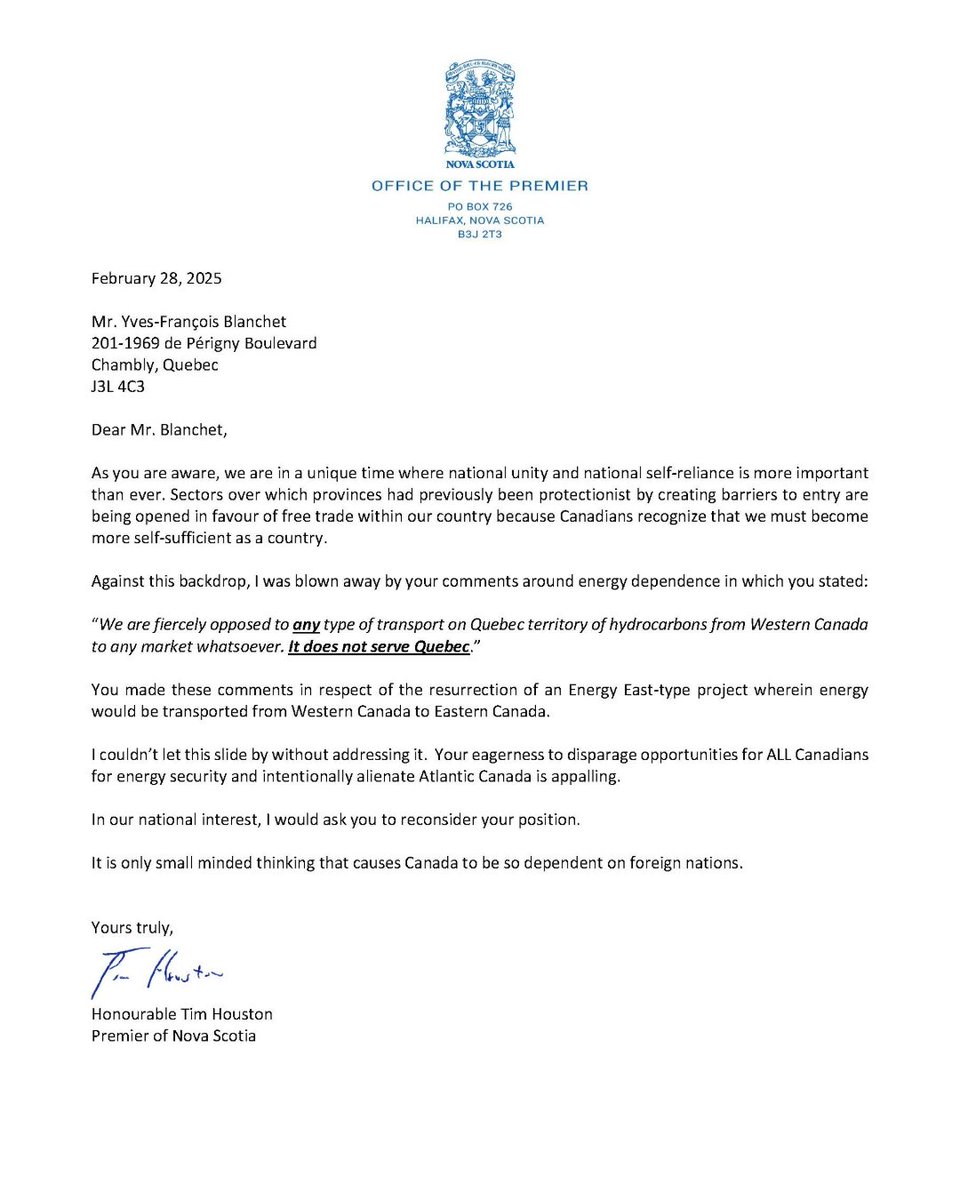
It’s absolutely unacceptable that the Bloc Québécois Leader is insistent on blocking Atlantic Canada from accessing Western Canada's energy.
In the national interest, I urge him to rethink his position and support increasing our country’s energy security.
Imagine a scenario where, under the Free Trade and Mobility within Canada Act introduced by Premier @TimHoustonNS , any provincially licensed facility in any Canadian province can seamlessly supply ingredients and products to Nova Scotia’s food sector—provided the supplier’s province agrees to accept Nova Scotia’s products in return.
This initiative is designed to expand market access, offering consumers a wider range of choices while fueling healthy competition among businesses.
The ripple effect of such a policy could lead to more innovation, reduced costs, and vibrant regional economies, particularly benefiting small enterprises eager to grow.
Initially, creating a common set of safety and quality benchmarks across provinces will be a meticulous and resource-demanding task. However, once these clear standards and evaluation criteria are established, the process will become much more streamlined and effective.
With the looming impact of tariffs, it’s essential that provinces come together swiftly to form this unified market. Ultimately, this strategy is about building a more resilient and competitive Canadian food industry.
The Maritime Livestock Price Insurance Pilot Program will allow producers to purchase price protection on beef cattle in the form of an insurance policy to protect against unexpected market declines.
Could last night’s hockey game be the most politically charged showdown since the 1980 Miracle on Ice? Of course, Canada–U.S. relations are nothing like the Cold War standoff between the Soviets and the U.S., but there was still an undeniable sense that this victory transcended mere sport. #canadavsusa
The latest #CPI report shows that food prices experienced deflation year-year.
Even with the slight year-year deflation, prices remain higher than they would have been if inflation had been more normalized during the COVID years. The elevated inflation during that period continues to impact the current overall pricing environment.
Many consumers are now visiting multiple stores to find the best deals instead of shopping at one store for all their needs. This shift in shopping habits is affecting the retail market landscape and prompting them to adjust pricing strategies and customer service approaches to remain competitive.
Halifax Grain Elevator—a strategic asset that is not only vital to Nova Scotia but to all Atlantic provinces – will be directly impacted by Phase 1B outlined in Port Authority's 50-yr plan. This longstanding infrastructure will be made permanently inaccessible at the end of '26.