Backend dev 👨🏻💻 and AI user, former 3D ArchViz expert and author. Passionate about #AI, #Robots and #MetaQuest3. Founder providing valuable news on Tech 👇
Germany is a sleeping giant of physical AI
everyone's been writing Germany off in the AI race because there's no German OpenAI and no big data center story.
but theres actually two AI races happening:
the first is software. chatbots, LLMs, data centers. US/China are winning that, not even close.
the second one is physical. robots that pick up boxes, weld cars, carry groceries, stack pallets.
and on this one Germany is one of the top contenders in the world
this stat might convince you (it convinced me):
Germany is 3rd in the world for robots per factory workers (449 robots per 10,000 human workers).
only South Korea (1,220) and Singapore (818) are ahead.
Japan is behind at 446. the US is all the way back at 307.
so Germany already runs more of its economy on robots than almost anywhere else on earth.
and the German companies building this next wave of physical AI are some global heavyweights.
a few worth knowing...
> Neura Robotics in Metzingen is building humanoid robots and raising €1B from Tether at a €4B valuation (this was March 2026). Volvo already in from an earlier round.
> Sereact in Stuttgart raised $110M in April 2026 to build the software brain that lets robots see and grab things. already runs 1 billion+ real-world picks for BMW, Mercedes, and Daimler Truck.
> Agile Robots in Munich was the worlds first robotics unicorn. revenue doubling yearly, around €200M now, heading for €1B.
>RobCo in Munich raised $100M in early 2026 at a ~$500M valuation. their robots learn new tasks by watching a worker do it once instead of getting programmed line by line. already pushing into the US and aimed at the small and mid-size factories that make up most of german industry.
> Fraunhofer (Germany's network of 76 applied research labs) built the evoBOT in the video below. self-balancing, two arms, carries 100kg of cargo, being tested at Munich Airport right now.
but why is Germany specifically well positioned for physical AI though?
three things stack on top of each other.
first, the factories. Germany has thousands of family-owned precision manufacturing shops that have been logging sensor data for decades.
that data is basically the training fuel for physical AI and almost nobody else has it at this depth.
second, the customers are already there in-country.
VW, BMW, Mercedes, Porsche, Bosch, Siemens. a robotics startup in Stuttgart can ship its first commercial deployment to a brand everyone recognizes in year one.
that's why Sereact's customer list reads like a german car show lol.
third, the engineer pipeline. Fraunhofer spins out companies like Agile Robots straight from its labs. KUKA built the first 6-axis electromechanical robot arm back in 1973. they've been doing this for 50 years.
so the chatbot race is mostly settled and Germany lost spectacularly
but the robot race is still early innings. and i think Germany's well positioned
The ‚i‘ and the ‚u‘ are definitely to close to each other on german mobile keyboard layouts. My apologies! For me, as a Meta Quest owner and Metaverse user, it’s definitely a sh*t perspective. A little less AI and a bit more Metaverse would be favourable in my life actually.
A major additional factor should be considered.
Satellites with localized AI compute, where just the results are beamed back from low-latency, sun-synchronous orbit, will be the lowest cost way to generate AI bitstreams in <3 years.
And by far the fastest way to scale within 4 years, because easy sources of electrical power are already hard to find on Earth. 1 megaton/year of satellites with 100kW per satellite yields 100GW of AI added per year with no operating or maintenance cost, connecting via high-bandwidth lasers to the Starlink constellation.
The level beyond that is constructing satellite factories on the Moon and using a mass driver (electromagnetic railgun) to accelerate AI satellites to lunar escape velocity without the need for rockets. That scales to >100TW/year of AI and enables non-trivial progress towards becoming a Kardashev II civilization.
Have you seen the new look of the Grok App icon?
It channels the power of a singularity—encased in dual silver borders, yet open on two sides, inviting possibility.
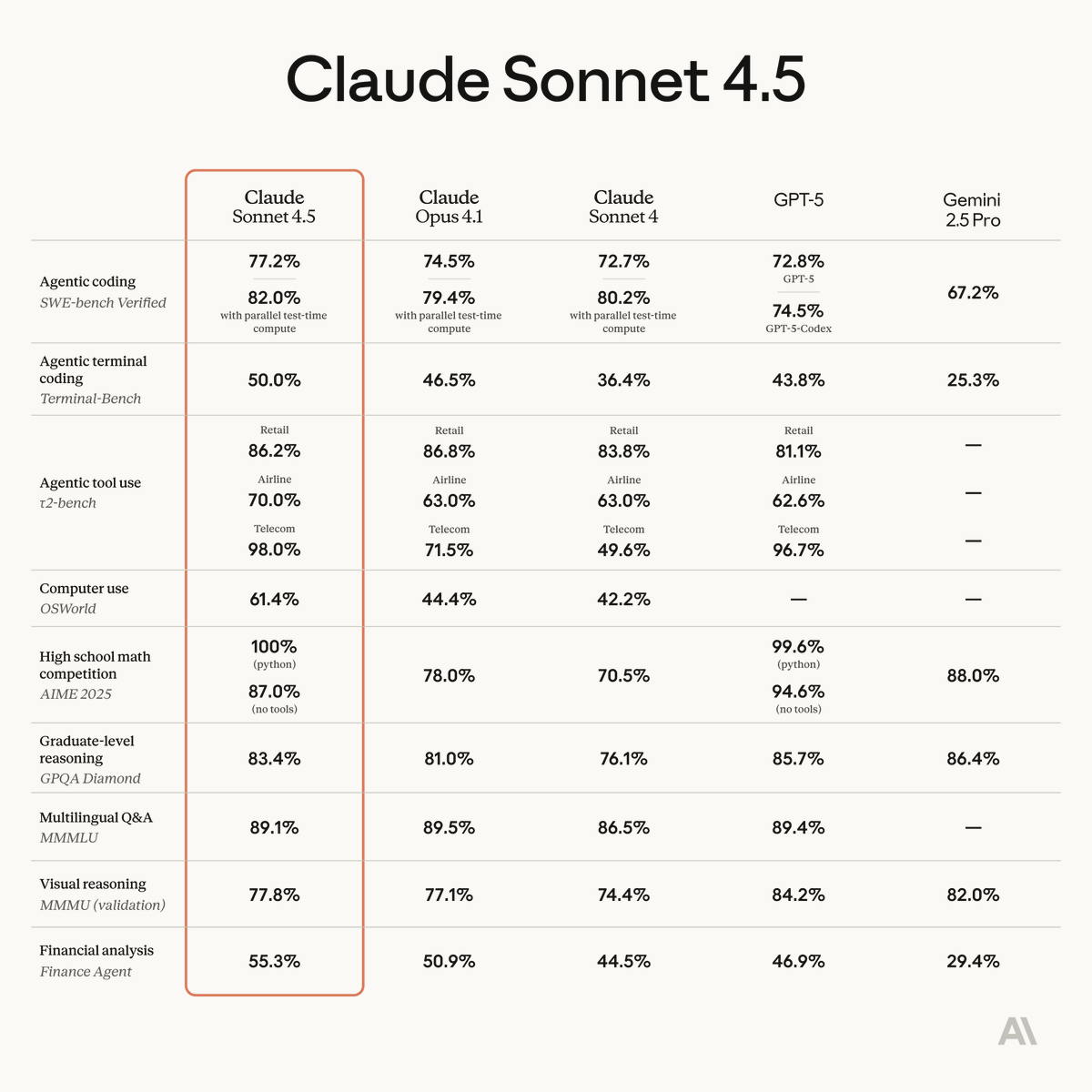
Introducing Claude Sonnet 4.5—the best coding model in the world.
It's the strongest model for building complex agents. It's the best model at using computers. And it shows substantial gains on tests of reasoning and math.
We've released a large-scale study on how people are using ChatGPT.
Consumer adoption has broadened beyond early-user groups, and lots of economic value is being created through both personal and professional use:
https://t.co/jVTwud5VXX
GPT-5-Codex is here: a version of GPT-5 better at agentic coding.
It is faster, smarter, and has new capabilities. Let us know what you think!
The team has been absolutely cooking, very fun to watch.
KICK TEST? THIS ROBOT ACED IT WITHOUT FLINCHING
At the World Robot Conference in Beijing earlier this month, a humanoid robot showed off next-level balance as two men kicked it back and forth across a red carpet.
It didn’t flinch, didn’t fall, and casually absorbed the hits like it was built to ignore human nonsense.
No wires exposed. No drama. Just quiet stability in action.
Source: shakingtechs on Instagram