Yo no tengo muchas amistades
Pero las que tengo tienen este nivel de argumento y de conversación.
Gracias siempre mi adorado por tu ser y tu pensamiento
Por esto es que te admiro y respeto.
83-year-old lady in medical ward with pneumonia. No delirium on assessment.
But when asking about delirium symptoms, the lady vividly recalls a strange episode a few weeks before when she had been admitted for a rib fracture.
She said she completely changed, that she was seeing ants walking on the walls and curtains and was very frightened. She said her daughters had told the surgeon that this wasn't their mother. She said she had this episode because of being given a drug but she couldn't remember the name of it.
She said she felt very ashamed that she was behaving differently and still feels shaken up by this experience.
Looking back through the records it looks like she was given pregabalin for two days and this was the cause. But no mention of delirium in the notes. The family were not informed other than the drug had caused a reaction.
Many such cases, of course.
But what really bothers me about this is the lack of clear communication to the lady herself and the family. They have been left with this lingering sense of what was a very disturbing event, without a clear explanation and with ongoing questions.
The lady herself still wonders if she was going 'doolally' - a locally-used slang term meaning mad.
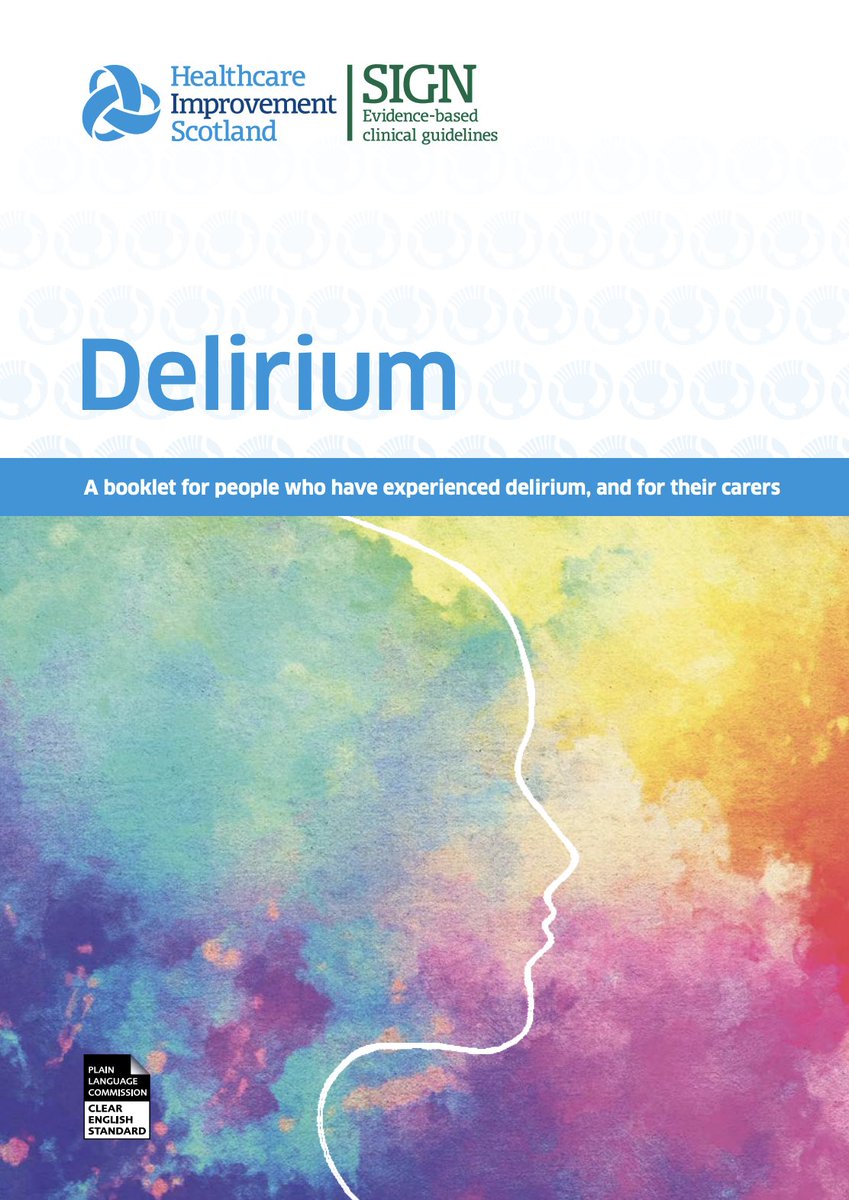
She was very reassured by an explanation of what happened including use of the word delirium. She also really appreciated being given a leaflet on delirium and said she would give this to her daughters.
Let's do better!
Call it delirium, tell the patient, tell the family, and give them written information. EVERY TIME.
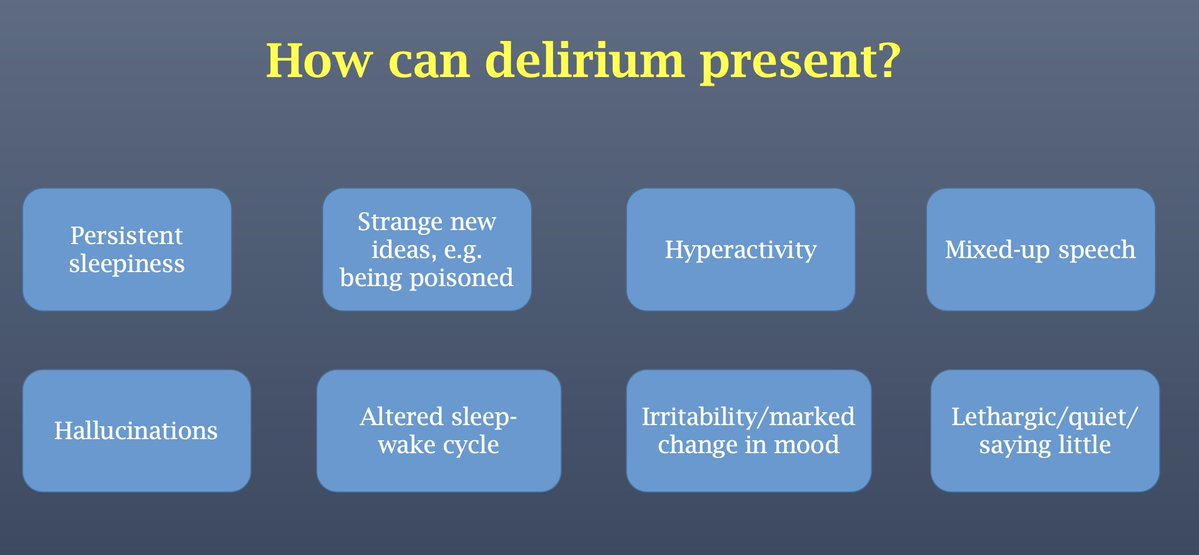
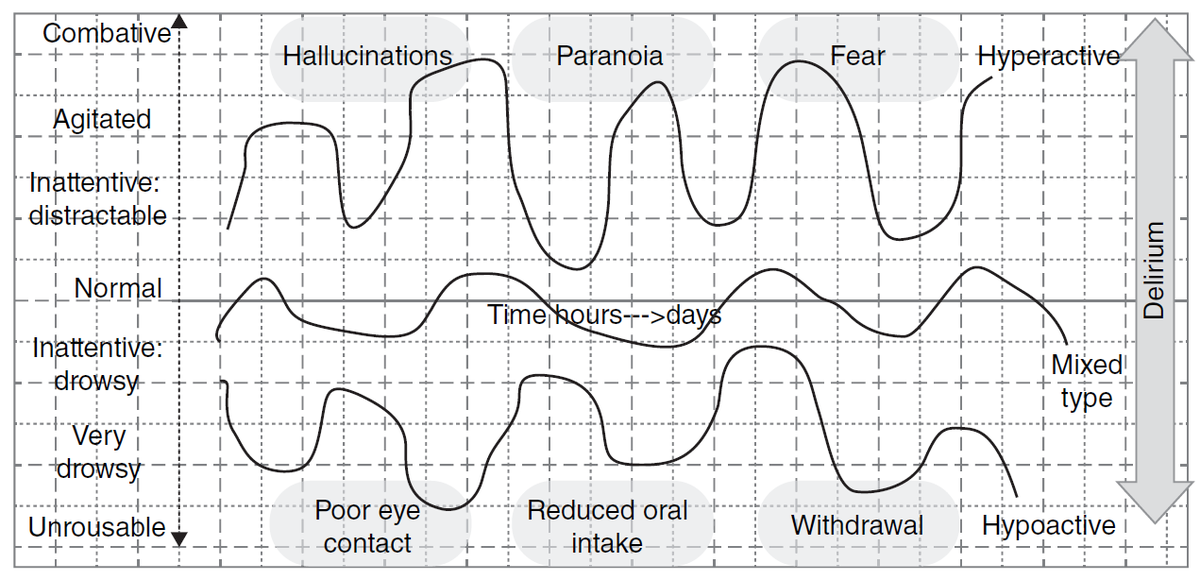
Delirium can present in several ways.
The key concept is change from baseline in hours/days.
This distinguishes delirium from dementia.
#delirium#dementia#patientsafety#4Ms
@Profeco@AtencionProfeco falla en el servicio @izzi_mx desde hace más de 24 horas y su respuesta es que es falla local, estas fallas intermitentes desde la contratación y la respuesta es la misma( pero si quiero cancelar me cobran penalización...)
Explain delirium in accessible terms: "The brain isn't processing information normally right now."
This helps families understand why repeating basics about what is going on, as well as being reassuring over and over again, can help the person experiencing #delirium.
Clinical tip on #delirium: it fluctuates - e.g. lucid one hour, confused or sleepy the next.
This cruel "rollercoaster" exhausts families & fools healthcare professionals.
Let's not be misled by moments of clarity. Review the notes for changes over the last 24-48 hours.
Relatives and close friends know the patient best.
"This isn't like her normal self" is very commonly the first sign of #delirium.
👍 Staff: take this observation seriously & assess immediately for delirium with a tool like the 4AT.
Esto 👇🏻
Los adultos mayores con ERC tienen un riesgo incrementado de sarcopenia y fragilidad. Tener una dieta muy restrictiva puede ser peor para ellos y aumentar el riesgo de desgaste energético proteicos
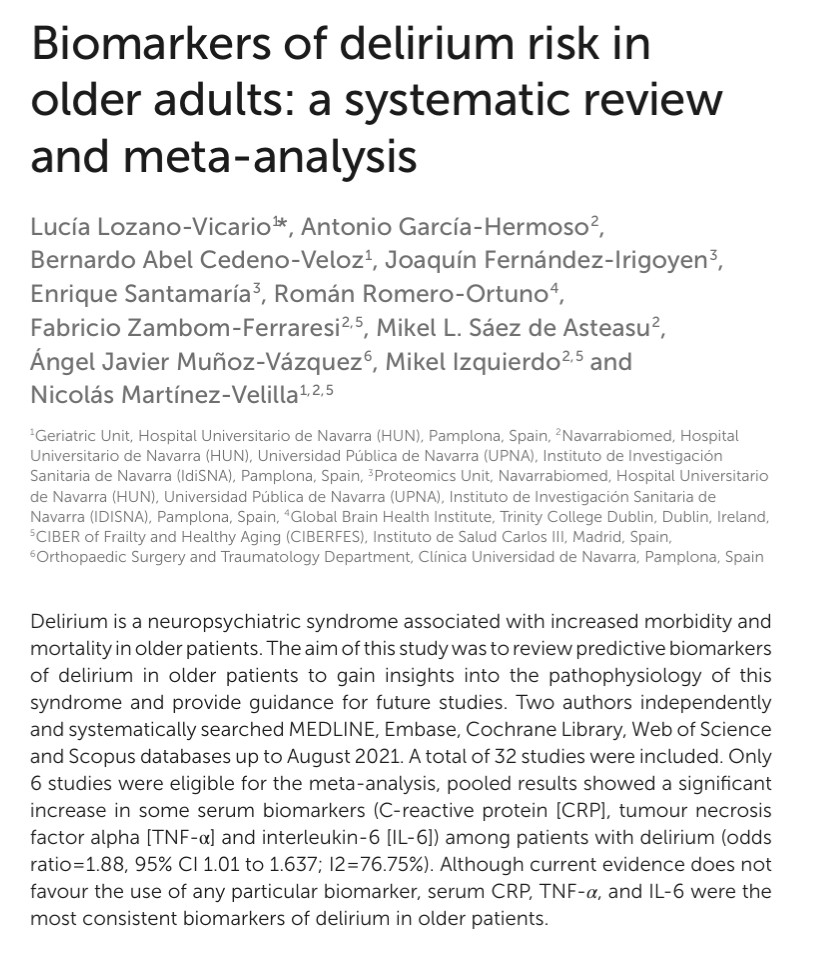
Biomarkers of #delirium in older patients
- 32 studies
- Inflammatory markers were most consistently associated with delirium
- e.g. ⬆️ CRP, TNF-α, & IL-6
We haven't worked out why #delirium, a condition that affects 1 in 4 older hospital inpatients & that is linked with x2-3 increase in 30-day mortality, is still very poorly detected & mostly badly managed.
One idea: it's because it is too complex, & too hard.
🧵
In more detail:
⭐️ Rule out acute physiological disturbances (e.g., hypotension, hypoxia, hypoglycemia, opioid toxicity).
⭐️ Search for underlying causes (e.g., infections, pain, urinary retention).
⭐️ Assess and manage distress (via questioning, observation, and informant history).
⭐️ Non-pharmacological interventions (e.g., reorientation, family involvement).
⭐️ Consider limited pharmacological options (e.g., low-dose antipsychotics for intractable distress).
⭐️ Prevent complications (e.g., immobility, dehydration, falls).
⭐️ Communication (with patients and families, using the term "delirium").
⭐️ Monitor recovery and rehabilitation (e.g., assessing improvement, modifying therapy).
⭐️ Consider if the patient has undiagnosed dementia (months/years of cognitive/functional decline before the present episode), and consider if further assessment for this and/or follow-up (e.g. in specialist clinic) is needed
#delirium
#Delirium | Instituto Nacional de Ciencias Médicas y Nutrición Salvador Zubirán
El delirium es un síndrome caracterizado por alteraciones de la conciencia, la atención y las funciones cognitivas.
#salud#saludmental#mente#delirium#EPS#INCMNSZ