SpaceXAI will provide @AnthropicAI with access to Colossus 1, one of the world’s largest and fastest-deployed AI supercomputers, to provide additional capacity for Claude → https://t.co/nfDR9S822L
1. We believe in iterative deployment; although GPT-5.5 is already a smart model, we expect rapid improvements. Iterative deployment is a big part of our safety strategy; we believe the world will be best equipped to win at the team sport of AI resilience this way.
2. We believe in democratization. We want people to be able to use lots of AI; we aim to have the most efficient models, the most efficient inference stack, and the most compute. We want our users to have access to the best technology and for everyone to have equal opportunity. We have been tracking cybersecurity as a preparedness category for a long time, and have built mitigations we believe in that enable us to make capable models broadly available.
3. We love you and we want you to win. We want to be a platform for every company, scientist, entrepreneur, and person. (My whole career has largely been about the magic of startups, and I think we are about to see that magic at hyperscale.)
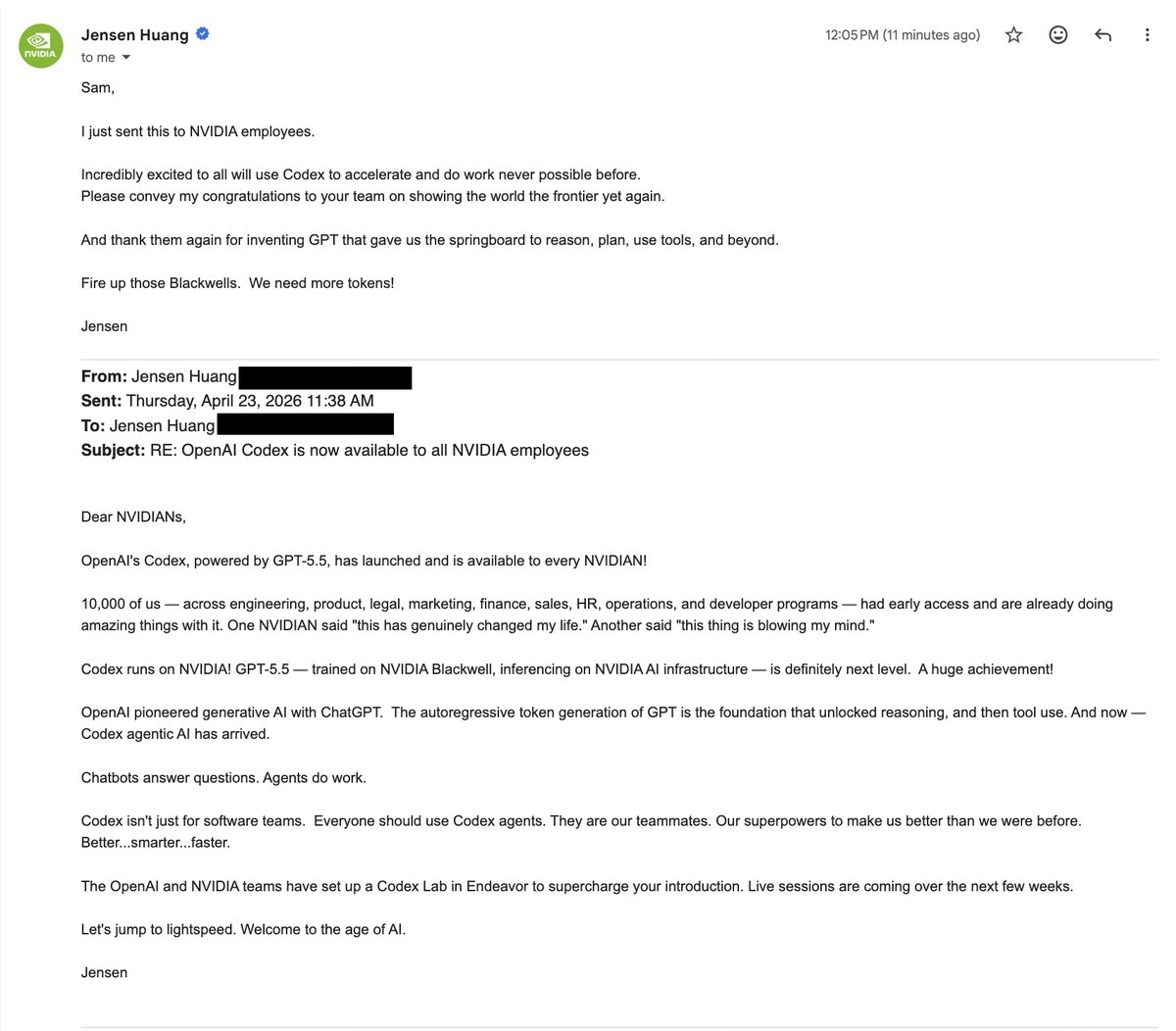
We tried a new thing with NVIDIA to roll out Codex across a whole company and it was awesome to see it work.
Let us know if you'd like to do it at your company!
SpaceXAI and @cursor_ai are now working closely together to create the world’s best coding and knowledge work AI.
The combination of Cursor’s leading product and distribution to expert software engineers with SpaceX’s million H100 equivalent Colossus training supercomputer will allow us to build the world’s most useful models.
Cursor has also given SpaceX the right to acquire Cursor later this year for $60 billion or pay $10 billion for our work together.
Peter Steinberger is joining OpenAI to drive the next generation of personal agents. He is a genius with a lot of amazing ideas about the future of very smart agents interacting with each other to do very useful things for people. We expect this will quickly become core to our product offerings.
OpenClaw will live in a foundation as an open source project that OpenAI will continue to support. The future is going to be extremely multi-agent and it's important to us to support open source as part of that.
Nothing humbles you like telling your OpenClaw “confirm before acting” and watching it speedrun deleting your inbox. I couldn’t stop it from my phone. I had to RUN to my Mac mini like I was defusing a bomb.
I'm joining @OpenAI to bring agents to everyone. @OpenClaw is becoming a foundation: open, independent, and just getting started.🦞
https://t.co/XOc7X4jOxq
Today we are launching my favorite feature of ChatGPT so far, called Pulse. It is initially available to Pro subscribers.
Pulse works for you overnight, and keeps thinking about your interests, your connected data, your recent chats, and more. Every morning, you get a custom-generated set of stuff you might be interested in.
It performs super well if you tell ChatGPT more about what's important to you. In regular chat, you could mention “I’d like to go visit Bora Bora someday” or “My kid is 6 months old and I’m interested in developmental milestones” and in the future you might get useful updates.
Think of treating ChatGPT like a super-competent personal assistant: sometimes you ask for things you need in the moment, but if you share general preferences, it will do a good job for you proactively.
This also points to what I believe is the future of ChatGPT: a shift from being all reactive to being significantly proactive, and extremely personalized.
This is an early look, and right now only available to Pro subscribers. We will work hard to improve the quality over time and to find a way to bring it to Plus subscribers too.
Huge congrats to @ChristinaHartW, @_samirism, and the team for building this.
Over the next few weeks, we are launching some new compute-intensive offerings. Because of the associated costs, some features will initially only be available to Pro subscribers, and some new products will have additional fees.
Our intention remains to drive the cost of intelligence down as aggressively as we can and make our services widely available, and we are confident we will get there over time.
But we also want to learn what's possible when we throw a lot of compute, at today's model costs, at interesting new ideas.
GPT-5 is the smartest model we've ever done, but the main thing we pushed for is real-world utility and mass accessibility/affordability.
we can release much, much smarter models, and we will, but this is something a billion+ people will benefit from.
(most of the world has only used models like GPT-4o!)