1/5
Finance moving onchain requires more than a blockchain that can process transactions.
It needs infrastructure built around how markets operate, from trading and liquidity to settlement, asset management and institutional access.
This is where @injective 's approach shines.
1/5
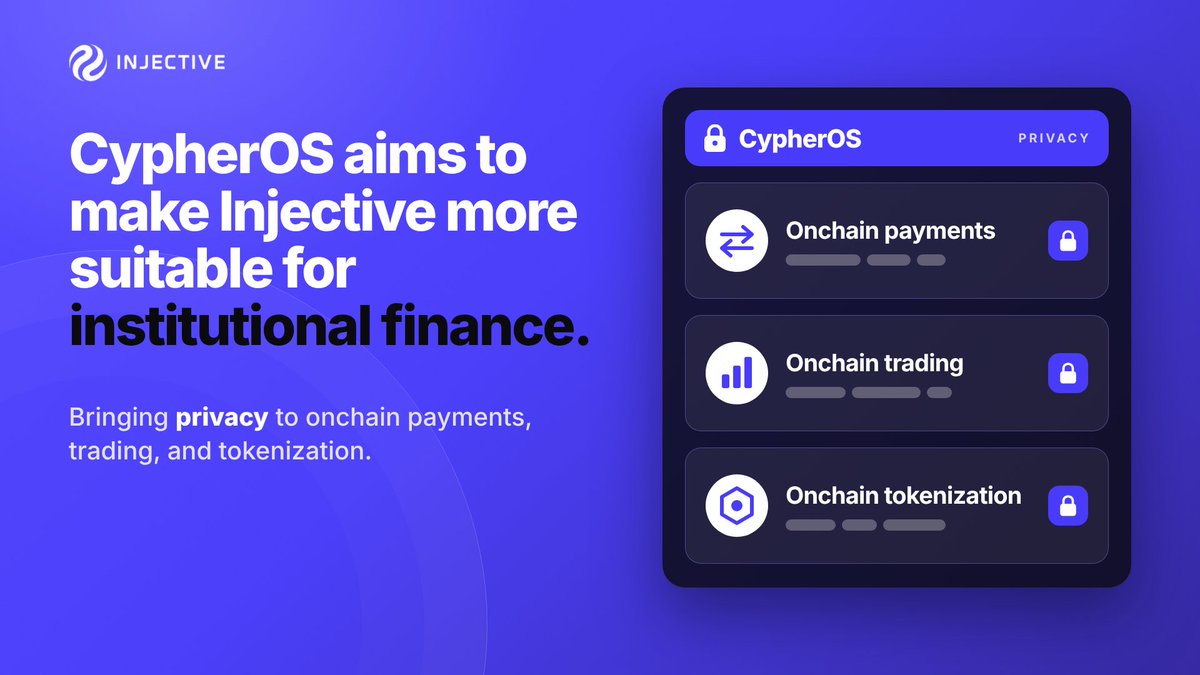
Privacy is still a major challenge for institutional adoption of public blockchains.
Financial institutions need onchain efficiency, but exposing every trade, client position and transaction isn't always an option. @injective is addressing this with CypherOS.
Dollar stablecoins have dominated onchain finance, but not every market should have to route through the dollar to participate in tokenized finance.
@injective is taking a step toward changing that with KRW1, a Korean won-backed stablecoin issued by BDACS, becoming the proposed won-denominated settlement asset for tokenized markets on its network.
Under the MOU signed on October 20, both parties are working toward bringing KRW1 into Injective's RWA ecosystem. KRW1 is backed 1:1 by Korean won, with minting and redemption restricted to approved institutional partners and subject to regulatory approval.
This creates an opportunity for tokenized assets on Injective to be traded and settled directly in Korean won rather than routing through dollar stablecoins first. For Korean institutions and investors, that could reduce unnecessary currency conversion and FX exposure when accessing onchain markets.
It also means Injective's stablecoin infrastructure is expanding beyond dollar liquidity. Native USDC and KRW1 can serve different markets side by side, giving tokenized finance access to both dollar and won settlement rails.
With over $7.5B in RWA volume processed and more than $1B in tokenized assets issued on Injective, this partnership builds on an existing financial ecosystem rather than starting from scratch.
The first step toward native Korean won markets onchain is underway, with further expansion expected as Korea's regulatory framework develops.
Injective is making onchain finance more accessible by bringing settlement currencies closer to the markets and institutions that actually use them..
@injective is heading into a busy week, and the latest ecosystem developments are worth paying attention to.
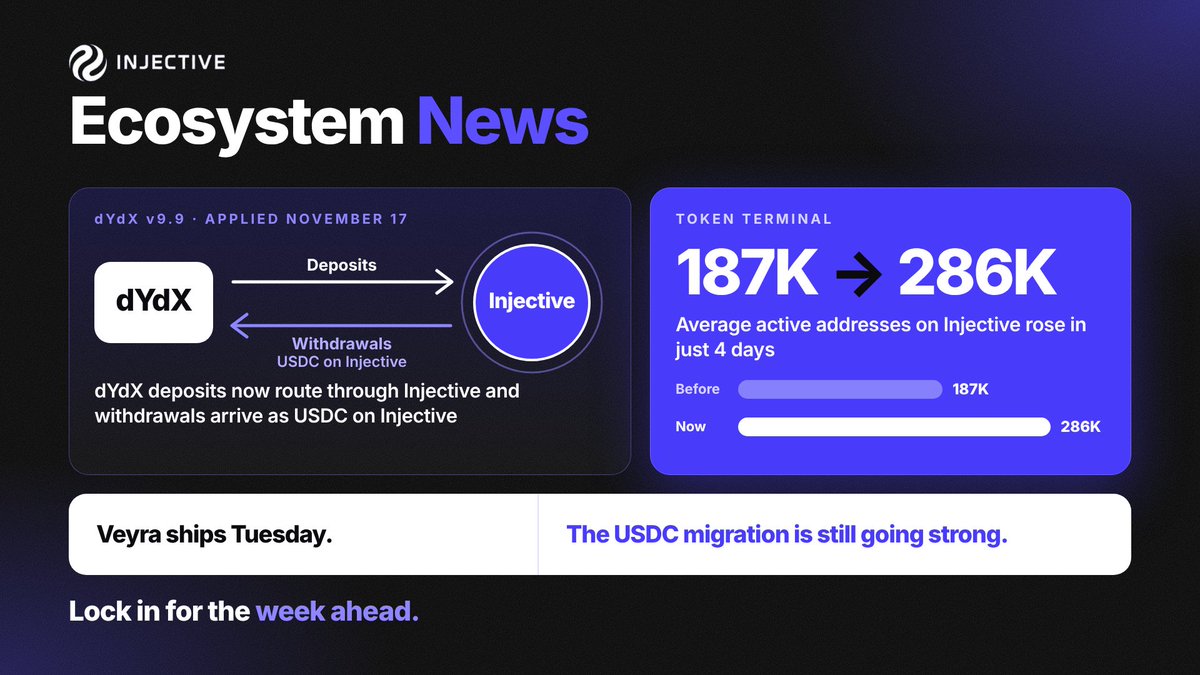
On November 17, @dYdX applied its v9.9 upgrade, bringing an important change to how deposits and withdrawals work. Deposits now route through Injective, while withdrawals arrive as USDC on Injective.
This creates a more direct connection between dYdX and Injective's infrastructure, while adding another source of activity to its USDC ecosystem.
Network activity is also showing encouraging growth. According to @tokenterminal, Injective's average active addresses increased from 187K to 286K in just four days.
That's a rise of roughly 53% in a very short period. While active addresses alone don't tell the whole story, the increase is a useful signal of growing participation across the network.
Then there's Veyra.
The mainnet upgrade is scheduled for Tuesday, November 24, bringing another step forward for Injective's institutional and RWA infrastructure. It also adds to the broader development happening across the ecosystem.
Between the continued USDC migration, new dYdX deposit and withdrawal routes, rising network activity and Veyra approaching, there's plenty to follow.
Injective isn't entering the week with just one headline. Several parts of its ecosystem are moving forward at once.
A lot to keep an eye on, Ninjas. 🥷
I like the direction @injective is taking with Multi-VM because it addresses a problem that often gets overlooked in blockchain development: developers shouldn't have to choose between ecosystems just to build on the same network.
#Injective supports both WASM, through CosmWasm and Rust, and native EVM, through Solidity. More importantly, these environments operate within one network, sharing state, consensus and liquidity without needing bridges or separate rollups.
The MultiVM Token Standard takes this further by giving assets one identity and balance across both environments. Developers don't have to treat the same asset as two disconnected versions simply because it is being used by different virtual machines.
This also creates more flexibility for builders. Ethereum developers can continue using familiar Solidity tools, while Cosmos developers can work with Rust and CosmWasm. Both can still access Injective's native modules and shared financial infrastructure.
The interesting part is what this makes possible for applications.
With cross-VM composability, applications built in different environments can interact, access shared liquidity and even communicate within a single transaction. That opens the door to products that combine capabilities from both ecosystems instead of operating in isolated environments.
And Injective isn't stopping at Ethereum and Cosmos. Solana VM integration is also on the roadmap, potentially extending that flexibility even further.
I see Multi-VM as an important evolution for Injective. It's no longer just about providing infrastructure for trading and financial applications. It's about creating an environment where developers from different ecosystems can build together without giving up their existing tools, assets or access to liquidity. 🥷
1/5
Looking back at how @injective started the year compared to where the ecosystem stands today, the progress is becoming difficult to ignore.
Over recent months, major upgrades and institutional developments have continued to expand what Injective can support.
1/5
With 2 days to Veyra, @injective is preparing for one of its most significant mainnet upgrades of the year.
IIP-717 passed with 99.51% approval, bringing new infrastructure for institutional markets, cross-chain activity and more advanced onchain finance.
What stands out to me about @injective USDC is that the growth is happening alongside a wider ecosystem transition, not in isolation.
USDC.inj has reached $55M in supply, growing 326% over the past 30 days, making it the fastest-growing USDC deployment across chains during that period.
A significant part of this is the migration from Noble USDC to Injective USDC, bringing Cosmos and connected ecosystems toward a shared dollar standard. The idea is to reduce fragmentation and allow applications, users and markets to operate around the same USDC asset.
Injective also connects this liquidity to Circle's CCTP v2, enabling crosschain connectivity with networks such as Ethereum, Base and Solana, while IBC extends USDC.inj across participating Cosmos chains.
With ecosystems like @cosmos and @dYdX moving toward USDC.inj, the implications go beyond Injective's own liquidity. This creates a more connected foundation for trading, lending, payments, collateral and capital movement across chains.
The growth in supply is impressive, but the real story is what happens when more of the ecosystem starts using the same dollar infrastructure.
Options trading on #Injective is built around a simple principle: every position is fully backed, and traders know their maximum risk before entering a trade.
Calls and puts allow users to take positions on where an asset's price index will settle at expiry. But Injective adds defined payout limits to both sides. Calls have a strike and cap, while puts have a strike and floor. This means every contract has a fixed maximum payout, with one premium for each position.
That structure makes full collateralization possible. Option writers lock the maximum payout upfront in native @injective USDC, which remains onchain until expiry. No borrowing, margin top-ups or liquidations when the market moves sharply.
Traders also get institutional liquidity quotes from day one, with the premium, maximum profit, maximum loss, breakeven and payoff chart displayed before they confirm a transaction.
The first markets cover more than traditional equities.
They include
SICI,
Tracking AI GPU rental prices,
The US500,
US Tech 100,
Gold,
Silver and
WTI crude oil.
Injective is bringing options on crypto, equities, commodities and AI infrastructure into an onchain environment where collateral, execution and risk are transparent from the start.
1/5
Cosmos has needed a more unified dollar liquidity layer.
@injective 's USDC deployment brings a shared asset for trading, lending, payments and treasury activity, helping applications and users move away from fragmented USDC representations.
1/5
#Injective's expansion in Japan is taking a step beyond infrastructure and market access.
Its collaboration with the University of Tokyo's Endowed Chair adds an academic dimension to its growing presence in the region.
Keeping up with onchain markets doesn’t always mean sitting in front of a laptop. Sometimes, I just need my phone to check what’s happening with the tokens I’m following.
That’s where @GeckoTerminal comes in handy.
I use the mobile app to keep track of DEX pools, token prices and market activity, especially when I’m away from my desk.
My Watchlist currently includes $VELVET, $PONS and $HOOKR. Rather than searching for these tokens every time, I’ve saved their pools so I can easily return to the markets I’m researching.
When I check my Watchlist, I usually pay attention to a few things:
✔️Price movements: How has the token been moving?
✔️Trading volume: Is there meaningful trading activity around the pool?
✔️Liquidity: How much liquidity is available?
✔️Transactions: What’s happening with the level of trading activity?
I don’t look at these figures in isolation. I use them to understand the market better, compare activity and decide what deserves a closer look in my research.
What I particularly appreciate is having these markets together in one place. I can open the app, revisit my Watchlist and get a quick overview without going through the process of searching for everything again.
For someone who spends time researching different onchain markets, that convenience matters.
GeckoTerminal makes it easier to keep that research close, even when I’m on the move.
Your phone can be more than a place to check notifications. It can also be part of your onchain research routine.
Download GeckoTerminal on App Store:
https://t.co/gzTPmhUwna
On playstore:
https://t.co/5n3qtlGTfs
Take a look at my Watchlist and set up yours:
https://t.co/ewlk3b8NcS
🌏 Trump, Xi and Putin finally sat down together. So what did they say?
On the APEC sidelines in Shenzhen on Nov 19, Xi laid out 4 points for how major powers should get along: mutual respect, peaceful coexistence, win-win cooperation and dialogue.
This one different.
Canborsa Road to 1 Million got two leagues, Impact Score, growing $10k pool, and a Dubai ticket on the line.
Small accounts finally get a fair shot.
Watch my breakdown:
@Canborsa_DEX
join with the link
https://t.co/14kZILRCiG
credit: @APCollectiveHub
A token's quoted output doesn't always tell the full story of a buy.
One detail I find interesting about @Hypesium is how its protection system handles token taxes during transaction preparation.
Before a buy is sent, Hypesium simulates the exact transaction and checks the token's buy and sell taxes.
It also incorporates detected tax into the minimum-out calculation, provided it falls within the selected protection profile.
For example, a token with a 5% buy tax can deliver fewer tokens than its pre-tax output.
Accounting for this difference helps make transaction expectations more realistic and can prevent buys that fail the selected protection rules.
It's a useful detail because transaction protection should go beyond checking whether a token can be bought.
Not every exit needs to close an entire position.
@Hypesium's position monitor allows users to sell 25%, 50%, 100%, or choose a custom percentage of their holdings.
Consider holding 1,000 tokens. Selling 250 leaves 750 tokens in the position, giving the trader room to manage the remaining exposure separately.
This creates a useful distinction between reducing a position and exiting it completely.
I find this practical because traders can adjust their exposure in stages instead of making every exit a single decision.
More control over position size means more flexibility in executing an exit strategy.
@Hypesium
𝐏𝐫𝐢𝐦𝐮𝐬 𝐒𝐤𝐢𝐥𝐥𝐬 𝐭𝐮𝐫𝐧 "𝐩𝐫𝐨𝐯𝐞 𝐭𝐡𝐢𝐬" 𝐢𝐧𝐭𝐨 𝐚 𝐩𝐫𝐨𝐦𝐩𝐭
Most zkTLS builds start with a blank template and a long API doc. @primus_labs Skills start with one sentence.
The repo's pattern is simple: tell your AI IDE (Cursor, Claude Code and similar) to use a Primus skill and build a program or DApp that proves whatever you fill in.
The skill carries the setup knowledge, so the IDE does the scaffolding.
⇨ a frontend skill for DApps on the enterprise zkTLS SDK (Node + Vite)
⇨ backend skills for Node programs on the network core SDK, plus a decentralized network DApp variant
⇨ a core SDK guide that walks through building a request, generating an attestation, verifying it locally and verifying it on chain in Solidity
The part that got my attention is further down the repo. There are verifiable versions of OKX OnchainOS and Binance Skills Hub API calls, adapted into flows built on the core SDK.
An agent skill normally returns data and you take its word for it. A verifiable one changes that:
𝐀 𝐯𝐞𝐫𝐢𝐟𝐢𝐚𝐛𝐥𝐞 𝐬𝐤𝐢𝐥𝐥 𝐫𝐞𝐭𝐮𝐫𝐧𝐬 𝐭𝐡𝐞 𝐚𝐧𝐬𝐰𝐞𝐫 𝐚𝐧𝐝 𝐚𝐧 𝐚𝐭𝐭𝐞𝐬𝐭𝐚𝐭𝐢𝐨𝐧 𝐨𝐟 𝐭𝐡𝐞 𝐜𝐚𝐥𝐥 𝐛𝐞𝐡𝐢𝐧𝐝 𝐢𝐭.
Picture a trading agent that reads a price endpoint through one of these flows. Later, anyone reviewing its decision can check the attestation tied to that call, instead of trusting a log. Worth remembering that the attestation is signed by a Primus attestor, so trust sits there, which is the whole reason the attestor network matters.
Skills launched on Mar 17, 2026 with two entries and a promise of more. The repo has since added backend, network and exchange flows.
If you could attach a proof to one API call your agent makes today, which one would you pick?