One thing I like about what @injective is building is that it’s not stopping at perpetual markets.
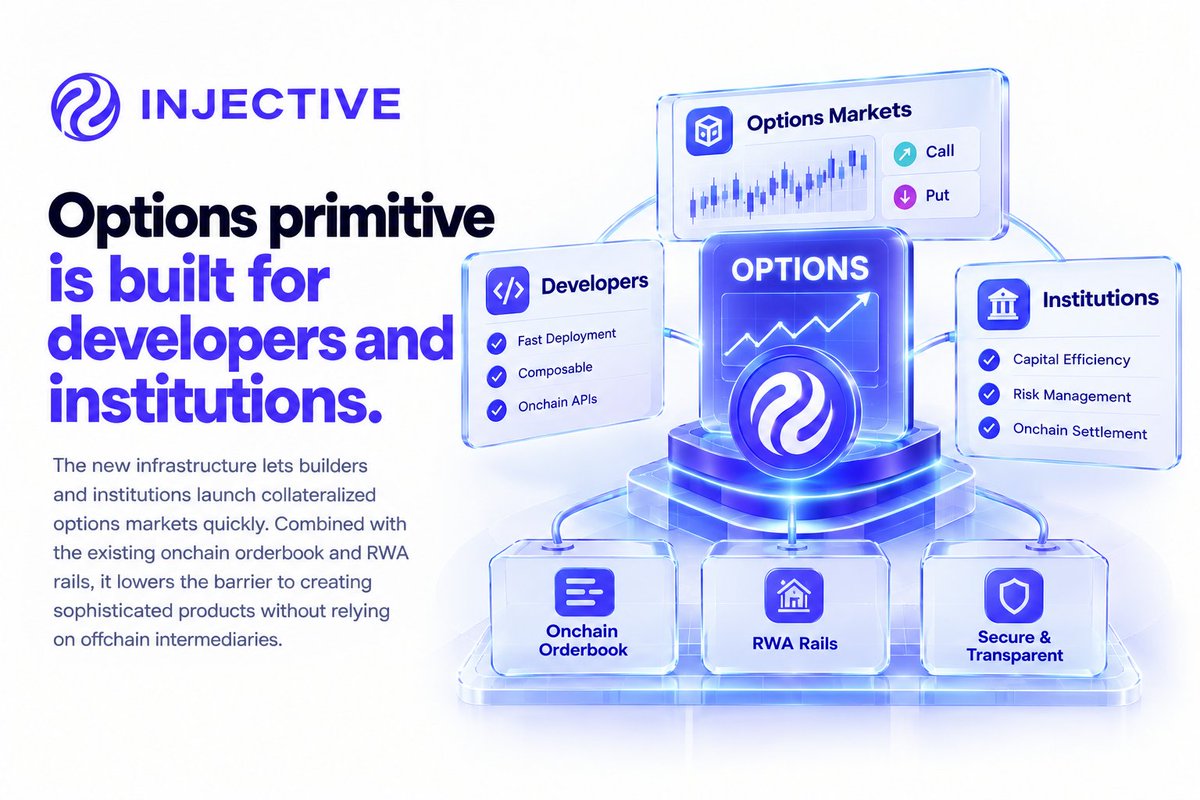
The new modular options primitive gives developers and institutions a way to launch fully collateralized options markets more easily, without building everything from scratch.
Combined with Injective’s onchain orderbook and RWA infrastructure, this opens the door to more sophisticated financial products built directly onchain.
For developers, that means more room to create. For institutions, it means new ways to approach trading, hedging, and capital efficiency.
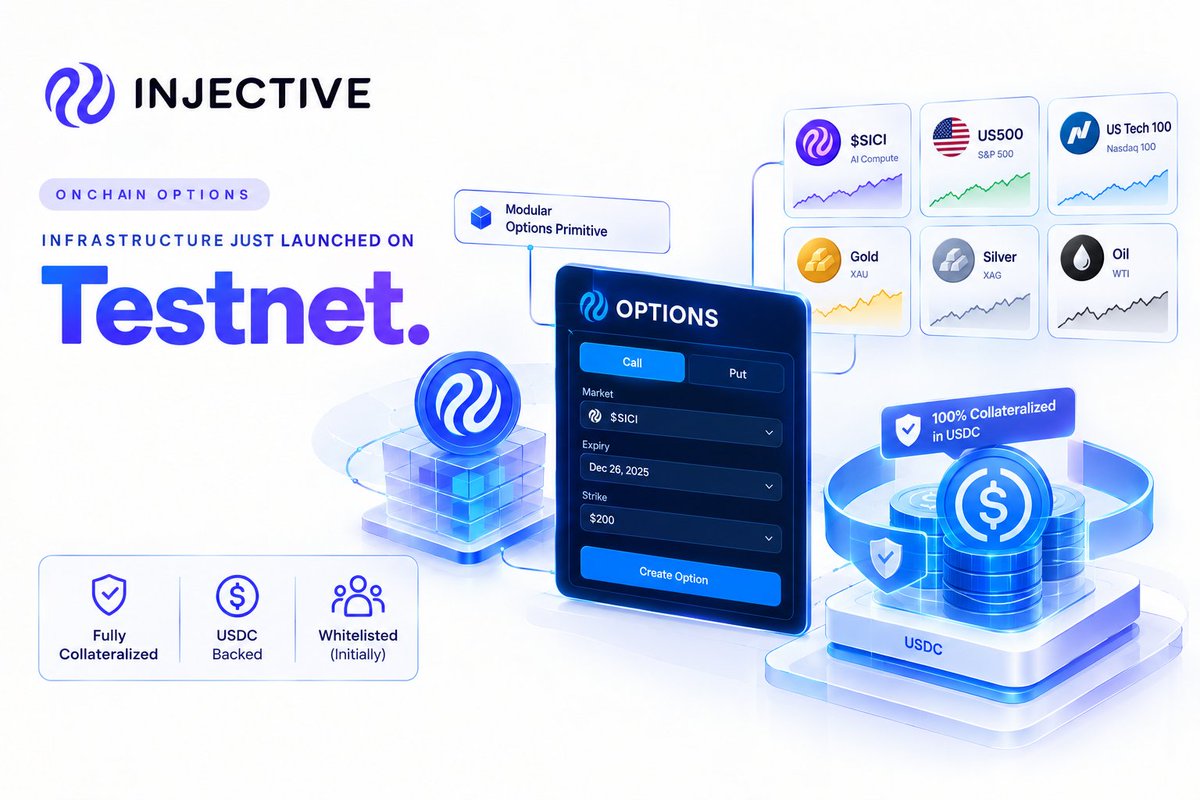
The options primitive is live on testnet, with initial access limited to whitelisted participants.
It’s still early, but Injective is laying the groundwork for financial markets that go beyond simple spot trading and perps. 🥷
WEDNESDAY REMINDER 📈🎯
The market will always offer another opportunity, but your capital won’t survive every mistake.
I’m learning to value the decisions nobody sees: the setups I skip, the patience I practise, and the risks I refuse to take.
Progress isn’t always about doing more. Sometimes, it’s about knowing when to do nothing.
Protect your capital. Trust your process. Keep becoming better. 🔥
Alhamdulillah for the journey. 🤲
I’ve been watching Injective’s RWA markets expand, and the latest options demo caught my attention.
@injective has shared a live demo of onchain RWA options, showing how developers and institutions can set up these markets in just a few clicks.
What makes this interesting is the move beyond perpetual futures. Options introduce more ways to structure exposure to real-world assets and indices, giving traders and builders additional tools to work with.
Think about the possibilities: instead of limiting onchain RWA markets to tracking price movements through perps, options can support strategies built around strike prices, expiration dates, and different risk profiles.
The demo also highlights how much the developer experience matters. If creating these markets becomes simpler, it could lower the barrier for teams looking to build more sophisticated financial products onchain.
Of course, a demo is only one step. Liquidity, risk management, and real adoption will determine how far these markets go.
Still, I like seeing Injective push into financial products beyond spot markets and perps. The range of instruments available onchain continues to grow, and RWA options are another development worth watching. 🥷
Tomorrow is Stockdrop day, and I’m curious to see which tokenized stocks end up in the hands of this round’s participants. 🥷
The latest $INJ Community BuyBack is about to deliver another part of the experience, with claims opening in under 24 hours for eligible Ninjas.
What I like about this model is that it combines three things: committed INJ gets burned, participants receive a share of ecosystem revenue, and there’s a chance to receive tokenized stocks delivered through Solana.
You’re not just watching another token burn happen. There’s a reward mechanism attached, with onchain equities adding an interesting twist.
Of course, the stock allocation is randomized, so everyone’s outcome can be different.
If you participated in the latest BuyBack, get ready to check your Stockdrop allocation tomorrow.
Let’s see what this round brings! 🔥
Sometimes, the most useful places are the ones we pass every day.
Some places make everyday life easier.
This spot under a major bridge provides a convenient route to the market. A small discovery, but a useful one.
Exploring everyday places with @tagSpaceCo
$TAGAI
There was a stretch where my whole liquidity routine looked like this:
Open Uniswap. Pick a range. Deposit. Close the tab.
An hour later, price has moved. My range is out.
The capital I thought was working is just sitting there, earning nothing.
So I open another position. Then another. Then a third to cover the gap between the first two.
I wasn't running a strategy anymore. I was running a to-do list.
Here's what changed it 🧵📹👇
A lending protocol can see your wallet's onchain history in full. 𝗪𝗵𝗮𝘁 𝗶𝘁 𝗰𝗮𝗻'𝘁 𝘀𝗲𝗲, 𝗮𝗻𝗱 𝘄𝗵𝗮𝘁 𝗮𝗰𝘁𝘂𝗮𝗹𝗹𝘆 𝗱𝗲𝘁𝗲𝗿𝗺𝗶𝗻𝗲𝘀 𝘄𝗵𝗲𝘁𝗵𝗲𝗿 𝘆𝗼𝘂'𝗹𝗹 𝗱𝗲𝗳𝗮𝘂𝗹𝘁, 𝗶𝘀 𝗲𝘃𝗲𝗿𝘆𝘁𝗵𝗶𝗻𝗴 𝘁𝗵𝗮𝘁 𝗵𝗮𝗽𝗽𝗲𝗻𝗲𝗱 𝗯𝗲𝗳𝗼𝗿𝗲 𝘆𝗼𝘂 𝗲𝘃𝗲𝗿 𝘁𝗼𝘂𝗰𝗵𝗲𝗱 𝗰𝗿𝘆𝗽𝘁𝗼.
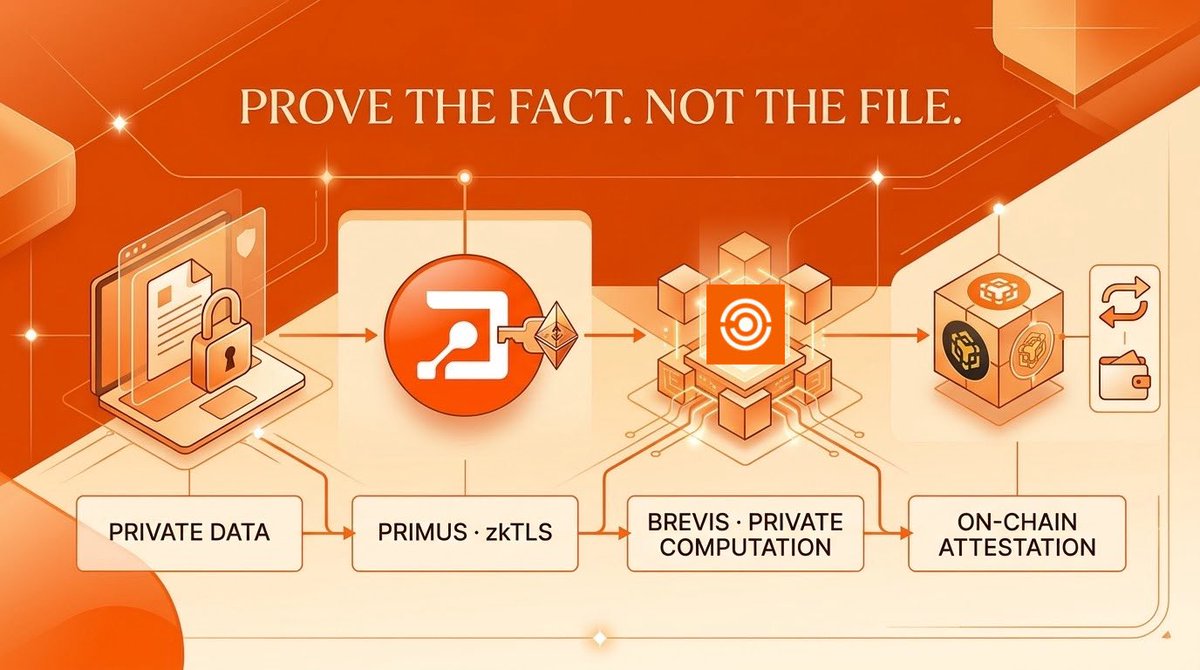
➢ ZKredit closes that blind spot, co-built by @primus_labs, BNB Chain, and Brevis since March 2026. The architecture splits the work deliberately: Primus captures the proof from your real world data source via zkTLS, Brevis runs the private computation on it, and only the result, never the underlying file, reaches BNB Chain's ZKredit Registry as an onchain attestation.
⇨ That split is the architectural difference from a standalone zkTLS verifier, which can confirm a claim is real but doesn't on its own guarantee that computation on that claim happens privately too, the piece Brevis adds here. Compare that to handing a lending app your actual financial records directly, which is still how most "verified" DeFi credit products operate.
↓ Say, hypothetically, someone has a clean repayment history with a traditional lender. ZKredit would let them prove that history is real without a protocol, Primus, or Brevis ever seeing the loan details, the lender's name, or the account itself.
✓ 𝗭𝗞𝗿𝗲𝗱𝗶𝘁 𝗱𝗲𝗹𝗶𝗯𝗲𝗿𝗮𝘁𝗲𝗹𝘆 𝗮𝘃𝗼𝗶𝗱𝘀 𝗰𝗼𝗺𝗽𝘂𝘁𝗶𝗻𝗴 𝗰𝗿𝗲𝗱𝗶𝘁 𝘀𝗰𝗼𝗿𝗲𝘀 𝗼𝗿 𝗺𝗮𝗸𝗶𝗻𝗴 𝗹𝗲𝗻𝗱𝗶𝗻𝗴 𝗱𝗲𝗰𝗶𝘀𝗶𝗼𝗻𝘀. It stays neutral infrastructure, a tamper-proof record any BNB Chain protocol can query through a single interface call.
This isn't a standalone experiment either.
BNB Chain's 2026-2028 roadmap includes plans to build native ZK privacy modules into its core architecture. ZKredit is part of that broader privacy push, positioned within the same identity and privacy stack.
The journey of Primus didn't start today
Thanks @HottieBabeGem for the introduction since 2025 Feb 27
Primus keep building..
Let's learn more about primus
DeFi still treats almost every wallet like a stranger.
If you want credit, the default answer is usually simple:
overcollateralize.
That works, but it also shows how little context onchain finance has about the borrower.
ZKredit is one of the more interesting directions from @primus_labs with BNBCHAIN and Brevis
The idea is to bring offchain financial reputation onchain without forcing users to expose the raw data behind it.
Instead of uploading your full exchange history or doxxing your financial profile, you prove specific claims:
account age, balance thresholds, activity history, credit-related signals.
Primus zkTLS verifies that the data came from the real source.
Brevis helps turn that into a proof that can actually be used onchain.
That matters because better credit rails need more than transparency.
They need context.
If DeFi wants to move beyond treating every borrower the same, privacy-preserving verification feels like one of the missing pieces.
https://t.co/i3hNDTPp0p
While the world is loud, we build.
@UnseenOrdo — the first cinematic UDA collection on Bitcoin RGB.
Only 300 free mint spots left on UNSEEN (first private NFT on Bitcoin RGB).
Spots are moving. Don’t wait.
Join now 👇
https://t.co/qmvdQFSVH5
1 week into Cosmic Signature Cycle 3 🌌
914 gestures and counting 👀
8.7125 ETH, 1,000 CST + 3 NFTs in the signature allocation.
Every gesture extends the clock. Let’s see how far we can take this cycle 🚀
#CosmicSignature#CST@CosmicSignature
Memecoins meet real world assets on Bitcoin.
@RGBHorse is pushing the boundaries with stock pairs like $TSLA, $AAPL, and $NVDA, powered by RGB.
@RGBHorse is bringing a new dimension to Bitcoin, bridging memecoin culture with RWAs
Bitcoin is about to get more interesting.⚡
HOW CRYPTO ETF FLOWS WORK: WHY INSTITUTIONAL MONEY MOVES MARKETS 📊
Crypto ETFs let investors gain exposure through traditional markets.
Their inflows and outflows reveal more than sentiment. They offer clues about investment demand for assets like $BTC, $ETH, $SOL.
1/10 🧵👇
One thing I’ve wanted to see more of in onchain finance is the move beyond perpetual futures into more sophisticated financial products.
@injective has taken a step in that direction with a new modular options primitive now live on testnet.
The initial rollout includes fully collateralized calls and puts across six markets: $SICI for AI compute, US500, US Tech 100, gold, silver, and oil. Access is currently limited to whitelisted participants.
What stands out to me is the collateral model. Every option is backed by native USDC from the moment it’s written, giving the system a fully collateralized foundation rather than relying on unbacked exposure.
This also creates an interesting mix of markets. AI compute sits alongside major equity indices and traditional commodities, bringing very different types of exposure into the same options infrastructure.
For developers, a modular primitive could make it easier to build new options markets without having to create the entire system from scratch.
It’s still testnet, so broader adoption and real market activity are the next things to watch. But seeing Injective expand from perps into fully collateralized onchain options is a meaningful development.
The range of financial instruments being built onchain keeps getting wider. 🥷
Standards only matter if the industry uses them @quipnetwork
The Quantum Alliance’s launch has been picked up across CoinDesk, Decrypt, Quantum Daily, Bitcoin News, and TFTC.
Coverage is useful. The harder part comes after the headlines: shared tests for what “quantum-ready” means on wallets and chains, so the phrase isn’t just marketing. Postquant Labs (the team behind Quip) joined as a founding contributor for that reason — production experience next to open criteria, not another private label.
Nine organizations can define a bar. Adoption decides whether holders and institutions get a real signal or more noise.
→ https://t.co/nAqqkMk04y
@quipnetwork
@injective 5/5
I like this direction because it opens up a different conversation around AI and finance.
From AI companies to the cost of the GPUs behind them, @injective is exploring new ways to bring emerging markets onchain.
Brick by brick, the ecosystem keeps expanding. 🥷
1/5
AI is more than the companies building models. The computing power behind them has its own market too.
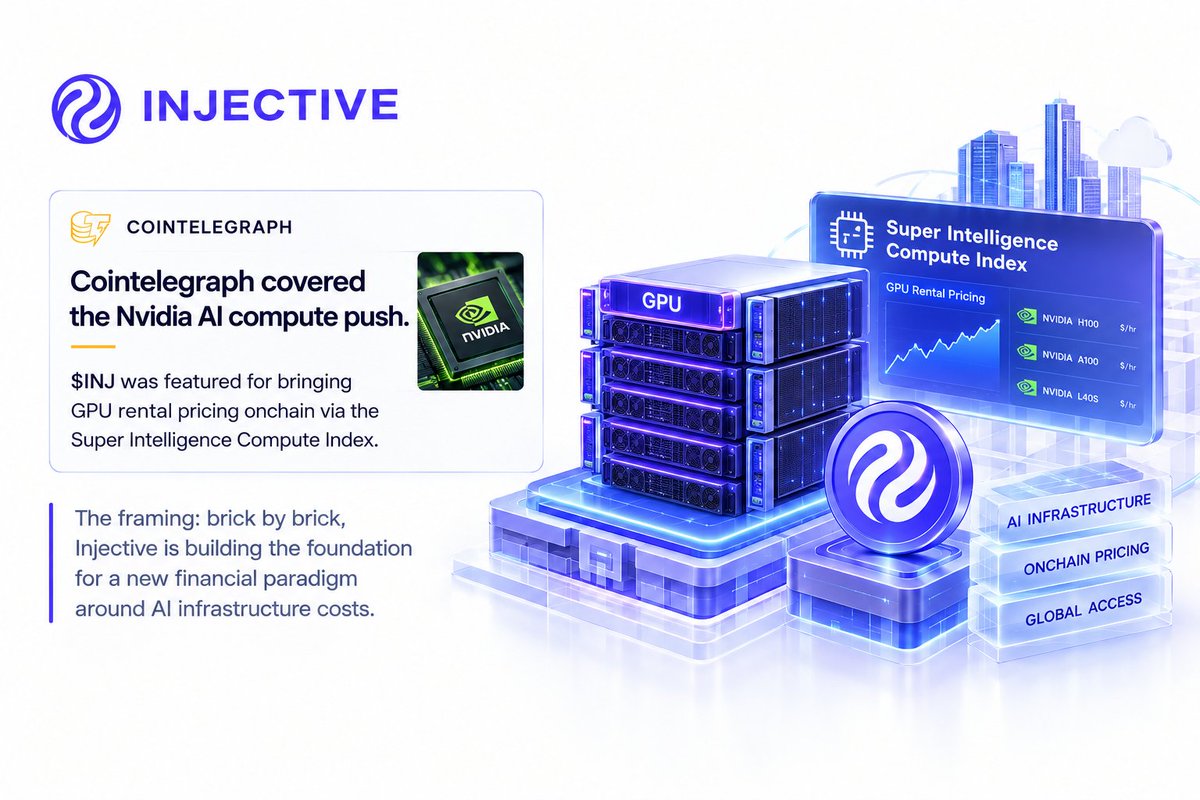
Cointelegraph recently covered Injective's push to bring AI compute pricing onchain through the Super Intelligence Compute Index.
@injective
@injective 4/5
@injective has already been exploring AI-related markets through pre-IPO perps and its $AIX index.
With $SICI, the focus expands toward the infrastructure powering the AI economy, rather than just the companies operating within it.