Last fall we GPS-tagged a young saw-whet owl at Cape May Point. By April she was in Downeast Maine. A Long-eared Owl we tagged flew 141 miles in about 4 hours one April night, picked up by phones along the way. Help tag this year's owls: https://t.co/bwywwXHrvp #owls
4/ Last season's owls turned up in Maine, New Hampshire, Nova Scotia, New Brunswick and Quebec. Banding starts this month. Where will this year's go? https://t.co/bwywwXHrvp
Last fall we GPS-tagged a young saw-whet owl at Cape May Point. By April she was in Downeast Maine. A Long-eared Owl we tagged flew 141 miles in about 4 hours one April night, picked up by phones along the way. Help tag this year's owls: https://t.co/bwywwXHrvp #owls
3/ The goal is $15,000: 5 GPS backpacks, 9 transmitter leg bands, a year of data for each, and new nets. The Cape May Owl Project is independent and funded by donors and partners, including @ConSciGlobal and @nature_NJ.
Our Lit is #LIT !
10 new citations featuring CTT technology just landed on our Select Publications page.
0.06 g tags on monarchs. GPS collars on desert kit foxes. Six years of 15-minute fixes on white-backed vultures. Golden eagles and wind turbines. And six more...
From 0.06 g radio tags to 2.8 g GPS over Cellular, Cellular + Argos hybrids and Iridium units submersible to 3,000 ft. All made in Cape May, New Jersey. The proof is in the literature.
Read the studies: https://t.co/7yBohth5ro Shop the full range: https://t.co/WT34fRnWOZ
4/ BlūSeries tags are Motus tags, and the Blū+ data they can gather from the smartphone network fills in the Motus network wherever there's human infrastructure, which is how we can follow one songbird street by street. Where does it go next? Follow along for the next chapter.
A Northern Waterthrush tagged w/ #MotusWTS compatible BlūBat tag left after sunset on Sep 11. Two weeks later it was in Colombia, incl. trekking over ~800 km of open sea. 3,082 km so far! Check out the video for more details. With @NJAudubon@cmbobirds@nature_NJ#BirdMigration
3/ Last detected in Jamaica before dawn on Sep 24. Next detection: over Barranquilla, Colombia at 7:17 PM on Sep 25. At its first-night pace, that crossing is about 18 hours of nonstop flight.
2/ It spent 11 days refueling at The Nature Conservancy's South Cape May Meadows Preserve first. We logged 101 detections as it moved around the preserve.
@spamlorde@R_H_Ebright@FurinCleavage but- it's always has to be considered - and the fact is that we're talking about a minuscule fraction of a percent of the population getting one of these tags.
@spamlorde@R_H_Ebright@FurinCleavage duly noted- and why Dr. Lee Brown at James Madison University and her graduate student studied the effect of the tags on flight. Given 11% of those tagged made it to the overwintering sites last fall, and that aligns with the expected number of untagged, we feel pretty good.
@R_H_Ebright@ocnj3@gglinskii we've tested with drones and phones, and with the Blū+ detections were getting 30-200m and more if its directly overhead. But I think it's safe to say 30-200m with good line of sight. With a BlūSeries Receiver on a Motus station we're getting 2-3KM !
@lshute11@R_H_Ebright Hi Larry. It depends on the last location time. If there’s a good ping as the butterfly leaves the coast then yes- we can calculate flight time (and speed) as the diff between the two points. We’ve been doing this for ruby-throated hummingbirds where we have a good sample size.
Super exciting stuff coming from #ProjectMonarch ! This collaboration, forged by the @cmpsciencecentr and @CellTrackTech and now over 70 collaborators - is uncovering the mysteries of monarch migration at an unprecedented level of detail! Download the app and follow along live!
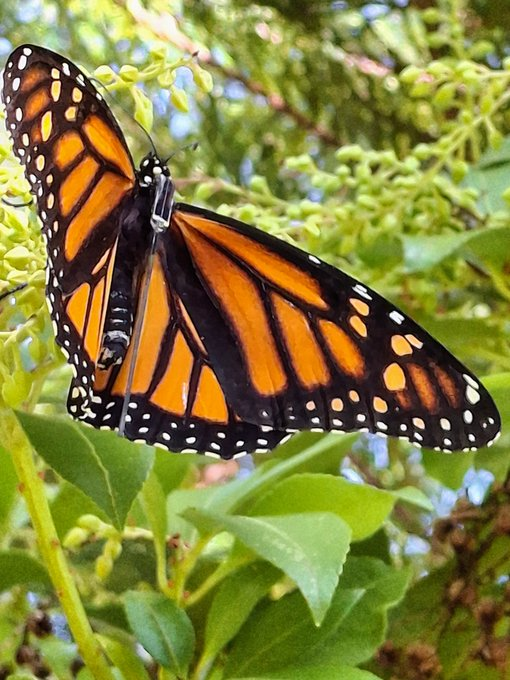
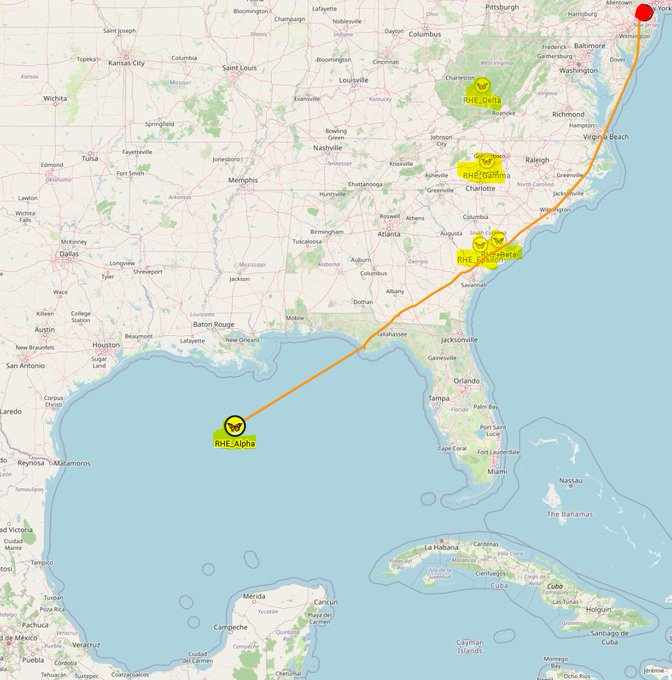
One of the Monarch butterflies I radio-tagged on Sep 11-13 flew an astonishing 539 km today, due southwest, straight across the Gulf of Mexico (alias Gulf of America), covering half the distance between St. Joseph's Peninsula on the Gulf coast of Florida and the coast of Mexico.