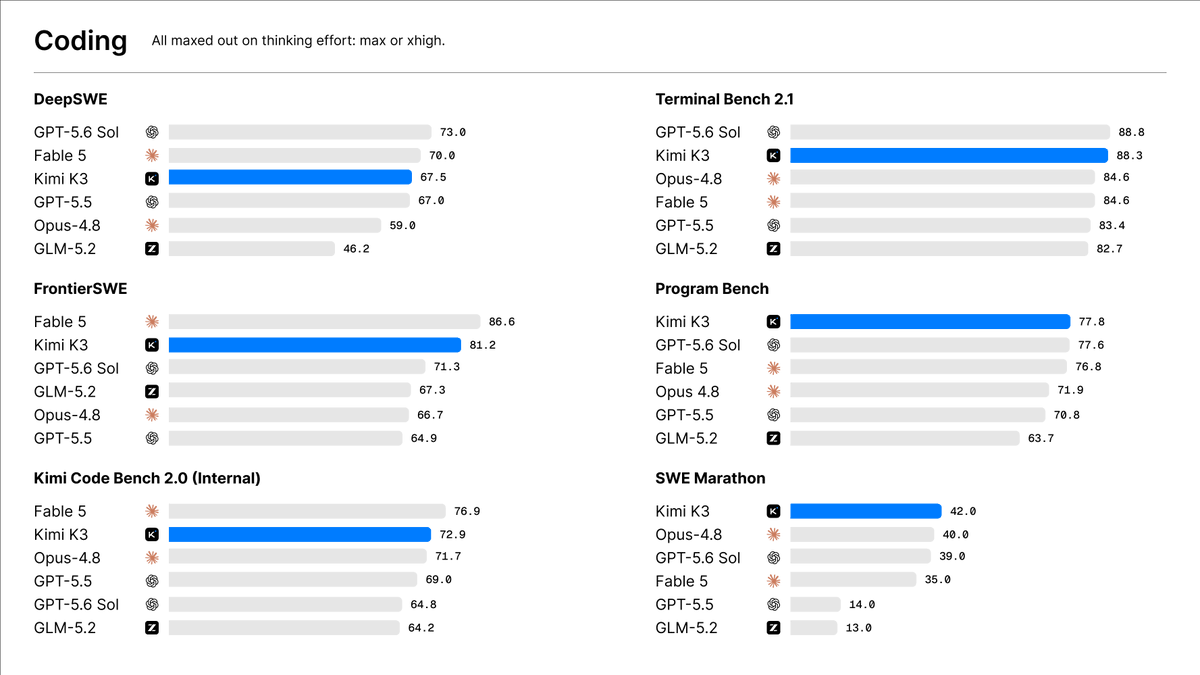
Introducing Kimi K3: Open Frontier Intelligence
🔹 2.8 Trillion Parameters, 1 Million Context, Native Multimodal
🔹 Kimi Delta Attention enables up to 6.3x faster decoding in million-token contexts
🔹 Attention Residuals deliver ~25% higher training efficiency at <2% additional cost
🔹 Built for long-horizon agentic coding and self-evolving workflows
Kimi K3 is now live on on https://t.co/zrk6zZxZUo, Kimi Work, Kimi Code, and the Kimi API.
Open Weights by July 27, 2026.
🔗 API: https://t.co/XCrgjXAqMw
🔗 Tech blog: https://t.co/YTfiMSNM1f
@paulg I’m afraid ‘reading’ is not singular. Any knowledge skill: coding, design, planning, writing is no longer ‘needed’ So much that built mental agility is already
The faster technology moves, the more I think about Bezos' question
What won't change in the next 10 years?
Things I've been writing down over time:
- Humans will always need shelter, food, energy, and healthcare.
- The desire for ownership and the accumulation of wealth.
- The physical world will move more slowly than the digital one.
- Every increase in technological capability, especially AI, will require more energy.
- People and businesses will continue to need access to capital.
- Capital will continue to seek returns that exceed inflation.
- Underwriting methods evolve, but demand for credit (loans) is persistent.
- Trust remains scarce and becomes increasingly valuable as content, code, and fraud become cheaper.
- Verified identities and reputation becomes more important as information becomes abundant and synthetic.
- Long-term wealth creation and dynastic (multi-generational) thinking predate modern technology, and will persist.
- Coordination and transaction costs never fully disappear; market friction will continue to justify the existence of firms and intermediaries.
- People will continue to compete for status.
- Consumers will pay a premium for products and services that confer status.
- Time remains fixed at 24 hours per day.
- But attention is a finite resource and an enduring constraint.
- Products that credibly save time (or enable delegation) have a perpetual market.
- Inaccessible, proprietary data will be a persistent moat. The more inaccessible and difficult to aggregate, the deeper the moat.
- People want accountability, recourse, and clearly identifiable responsibility when things go wrong.
- Regulation consistently lags technological innovation.
- Compliance requirements, licensing, and regulatory moats persist even when machines can perform the underlying task.
- Local knowledge remains valuable and difficult to replicate.
- Heterogeneous markets (like real estate) continue to reward people with deep contextual understanding.
- Incumbent organizations tend to underinvest in disrupting their own businesses, which always creates opportunities for challengers.
Bezos' insight on what wouldn't change in 10 years was "Customers will always want lower prices and faster delivery."
It's boring/ true, but I think that's the point.
Everything we build today can and will be rebuilt more cheaply, faster by someone else.
Build on the invariants, not the trends.
What have I missed?
@dillon_mulroy The trick is being comfortable with idling.
We’re really used to typing non stop.Max 3 things running at a time.
Idling? use that to brainstorm / sketch / plan sth!
@egregore_xyz Agile and known frameworks went out the door with AI.
The industry desperately needs new frameworks and systems for dev teams AND agents to organize around projects.
This looks like it’s bridging that exact gap.
Very cool
I suspect the old "agile teams/squads" will soon transform into a new structure where we can enable high value individuals with great autonomy and supply them with the last 20% that can bring their work from "ok" to "great"
It's the best time in history to be a jack-of-all trades.
A PM who can code, or a Dev who can sell is extremely dangerous.
"Specialized" teams are losing momentum. Any blocking process in teams now have a huge opportunity cost. (Dev waiting designs, fe waiting backend etc.) 🧵
@ycombinator@Basedash Congrats on the launch. We're building sth similar at @datapadio and honestly it's good to see the space maturing.
Coding had its Copilot moment; data hasn’t (yet).
The biggest roadblock is trust and demand from non-techies and market growth will certainly help.